
The most effective ExoMind marketing strategy combines patient-education content, high-intent Google Ads, an optimized Google Business Profile, and a website that speaks directly to the fears and hopes of someone considering brain stimulation therapy for the first time. Most clinics that invest in a BTL ExoMind machine expect the patients to come automatically. They do not. ExoMind is a category-creating treatment, which means your marketing must educate before it can convert. The clinic owners who understand this distinction are filling their treatment chairs. The ones who do not are watching a six-figure investment collect dust.
This guide covers every channel, every strategy, and every mistake we see ExoMind clinic owners make when trying to get patients through the door. Whether you just purchased your machine or you have had it for six months with underwhelming results, this is the playbook that will change your trajectory.
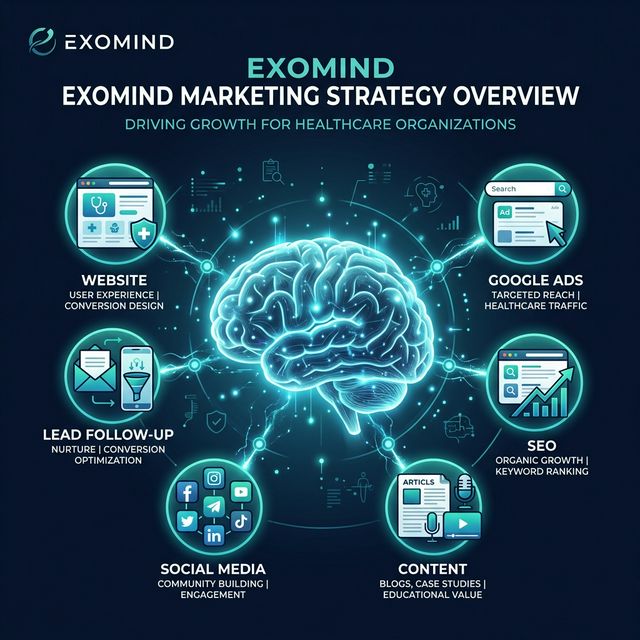 ExoMind marketing strategy overview infographic
Key Takeaways
- ExoMind requires education-first marketing — patients don't know the treatment exists yet, so your campaigns must educate before they convert.
- Five distinct patient personas drive ExoMind demand — medication-averse patients, treatment-resistant depression, stressed executives, postpartum mothers, and wellness biohackers.
- Google Ads is your fastest channel — start at $2,500-$4,000/month targeting branded and condition-specific keywords.
- Your website must lead with empathy, not technology — the "Fear-First" framework converts 4-8x better than traditional clinic pages.
- AI search optimization (GEO) is critical — content must be structured for ChatGPT, Perplexity, and Google AI Overviews citation.
Why Is ExoMind Harder to Market Than Traditional TMS?
ExoMind presents a unique marketing challenge that most clinic owners underestimate. Traditional TMS has been on the market for over a decade. Psychiatrists refer to it. Insurance companies cover it. Patients have heard of it. ExoMind has none of those built-in advantages yet.
Here is what makes ExoMind marketing fundamentally different from marketing other mental health treatments:
The awareness gap is massive. When someone searches "depression treatment near me," they are thinking about therapy, medication, or maybe TMS. ExoMind is not in their mental vocabulary yet. Your marketing cannot assume awareness. It must create it.
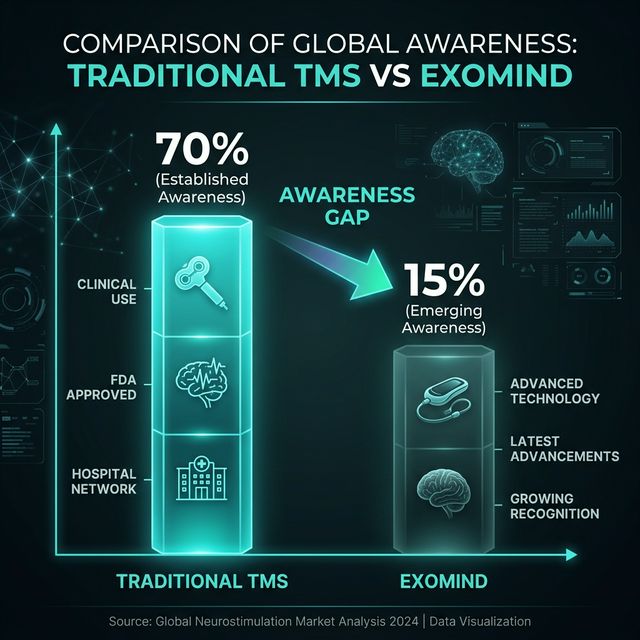 ExoMind awareness gap versus traditional TMS comparison
Action Step: Audit your current marketing materials. If any assume the patient already knows what ExoMind is, rewrite them with education-first messaging.
The treatment sounds futuristic. "Non-invasive brain stimulation using magnetic pulses" sounds like science fiction to the average person experiencing depression. Your copy must bridge the gap between cutting-edge neuroscience and a nervous patient sitting on their couch at midnight researching alternatives to their SSRI.
The price point requires justification. At $3,000 to $4,800 for a full six-session course, ExoMind is a significant out-of-pocket investment for most patients. Your marketing must reframe value early and often, or the price objection kills the conversation before it starts.
The regulatory landscape is nuanced. ExoMind is FDA-cleared for major depressive disorder. It carries CE marking and Health Canada approval for anxiety, OCD, and excessive eating disorders. Your marketing must be precise about what you can and cannot claim, especially in paid advertising where one wrong word gets your account suspended.
The clinics that succeed with ExoMind marketing are the ones that stop treating it like "just another TMS device" and start treating it like what it is: a new category that requires patient education as the foundation of every marketing dollar spent.
What Are the 5 Patient Personas You Should Be Targeting?
The biggest mistake we see ExoMind clinic owners make is marketing to "anyone with depression." That is too broad. ExoMind attracts specific patient profiles, and your messaging must speak directly to each one. For a detailed patient persona guide, see our complete breakdown of each segment and how to reach them.
Persona 1: The Medication-Averse Patient (Ages 30-65)
This is your largest audience. These patients have either tried SSRIs and experienced intolerable side effects (weight gain, sexual dysfunction, emotional blunting) or they philosophically refuse pharmaceutical intervention. They are actively searching for "drug-free depression treatment," "depression treatment without medication," and "natural alternatives to antidepressants."
What they need to hear: ExoMind is FDA-cleared, completed in six sessions, requires no medication, and has an average discomfort rating of 0.2 out of 10. Their fear is that "non-drug" means "unproven." Your job is to prove otherwise with clinical data.
Persona 2: The Treatment-Resistant Depression Patient
These patients have tried two or more antidepressants without adequate relief. They feel hopeless. They have been told by their psychiatrist that "we just need to find the right medication." Clinical studies show ExoMind achieved a 65% improvement rate in treatment-resistant depression patients. That statistic is your headline for this audience.
What they need to hear: "If medications have not worked, your brain may respond to a different approach entirely." Position ExoMind as the next logical step, not a last resort.
Persona 3: The Stressed Executive (Ages 35-55)
High-income professionals who want cognitive optimization, not just symptom relief. They are searching "mental clarity treatment," "brain performance optimization," and "executive burnout treatment." They will not use the word "depression" to describe themselves even if they qualify clinically.
What they need to hear: Frame ExoMind around performance, clarity, and resilience rather than disease treatment. "Reclaim your edge" resonates more than "treat your depression" with this group.
Persona 4: The Postpartum Mother
New mothers experiencing postpartum depression who are terrified of taking medication while breastfeeding. This is a deeply emotional and underserved audience. They are searching "postpartum depression treatment without medication" and "safe depression treatment while breastfeeding."
What they need to hear: ExoMind is non-systemic. There is no drug entering the bloodstream. This is the single most important differentiator for this audience.
Persona 5: The Wellness-Forward Biohacker
This is a smaller but growing segment. They follow Andrew Huberman, take cold plunges, track their HRV, and view brain health as another optimization lever. They have money. They do not need convincing that brain stimulation works. They need convincing that ExoMind is the best version of it.
What they need to hear: Speak their language. Brain mapping, neural connectivity, targeted stimulation protocols. Position ExoMind as the most advanced, personalized option available.
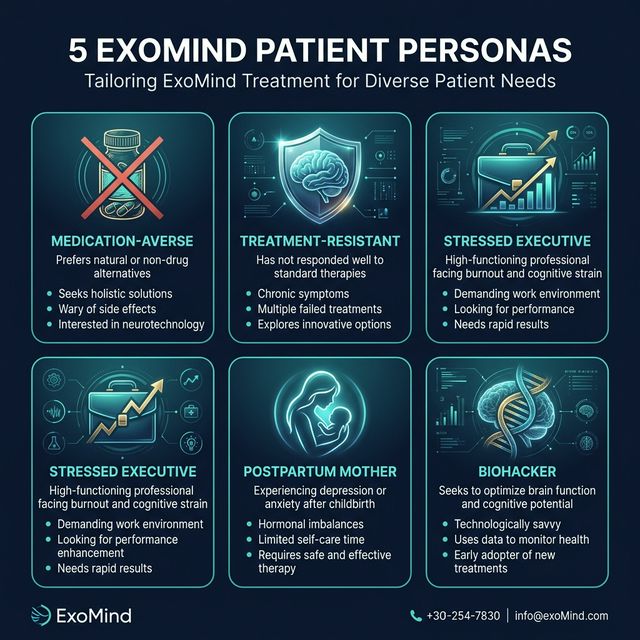 ExoMind patient persona breakdown by demographics and search intent
Action Step: Identify which two of the five patient personas generate the most inquiries at your clinic. Allocate 70% of your marketing budget to those two segments.
How Should You Position ExoMind on Your Website?
Your ExoMind service page is the single most important piece of marketing you will create. Every Google Ad, every social media post, every Google Business Profile interaction ultimately drives to this page. If it does not convert, nothing else matters.
Here is the framework we use with every ExoMind clinic we work with:
Lead With the Patient's Fear, Not Your Technology
The first thing a visitor sees should not be "ExoMind uses patented ExoTMS technology to deliver precisely targeted magnetic pulses." That is what you find interesting. The patient finds it terrifying.
Instead, lead with their emotional reality: "You have tried medication. You have tried therapy. You are still struggling. There is another option, and it does not require a single pill."
Then transition into what ExoMind is, how it works, and why it is different.
The "Fear-First" Page Framework
Follow this exact structure for your ExoMind service page:
- Hero section: Empathetic headline that acknowledges their struggle, plus a clear call-to-action ("Book a Free Consultation")
- What is ExoMind: A plain-language explanation in three to four sentences, no jargon
- How it works: A visual step-by-step showing the six-session journey
- Clinical results: The hard data. 50% reduction in depressive symptoms within four weeks (Carmi et al., Brain Stimulation, 2024). 65% improvement rate in treatment-resistant depression (Tendler et al., Journal of Clinical Psychiatry, 2023). 58% remission rate maintained at 12 months (Levkovitz et al., World Psychiatry, 2015). 85-92% of patients rated the treatment as comfortable.
- Who is it for: Clearly state the ideal candidate (treatment-resistant depression, medication-averse, etc.)
- What to expect: Minute-by-minute walkthrough of a session to eliminate the unknown
- Cost and payment: Transparent pricing with financing options. Hiding the price does not reduce objections. It increases them.
- FAQ section: Address every objection: Does it hurt? Is it safe? How many sessions? Is it FDA-approved? What if it does not work for me?
- Final CTA: "Ready to feel like yourself again? Book your free consultation."
Every section should be scannable. Short paragraphs. Question-based subheadings. Mobile-optimized. A patient researching ExoMind at midnight on their phone should be able to consume your entire page in under four minutes.
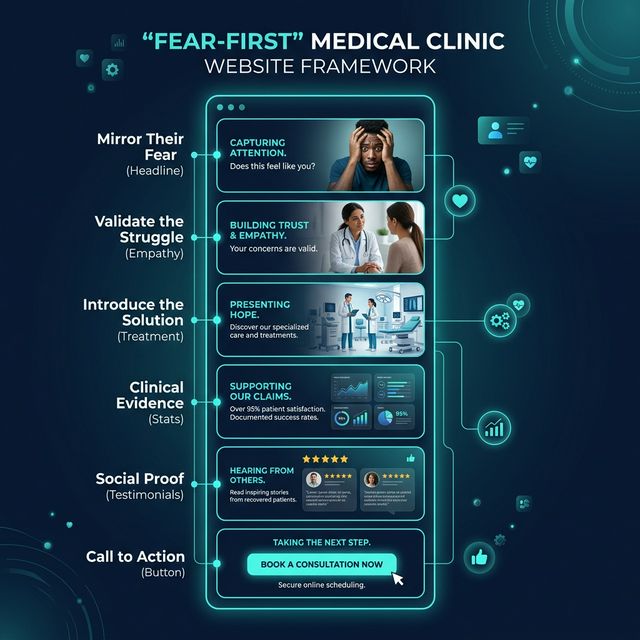 Fear-First page framework structure for ExoMind clinic websites
Action Step: Pull up your ExoMind service page right now. Does it lead with the patient's fear or your technology? If it leads with technology, rewrite the first three sentences using the Fear-First Framework.
What Google Ads Strategy Works for ExoMind Clinics?
Google Ads is the fastest path to filling ExoMind treatment chairs, but only if your campaign is structured correctly. Mental health advertising on Google comes with strict compliance requirements that trip up most clinic owners. For a comprehensive approach, see our complete Google Ads guide with step-by-step account setup.
The LegitScript Question
Google requires LegitScript certification for advertising addiction treatment services. ExoMind for depression does not fall under addiction treatment, but if your clinic also offers ketamine therapy, you may need LegitScript certification for your overall account. Confirm your specific requirements before launching campaigns to avoid account suspension.
Keyword Strategy: Three Tiers
Tier 1: Branded ExoMind keywords (highest intent)
These are patients who already know what ExoMind is. They are closest to booking.
- "ExoMind near me"
- "ExoMind therapy [city]"
- "ExoMind treatment cost"
- "ExoMind reviews"
Tier 2: Condition-specific keywords (high intent)
These patients are searching for a solution to their problem but may not know ExoMind exists yet.
- "TMS therapy near me"
- "depression treatment without medication"
- "drug-free depression treatment [city]"
- "non-invasive brain stimulation"
- "treatment-resistant depression options"
Tier 3: Broad awareness keywords (top of funnel)
These catch patients earlier in their journey. Lower intent but lower cost per click.
- "alternative depression treatment"
- "new depression treatments 2026"
- "is there a better treatment for depression"
- "depression treatment options"
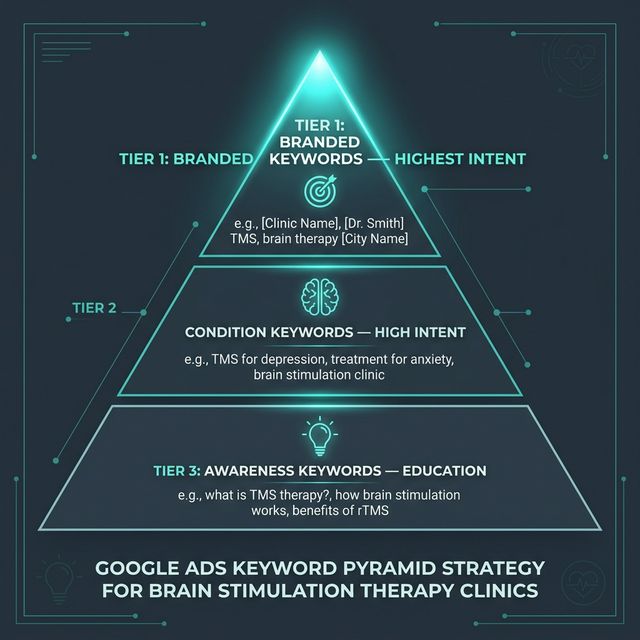 ExoMind Google Ads keyword tier strategy diagram
Budget Allocation
For a single-location ExoMind clinic, we recommend starting at $2,500 to $4,000 per month in ad spend (not including management fees). This gives you enough data to optimize within 60 to 90 days. Allocate approximately 50% to Tier 1 keywords, 35% to Tier 2, and 15% to Tier 3.
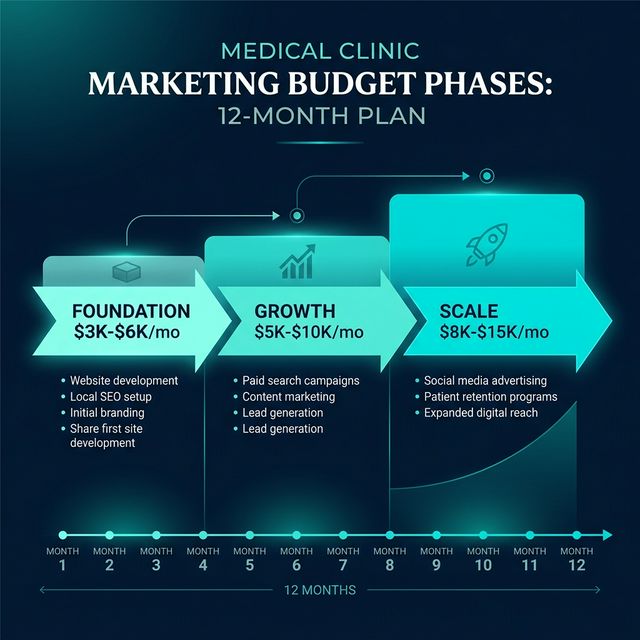 ExoMind marketing budget allocation by growth phase
Landing Page Rules
Never send Google Ads traffic to your homepage. Every ad group should point to a dedicated landing page built specifically for that keyword cluster. Your "ExoMind near me" ads should land on a page that immediately confirms location, availability, and a booking CTA. Your "depression treatment without medication" ads should land on a page that educates about ExoMind as the drug-free alternative before asking them to book.
The average cost per lead for TMS-related Google Ads campaigns in competitive metro areas ranges from $75 to $250. At a $3,000 to $4,800 treatment value, even a modest 15% close rate means your Google Ads ROI is comfortably positive.
Action Step: Set up or audit your Google Ads account. Start with Tier 1 branded keywords at $2,500/month and measure cost per lead for 60 days before expanding.
How Do You Create ExoMind Content That Converts?
Content marketing is the long game that compounds. Blog posts, videos, and social content build organic search visibility over time while simultaneously feeding your Google Business Profile, social media, and email marketing. Learn more in our ExoMind website copy guide for converting visitor traffic into bookings.
The Content Pillars for ExoMind
Every piece of content you create should fall into one of four pillars:
Pillar 1: Education. "What is ExoMind?" "How does ExoMind work?" "ExoMind vs. traditional TMS." These posts catch patients at the top of the funnel when they are just learning about the treatment. They also dominate AI search results on ChatGPT and Google AI Overviews.
Pillar 2: Proof. Patient testimonials (HIPAA-compliant, always), clinical data, before-and-after stories. These build trust and push patients from "interested" to "ready to book."
Pillar 3: Objection handling. "Does ExoMind hurt?" "Is ExoMind covered by insurance?" "How much does ExoMind cost?" Every objection a patient has should be answered in a dedicated piece of content. These are the highest-converting pages on your site because they catch patients at the decision stage.
Pillar 4: Authority. Content that positions your clinic (and you) as the local expert in brain stimulation. Op-eds on the future of mental health treatment. Commentary on new research. Interviews with your clinical team. This is what separates a "clinic that offers ExoMind" from "the ExoMind clinic" in your market.
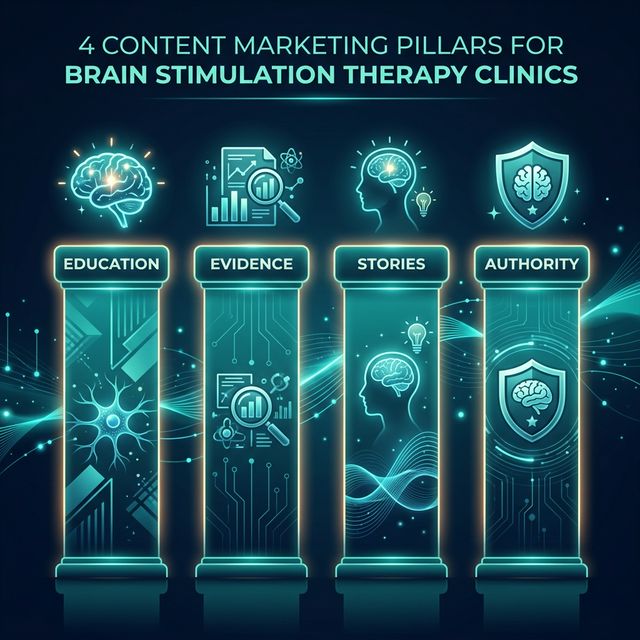 Four content pillars for ExoMind marketing
Optimizing for AI Search (GEO)
Here is something most ExoMind clinics are not thinking about yet: an increasing share of patient research is happening on ChatGPT, Perplexity, and Google AI Overviews rather than traditional search results. Optimizing your content for AI citation requires a different approach.
AI search engines cite content that follows specific patterns. Your blog posts should include a clear definition in the first 60 words of each post, self-contained answer blocks of 134 to 167 words that can be extracted without needing surrounding context, question-based H2 headings that match how patients ask questions, specific statistics with attributed sources, and comparison tables for any topic where two or more options are being evaluated.
If your website is built on a platform that renders content with JavaScript only (React, Next.js without SSR, Wix with dynamic pages), AI crawlers cannot see your content. GPTBot, ClaudeBot, and PerplexityBot do not execute JavaScript. Your content must be server-side rendered or statically generated to be visible to AI search.
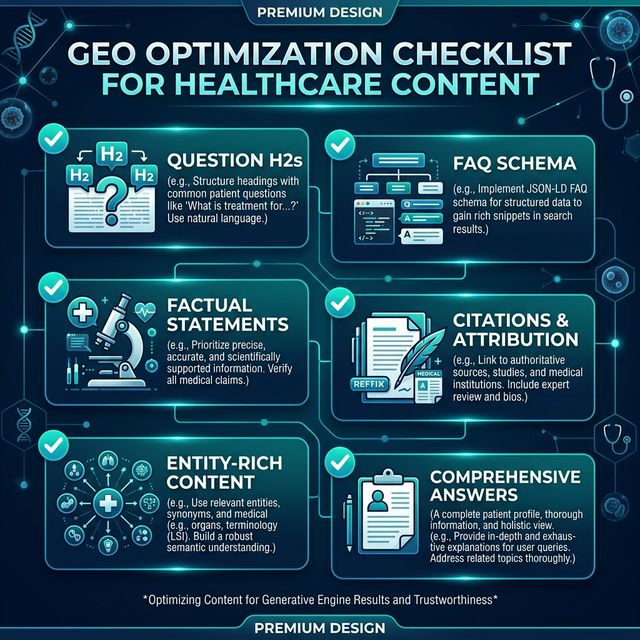 AI search optimization checklist for ExoMind content
What Social Media Strategy Actually Works for Brain Stimulation?
Social media for ExoMind clinics is a minefield. Meta (Facebook and Instagram) has strict policies around medical device advertising and mental health content. Posting the wrong thing can get your account restricted or permanently banned.
What Gets You Banned
Meta's advertising policies prohibit claims about specific medical outcomes, before-and-after comparisons for medical treatments, targeting based on health conditions, and language that implies a "cure" for depression or anxiety. Even organic posts that make strong medical claims can trigger account reviews.
What Actually Works
Educational content that does not make claims. Instead of "ExoMind cures depression," post "Here is how non-invasive brain stimulation technology works" with a visual explainer. Educate rather than sell.
Behind-the-scenes clinic content. Show the treatment room. Walk through what a session looks like. Introduce the staff. This humanizes the technology and reduces fear.
Patient stories (with written consent). A patient sharing their experience in their own words is not a medical claim. It is a testimonial. These are your most powerful social media assets.
Physician commentary. Your clinical director explaining why they chose ExoMind, what the research shows, and who makes a good candidate. This builds authority and is platform-safe.
Platform Prioritization
For ExoMind clinics, prioritize YouTube and Instagram over Facebook and TikTok. YouTube is the second-largest search engine and the best platform for educational content about medical treatments. Instagram's visual format works well for clinic branding and patient stories. TikTok's algorithm can deliver massive reach but the content moderation for medical topics is unpredictable. For a complete strategy on all channels, reference our local SEO playbook which covers location-based patient acquisition.
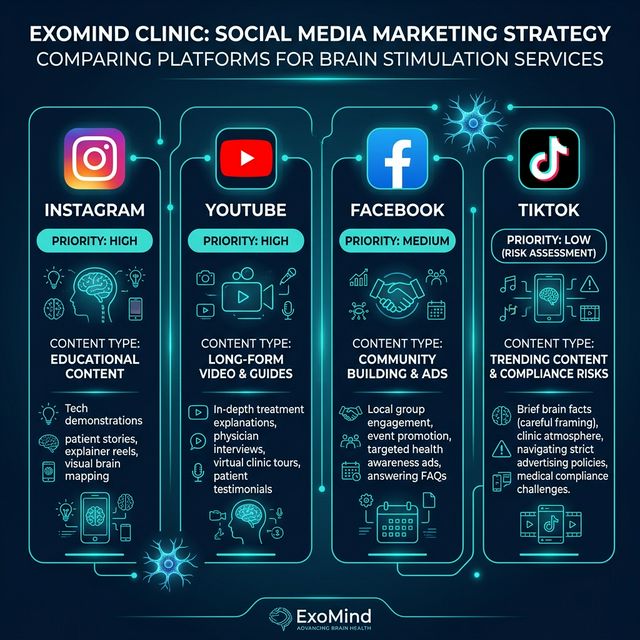 Social media platform comparison for ExoMind clinics
How Do You Handle the "Is This Real?" Objection in Your Marketing?
Brain stimulation therapy sounds like it belongs in a science fiction movie, not a medical clinic. Many potential patients will have an immediate skepticism response when they first encounter ExoMind. Your marketing must address this head-on.
Lead With FDA Clearance
The three most powerful words in your ExoMind marketing are "FDA-cleared treatment." Lead with this in every channel. It immediately signals legitimacy.
Use Clinical Data, Not Testimonials, for Skeptics
While testimonials work for patients who are already emotionally invested, skeptics need numbers. Present the clinical outcomes prominently: over 1,200 patients studied across Europe and North America, a 50% reduction in depressive symptoms within four weeks, a 65% improvement rate in treatment-resistant depression, a 58% remission rate maintained at 12 months, and a comfort rating of 0.2 out of 10 versus 5 out of 10 for traditional TMS devices.
Compare to Accepted Treatments
The most effective way to legitimize ExoMind is to compare it to something the patient already trusts. Traditional TMS is FDA-cleared and widely accepted. ExoMind uses the same underlying mechanism (transcranial magnetic stimulation) but with more precise targeting and a dramatically shorter treatment protocol (six sessions versus 36 sessions for traditional TMS). When patients see that ExoMind is an evolution of a proven technology rather than something entirely unknown, resistance drops significantly.
| Feature | ExoMind | Traditional TMS | Antidepressants (SSRIs) |
|---|---|---|---|
| FDA-Cleared | Yes (depression) | Yes (depression, OCD) | Yes (multiple conditions) |
| Sessions Required | 6 | 36 | Daily (ongoing) |
| Session Duration | Under 30 min | 19-37 min | N/A |
| Time to Results | 2-4 weeks | 4-6 weeks | 4-8 weeks |
| Comfort Rating | 0.2/10 | 5/10 | N/A (systemic side effects) |
| Common Side Effects | Mild headache (temporary) | Scalp discomfort, headache | Weight gain, sexual dysfunction, nausea, emotional blunting |
| Drug-Free | Yes | Yes | No |
| Approximate Cost | $3,000-$4,800 (6 sessions) | $6,000-$12,000 (36 sessions) | $1,200-$3,600/year (ongoing) |
This comparison table should appear on your website, in your blog content, and in your consultation materials. It is the single most effective asset for converting skeptics.
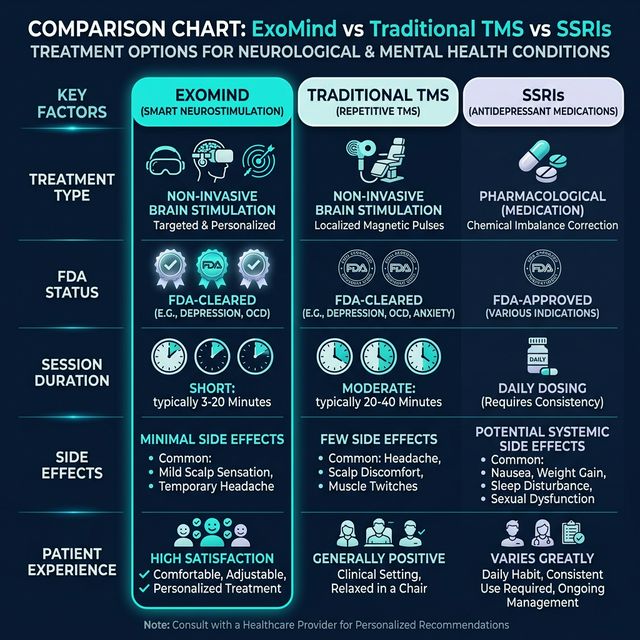 ExoMind versus traditional TMS versus SSRIs comparison chart
What Is the Ideal Marketing Budget for an ExoMind Practice?
Budget allocation depends on your market size, competition, and how quickly you need to fill your treatment schedule. Here is the framework we recommend for a single-location ExoMind clinic:
Month 1-3: Foundation Phase ($3,000-$6,000/month total)
- Google Ads: $2,000-$3,500/month (your fastest patient acquisition channel)
- Website optimization: One-time investment of $2,000-$5,000 to build a high-converting ExoMind service page and landing pages
- Google Business Profile optimization: $500 one-time (or DIY with our guide)
- Content creation: $500-$1,500/month for two to four blog posts targeting ExoMind-related keywords
Month 4-6: Growth Phase ($5,000-$10,000/month total)
- Google Ads: Scale to $3,500-$6,000/month as you identify winning keywords and ad copy
- SEO and content: $1,000-$2,000/month for ongoing blog content, local SEO, and backlink building
- Social media: $500-$1,000/month for organic content creation
- Email marketing: $500/month for lead nurture sequences targeting people who inquired but did not book
Month 7-12: Scale Phase ($8,000-$15,000/month total)
- Google Ads: $5,000-$8,000/month with refined targeting and expanded keyword coverage
- Content and SEO: $1,500-$3,000/month for comprehensive content strategy including video
- Social media advertising: $1,000-$2,000/month for retargeting campaigns
- Reputation management: $500/month for review generation and monitoring
At a minimum viable budget of $3,000 per month, a well-executed ExoMind marketing strategy should generate 10 to 20 qualified leads per month. At an average treatment value of $3,500 and a 20% close rate, that is $7,000 to $14,000 in monthly revenue from two to four new patients, delivering a strong return on your marketing investment from day one.
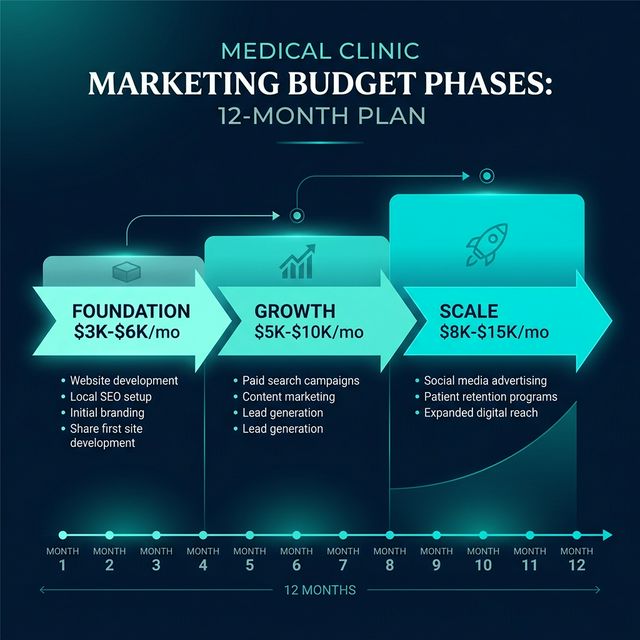 Monthly marketing budget framework for ExoMind practices
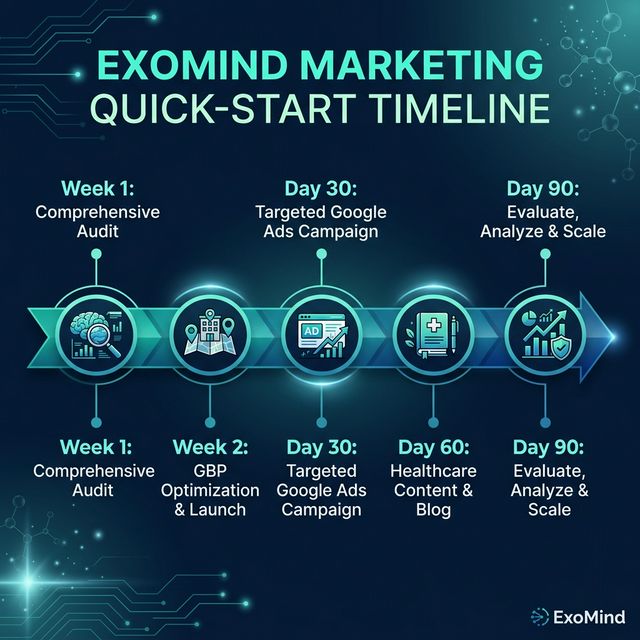 ExoMind marketing quick-start timeline