
TL;DR
- Same chair, five different buyers. MedSpa, urology, gynecology, pelvic floor PT, and functional medicine each attract a different patient with a different fear, a different decision cycle, and a different price ceiling.
- MedSpa positioning is wellness-first. The 35-54 female demographic already shows up. Emsella is a cross-sell, not a lead generator. See the service mix breakdown for the bundle math.
- Urology positioning is authority-first. Lead with peer-reviewed clinical data, position as the non-invasive alternative to slings and AUS implants, and target post-prostatectomy men aggressively. They have been ignored.
- Gynecology runs as two campaigns. Postpartum 28-42 and menopause 45-65 are different funnels with different language. One landing page kills both.
- Pelvic floor PT wins on Kegel-failure messaging. 30-50 percent of women cannot isolate the right muscle voluntarily (Bo et al., International Urogynecology Journal). Emsella is the upgrade path after PFMT plateau.
- Functional medicine is the underexploited men's market. Emsella is FDA-cleared (510k K181497) for male incontinence. Post-prostatectomy and longevity-oriented men are an open lane in 2026.
- Generic copy = no copy. A "pelvic health for everyone" headline converts no one. Pick the avatar, then write to that one person.
You bought the same Emsella chair as the urologist three towns over. Same FDA clearance. Same 11,200 supramaximal contractions per session. Same Samuels 2019 outcome data. And yet you're booking 3 patients a week and they're booking 12.
The chair isn't the variable. The positioning is.
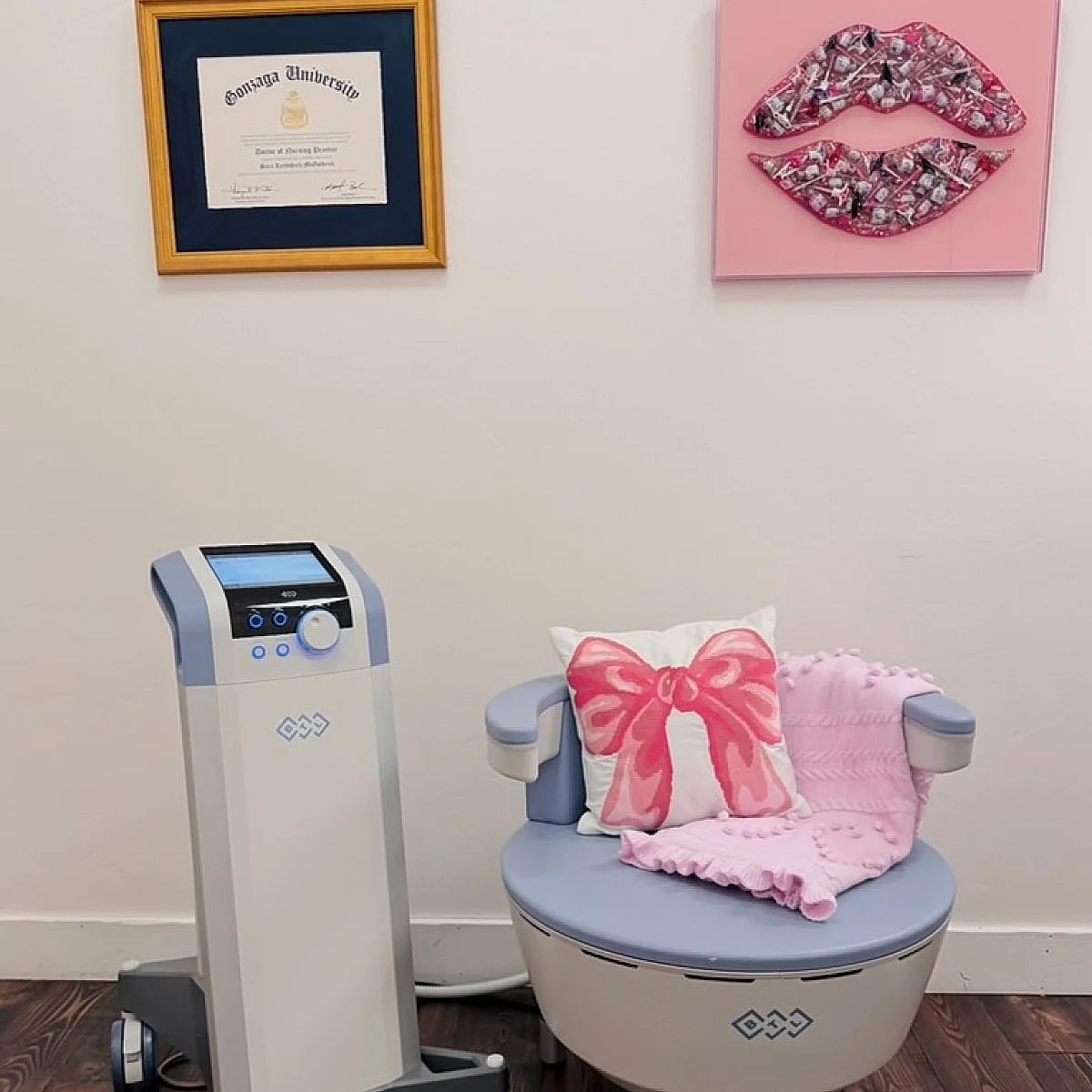 Same Emsella chair, five different clinic verticals
Most clinic owners treat Emsella like a single product with a single message. It isn't. Emsella is a piece of pelvic-floor infrastructure that converts completely differently depending on who walks through your front door. A 38-year-old MedSpa client coming in for a HydraFacial is not the same buyer as a 67-year-old man six months post-prostatectomy who hasn't told his wife how often he changes his underwear. Same device. Different fear. Different desired future. Different ad copy. Different intake script. Different price psychology.
This guide breaks down the five clinic verticals where Emsella actually works in 2026, what the patient avatar looks like in each, and the conversion playbook that fits the room.
What Does Emsella Look Like in a MedSpa?
A 41-year-old woman walks into your MedSpa for her quarterly facial. Halfway through the consult she mentions, almost as a joke, that she's stopped going to her Pilates class because she leaks every time she does jumping jacks. That throwaway sentence is a $2,400 package waiting for someone to acknowledge it.
What's happening: MedSpas attract the 35-54 female wellness-spending demographic.
 Emsella patient lifestyle: confident, active, restored
According to American Med Spa Association industry surveys, this segment dominates aesthetic device spending. They are already in your chair. They already trust you with their face, their body, and their downtime. They have not told you about the leakage because they have never been asked.
Emsella patient lifestyle: confident, active, restored
According to American Med Spa Association industry surveys, this segment dominates aesthetic device spending. They are already in your chair. They already trust you with their face, their body, and their downtime. They have not told you about the leakage because they have never been asked.
Why it fails: Most MedSpas market Emsella as a separate vertical with a separate landing page that competes with their MedSpa brand. The patient never sees the offer because she never enters that funnel. Or worse, the MedSpa runs clinical-tone Emsella ads ("HIFEM technology for stress urinary incontinence") that read as cold and medical, breaking the wellness frame the rest of the clinic operates in.
The fix: Position Emsella as a wellness and confidence service inside the existing MedSpa frame. The hero language is not "treat your incontinence." It's "get your jumping jacks back. Laugh without crossing your legs. Feel like yourself in your own body again." Add an Emsella question to your intake form: "Have you noticed any leaks when you laugh, jump, or exercise?" This single question surfaces the buyer.
The cross-sell mechanics matter as much as the message. Emsella pairs naturally with Emsculpt Neo and Emface as the BTL "Core to Floor" bundle, which industry pricing puts at $5,000 to $7,000 packaged. Patients who buy Emsella alone often return for Emsculpt within 90 days. Track that LTV correctly and the per-patient value lands well above the standalone $1,800 to $2,400 package.
Action Step: Add one line to your facial intake form: "Have you noticed any leaks during exercise, laughter, or sneezing?" Track how many patients say yes over the next 30 days. That number is your Emsella pipeline you didn't know you had.
How Does Urology Position Emsella Differently?
A 68-year-old man six months post-prostatectomy is sitting in his car in your parking lot. He has rehearsed how to ask his urologist about the leakage three times. He is going to ask about a pad. He is not going to ask about a $2,400 device he has never heard of. It is your job to make sure he does.
What's happening: Urology is the most authority-loaded clinical vertical that offers Emsella, and the most underutilized for marketing. Post-prostatectomy urinary incontinence affects a large portion of men following radical prostatectomy (American Urological Association guidelines). Most of these men suffer in silence longer than they need to, often years, because the alternatives (artificial urinary sphincter implants, male slings) feel like a bigger surgery on top of the surgery they just survived.
Why it fails: Most urology practices either don't market Emsella at all (treating it as a passive in-clinic option) or market it with the same female-skewed lifestyle copy a MedSpa uses. A 68-year-old man does not respond to "feel confident again." He responds to clinical data, surgical comparison, and the relief of "you don't have to be cut open again."
The fix: Lead urology Emsella positioning with three things: peer-reviewed authority, surgical-alternative framing, and a hyper-specific male post-prostatectomy avatar.
The clinical anchors are well established. The Samuels et al. 2019 study in Lasers in Surgery and Medicine showed 95 percent of patients reported improved quality of life after 6 sessions, with 75 percent reporting significant pad-usage reduction and 81.33 percent reporting significant UI symptom reduction. At 6 months post-treatment, 86.7 percent of Emsella patients showed improved pad use compared to 62.5 percent for pelvic floor muscle training. Cite these studies in the ad. Cite them in the consult. Cite them on the landing page.
Position Emsella explicitly as a non-invasive alternative to slings and AUS implants. The reader needs to know: no incision, no anesthesia, no recovery, you keep your pants on, you walk in and walk out in 28 minutes. That contrast carries the entire ad. For a deeper objection-handling sequence on price and surgical alternatives, see the Emsella objection handling playbook.
Action Step: Build a dedicated "Emsella for Men: Post-Prostatectomy" landing page with male imagery, surgical comparison, and the Samuels 2019 citation visible above the fold. This page alone, run to retargeting from your prostate-cancer patient base, will outperform any general Emsella campaign you've ever run.
What's the Right Gynecology Playbook for Emsella?
A 34-year-old mother of two has not run since her second baby. A 56-year-old woman in perimenopause has stopped having sex with her husband because of dryness, leakage, and shame. They are both your Emsella patients. They need completely different ads.
What's happening: Gynecology serves a barbell-shaped Emsella avatar. The two ends are postpartum (28-42, recently pregnant or within 5 years) and menopausal (45-65, perimenopause or post-menopause). The middle is thin. Most gynecology practices try to run one campaign across both, with predictably soft conversion.
Why it fails: Postpartum and menopausal women have nearly opposite emotional contexts. Postpartum is "I want my old body back. I want to run with my kids. I want to laugh without crossing my legs." Menopause is "I want my intimacy back. I want my sleep back. I want to feel like a woman in my own body again." One landing page cannot hold both. One ad creative cannot hold both. One intake script will fumble both.
The fix: Run two segmented campaigns. Postpartum campaign targets 28-42, uses imagery of mothers with children, and leads with athletic-recovery and post-baby restoration language. Menopause campaign targets 45-65, uses imagery of vibrant midlife women (and partners, if appropriate), and leads with intimacy and tissue-tone restoration language.
Each campaign gets its own landing page, its own ad creative, its own retargeting audience. The intake coordinator should identify which funnel the patient came from in the first 30 seconds of the call and flip framings accordingly. If a postpartum patient calls from a menopause ad, gracefully switch the script. If a menopause patient calls from a postpartum ad, do the same.
The clinical anchors are the same, the emotional anchors diverge entirely. Use Silantyeva et al. 2021 in Female Pelvic Medicine and Reconstructive Surgery for clinical citation across both. Use different photography, different testimonials, different copy.
| Vertical | Primary Avatar | Avg Age | Lead Hook | Decision Cycle |
|---|---|---|---|---|
| MedSpa | Female, wellness spender | 35-54 | "Get your jumping jacks back" | 7-21 days |
| Urology | Post-prostatectomy male | 55-75 | "Non-invasive alternative to slings" | 21-60 days |
| Gynecology (postpartum) | New/recent mother | 28-42 | "Reclaim your post-baby body" | 14-30 days |
| Gynecology (menopause) | Perimenopausal female | 45-65 | "Restore intimacy and tone" | 30-60 days |
| Pelvic Floor PT | Kegel-failure patient | 30-60 | "When PFMT plateaus, this is next" | 7-21 days |
| Functional Medicine | Longevity/men's health | 40-70 | "Pelvic strength is core protocol" | 30-90 days |
Action Step: Audit your current gynecology Emsella campaign. If there is one ad set, one landing page, and one intake script for both postpartum and menopause, split it this week. The split alone, with no creative changes, typically lifts conversion noticeably.
Why Is Pelvic Floor PT the Easiest Emsella Sell?
A 47-year-old woman has done Kegels for two years. Diligently. With a physical therapist. With apps. With biofeedback. It hasn't worked. She is sitting in your PT clinic right now, demoralized, wondering if surgery is her only option. You don't even have to sell her on Emsella. You have to sell her on the fact that her Kegel failure was not her fault.
What's happening: Pelvic floor PT clinics serve patients who have already accepted that pelvic-floor strength is the answer. The conversion conversation is not "is this real" or "will this work." It is "what's next when what I'm doing isn't enough." This is the lowest-friction Emsella avatar in any vertical.
Why it fails: Many PT clinics underprice Emsella because they fear it competing with their existing PFMT (pelvic floor muscle training) revenue. They position it timidly, as "another option," instead of as the upgrade path. The patient picks up on the lack of conviction and stalls.
The fix: Position Emsella as the clinical next step when PFMT plateaus. The supporting science is direct and citable. Bo et al. (2018) and the Cochrane review by Dumoulin, Cacciari and Hay-Smith both document that 30 to 50 percent of women cannot voluntarily isolate the correct pelvic-floor muscles, and even with proper PFMT, a measurable subset plateau or regress within 12 months. Emsella generates 100 percent muscle intensity vs the 30 to 40 percent achievable through voluntary contraction.
The script is direct: "You did the work. Your case is a muscle-recruitment problem, not a discipline problem. Emsella does what your nervous system can't do voluntarily. It's the upgrade path your therapy was leading toward."
This positioning earns the package price. Industry pricing for a 6-session package sits at $1,800 to $2,400, and PT clinics can hold the upper end because the clinical context elevates perceived value. For deeper coverage of how Emsella stacks against Kegels, surgery, and traditional PT, see the Emsella vs Kegels vs surgery comparison guide.
Action Step: Identify your top 20 PFMT patients who have plateaued in the last 6 months. Send each one a personalized email or call: "Based on your progress, I want to talk to you about the next step in your pelvic floor protocol." This list converts at multiples of cold ad traffic.
Where Does Functional Medicine Fit in Emsella?
A 58-year-old man pays $8,000 a year for a longevity program. He gets quarterly hormone panels, peptide therapy, and a cardiologist on speed dial. Nobody has ever asked him about his pelvic floor. He has stopped lifting heavy because of leakage. He has stopped getting morning erections. He has not told his wife or his doctor. You can be the one who does.
What's happening: Functional medicine is the most underexploited Emsella vertical in 2026. The patient base is high-LTV (annual program spend of $5,000 to $20,000+), already comfortable with non-traditional or off-label clinical conversations, and heavily skewed toward the 40-70 male longevity demographic that overlaps perfectly with the underserved post-prostatectomy and pelvic-strength market.
Why it fails: Functional medicine clinics either don't carry Emsella at all (assuming it's a women's-health device) or carry it as a passive in-office option without active marketing. The men sitting in their longevity programs never hear about it.
The fix: Position Emsella as part of a pelvic strength and longevity protocol. The clinical anchor is the FDA 510(k) clearance K181497, which explicitly covers male and female urinary incontinence. The FDA 510(k) summary is your authority document.
The conversation in this vertical extends beyond incontinence. Off-label discussion of erectile function and pelvic-floor strength as a contributor to ED is well established in the urological literature (and supported by NIH-indexed research on pelvic floor exercises and ED), but ad copy must stay tight to the cleared indication. The right move: lead the marketing on the FDA-cleared indication (urinary incontinence and pelvic-floor strength), and let the in-clinic clinical conversation expand from there.
This vertical also commands the longest decision cycle, often 30 to 90 days, but compensates with the highest LTV. Maintenance sessions every 3 to 6 months at $300 to $400, layered on top of the existing program, push annual Emsella revenue per patient well above any other vertical.
Action Step: Add a single line to your functional medicine intake or annual review: "Any changes in urinary control, pelvic floor strength, or sexual function?" That question alone surfaces the entire Emsella opportunity in your existing patient base. For coverage of how to handle the price conversation when patients balk at the package, see the objection handling guide.
How Do You Choose the Right Vertical for Your Clinic?
You don't always get to pick. You are already a urologist, or already a MedSpa, or already a PT clinic. The question isn't which vertical to be. It's which avatar inside your vertical to write to first.
What's happening: Most clinic owners try to "appeal to everyone who could benefit from Emsella." That phrase is the obituary of the campaign. Pelvic-floor patients across the five verticals share a device, not a buying decision. The marketing has to pick one buyer and write to that buyer with intensity.
Why it fails: Generic copy. "Improve your pelvic health with FDA-cleared Emsella" is the wallpaper of dead campaigns. It does not name the buyer. It does not name the fear. It does not name the desired future. It will not convert.
The fix: Pick the single highest-leverage avatar inside your vertical and build the entire funnel around them.
| Vertical | Primary Avatar | Per-Patient LTV | Cross-Sell Path |
|---|---|---|---|
| MedSpa | Female 35-54, wellness | $2,400 + Emsculpt/Emface bundle | Core to Floor $5,000-$7,000 |
| Urology | Post-prostatectomy male 60+ | $1,800-$2,400 + maintenance | Annual maintenance, low cross-sell |
| Gynecology (postpartum) | Female 28-42 | $2,400 + maintenance | Annual women's wellness |
| Gynecology (menopause) | Female 45-65 | $2,400 + HRT/wellness add-ons | Hormone optimization |
| Pelvic PT | Kegel-failure 30-60 | $1,800-$2,400 + ongoing PT | PT continuity |
| Functional Medicine | Longevity 40-70, male skew | $2,400 + annual maintenance + program | $5,000-$20,000+ annual program |
If you serve more than one vertical inside your clinic (gynecology + MedSpa is the most common combo), build segmented funnels per avatar. Two landing pages. Two ad creative sets. Two intake scripts. Same chair. Same clinical outcomes data. Different message-market fit. Different conversion rate. Different revenue.
Action Step: Pick one avatar. Write the headline to her (or him) specifically, not to "patients with pelvic floor concerns." Test it for 14 days. The lift over generic copy is large enough to feel in your booking calendar.
What Should You Do This Week?
You have one Emsella chair. You have one clinic. You have one shot at message-market fit. The clinics that win in 2026 are not the ones with the prettiest ads or the cheapest CPM. They are the ones who picked the right avatar and refused to dilute the message.
Pick your vertical. Pick your single highest-leverage avatar inside it. Write the headline to that one person. Build the landing page for that one person. Train your intake coordinator to recognize that one person on the phone. Then, and only then, layer the second avatar.
The chair is a commodity. The positioning is the moat.
Whether you run a MedSpa, a urology practice, a gynecology group, a pelvic floor PT clinic, or a functional medicine program, the path forward is the same: pick the buyer, write to the buyer, build the funnel around the buyer. See how we build segmented Emsella funnels for clinics.
Read Next
- Emsella vs Kegels vs Surgery: The Honest Comparison - The full modality breakdown for the conversion conversation
- Emsella vs Emsculpt vs Emface: Which Mix Maximizes Revenue? - Service-mix math for clinics running multiple BTL devices
- Emsella Sales Objection Handling: Close the $2,400 Package - The seven objections and the evidence-based responses that close them