TL;DR
- Emsella anchors the BTL pelvic health funnel. Six-session protocol prices $1,800 to $2,400. Lowest cash-pay friction in the BTL portfolio.
- Emsculpt Neo is the natural second device. Six-session Core to Floor bundles list $5,000 to $7,000 and convert 25 to 40% of completed Emsella patients when the cross-sell is operationalized.
- Emface has the highest revenue per chair hour at $2,250 to $4,500/hour, but the lowest demographic overlap with Emsella. Treat it as a separate top-of-funnel.
- Exion Vaginal stacks naturally with Emsella for the urogenital rejuvenation patient. Combined ticket lands $4,500 to $6,000.
- Emtone is a body-contouring add-on, rarely a standalone. Strongest inside a body package.
- Cross-sell, not price increases, drive the revenue lift. Annual value per device patient moves from $2,400 (Emsella alone) to $5,500+ (cross-sold into Emsculpt Neo, Emface, or Exion).
- Add devices in utilization order, not aspiration order. Adding device #2 before device #1 hits 60% utilization usually splits a fixed patient base across two machines.
If you already own an Emsella chair, the next decision is bigger than the first one. Adding Emsculpt Neo, Emface, Exion, or Emtone is not just a CAPEX question. It is a service mix question. Each device has its own price point, its own ideal patient, its own consult flow, and its own revenue per chair hour. Stack them wrong and you end up with three underused machines and a confused front desk. Stack them right and you build the kind of compounding revenue mix that turns one device into a multi-million-dollar aesthetic and wellness practice.
This is the math, the cross-sell rates, and the bundle logic, written for clinic owners deciding what to buy next. The numbers below come from BTL public materials, dealer quotes, and the BTL Aesthetics device portfolio overview. Pricing is what U.S. clinics charge patients, not what BTL charges clinics.
How Should a Clinic Think About BTL Device Service Mix?
Most clinic owners buy their second BTL device the same way they bought the first.
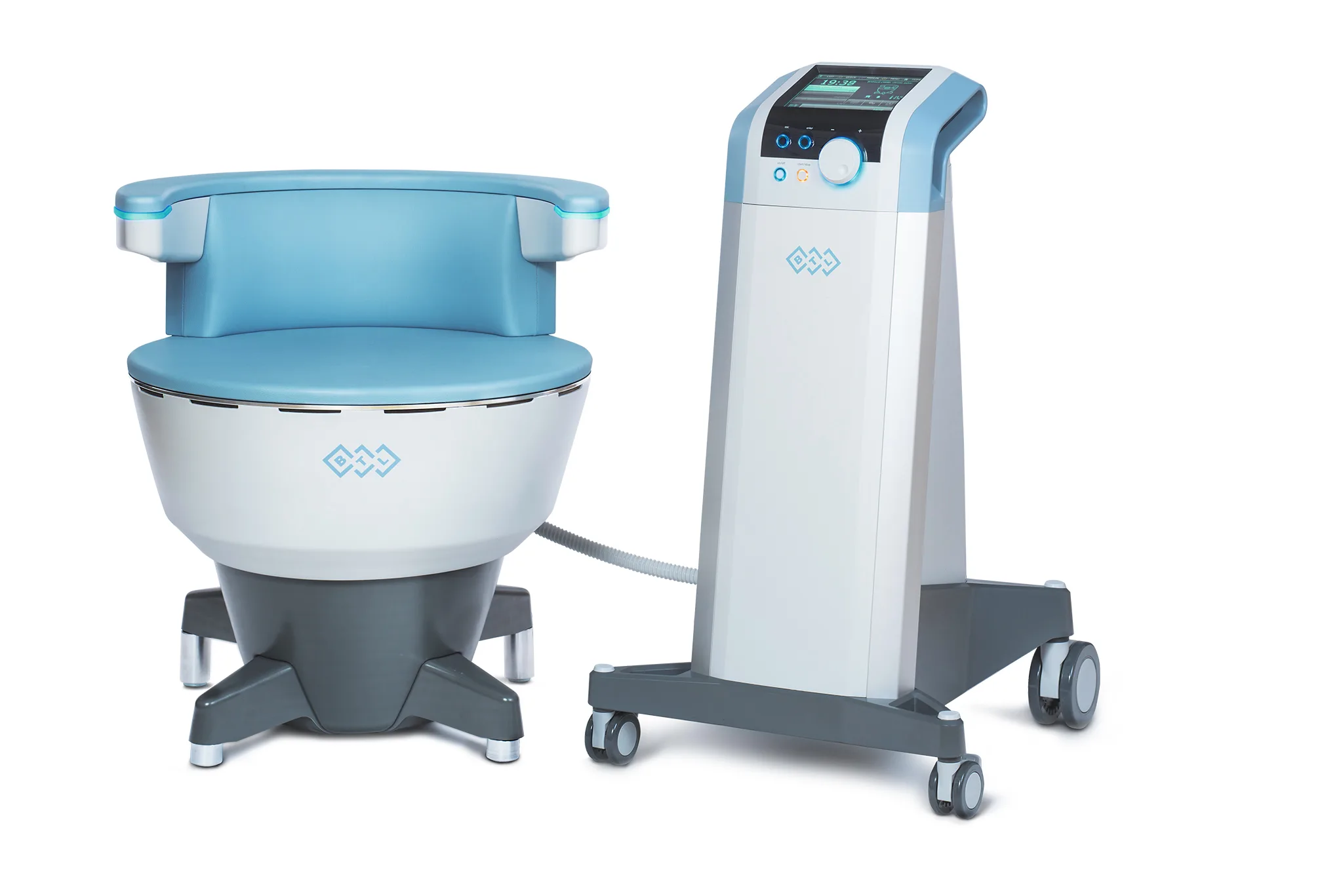 BTL Emsella chair, the anchor device for the multi-device practice
The rep walks in, the demo is impressive, the financing is workable, and the contract gets signed. The trouble starts later, when the second device sits next to the first one in a treatment room, sharing the same patient list and the same marketing budget, and the clinic owner realizes the volume has not actually doubled.
BTL Emsella chair, the anchor device for the multi-device practice
The rep walks in, the demo is impressive, the financing is workable, and the contract gets signed. The trouble starts later, when the second device sits next to the first one in a treatment room, sharing the same patient list and the same marketing budget, and the clinic owner realizes the volume has not actually doubled.
What's happening: The clinic treats each device as a standalone revenue line. Emsella runs a pelvic health funnel. Emsculpt Neo runs a body contouring funnel. Emface runs an aesthetic funnel. Each one has its own ad set, its own landing page, its own consult script, and its own follow-up sequence. The math looks great on the spreadsheet. The execution looks like three understaffed mini-businesses sharing one front desk.
Why it fails: The economics of multi-device aesthetic clinics are not driven by acquisition. They are driven by cross-sell rate and average ticket. A clinic that spends $300 to acquire a single-device Emsella patient and a clinic that spends $300 to acquire a multi-device Emsella patient have the same CAC. The second clinic pulls $5,500 in annual revenue per acquired patient. The first pulls $2,400. The difference is not marketing budget. It is the consult flow, the bundle logic, and the order in which the devices were added. We covered the unit economics of this in the Emsella ROI deep dive.
The fix: Treat the BTL portfolio as a single ascension funnel, not five parallel ones. Lead with one anchor device (typically Emsella or Emsculpt Neo). Stack the second device as a bundle, not a separate offer. Use the third and fourth devices as maintenance and lifestyle layers. The cross-sell rate becomes the metric that runs the clinic, not session count.
Action Step: Pull your last 90 days of patient records. Tag each completed Emsella patient as either single-device, two-device, or three-plus-device. If your two-plus rate is under 25%, you do not have a device problem. You have a consult flow problem.
What Does Each BTL Device Actually Cost a Patient and Earn the Clinic?
Before any service mix decision makes sense, the per-device economics need to be on one page. The table below is the reference set.
| Device | Indication | Session Length | Price Per Session | Standard Protocol | Protocol Price | Revenue / Chair Hour |
|---|---|---|---|---|---|---|
| Emsella | Urinary incontinence, pelvic floor | 28 min | $250 to $500 | 6 sessions | $1,800 to $3,000 | $500 to $1,000 |
| Emsculpt Neo | Body contouring, muscle plus fat | 30 min | $750 to $1,250 | 4 to 6 sessions | $3,000 to $6,000 | $1,500 to $2,500 |
| Emface | Facial lift, muscle plus dermal | 20 min | $750 to $1,500 | 4 sessions | $3,000 to $6,000 | $2,250 to $4,500 |
| Exion / Exion Vaginal | Skin tightening, intravaginal RF | 20 to 30 min | $500 to $800 | 4 to 6 sessions | $3,000 to $4,000 | $1,000 to $2,400 |
| Emtone | Cellulite, skin laxity | 20 min | $400 to $600 | 4 to 6 sessions | $1,200 to $2,500 | $1,200 to $1,800 |
| Core to Floor (Emsculpt Neo + Emsella) | Bundle | 28 to 30 min each | Bundle | 6 + 6 sessions | $5,000 to $7,000 | n/a (bundle) |
A few things jump off the page once it is laid out this way.
Emface is the highest revenue per chair hour. A 20-minute treatment at $750 to $1,500, turned three times an hour, is the most efficient use of clinical time in the BTL portfolio. The catch: it requires a different patient than Emsella, runs a different funnel, and uses a different injectable-adjacent consult flow.
Emsella is the lowest revenue per chair hour but the highest funnel volume. The 28-minute session and the cash-pay $300 average price tag mean a fully booked Emsella chair generates roughly $500 to $1,000 per hour. That is half of Emsculpt Neo and a quarter of Emface. The reason Emsella still anchors most multi-device clinics is funnel economics: the patient who walks in for incontinence is the cheapest patient in the BTL ecosystem to acquire, and the easiest to upgrade.
Emsculpt Neo is the natural bridge. It earns more per hour than Emsella, less than Emface, and shares enough of the demographic with Emsella that cross-sell is mechanical. The Core to Floor bundle exists precisely because the math of pairing them is so clean.
Action Step: Calculate your actual revenue per chair hour for every device you currently run. Use last quarter's revenue divided by occupied chair hours. If any device sits below 40% of the benchmark above, the device is not the problem. Utilization is.
Why Is Core to Floor the Most Important Bundle in the BTL Catalog?
The Core to Floor protocol is the single highest-leverage bundle BTL has ever published.
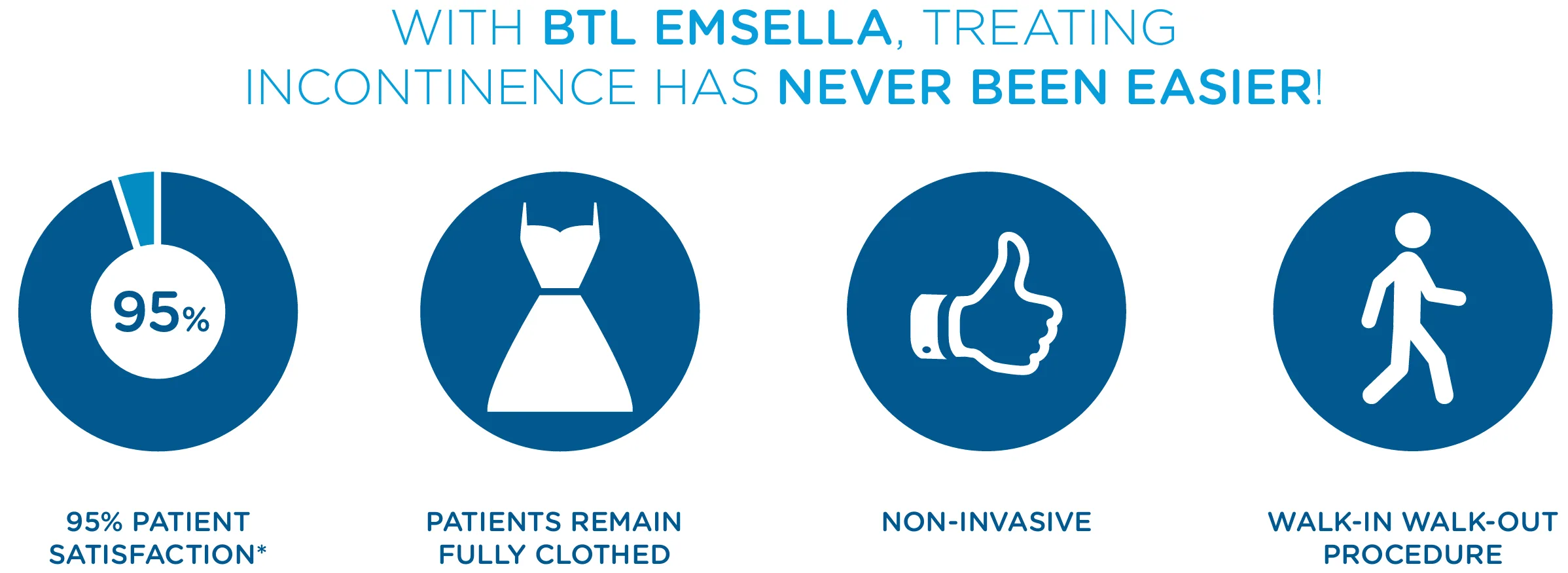 Emsella benefits and Core to Floor outcomes
It pairs Emsculpt Neo (abdominal HIFEM plus RF) with Emsella (pelvic floor HIFEM) in a single coordinated 12-session arc. The clinical logic is the part most clinics get right. The financial logic is the part most clinics miss.
Emsella benefits and Core to Floor outcomes
It pairs Emsculpt Neo (abdominal HIFEM plus RF) with Emsella (pelvic floor HIFEM) in a single coordinated 12-session arc. The clinical logic is the part most clinics get right. The financial logic is the part most clinics miss.
What's happening: Most clinics with both devices treat them as parallel revenue lines. Emsella is sold to incontinence patients. Emsculpt Neo is sold to body contouring patients. The two product lines almost never speak to each other. The Core to Floor language shows up on a brochure somewhere, but the consult flow does not actually present it as a default.
Why it fails: The clinical case for Core to Floor is genuinely strong. The pelvic floor and the abdominal core function as a coordinated unit, and a 2018 Cochrane review of pelvic floor muscle training (Dumoulin, Cacciari, Hay-Smith) found that isolated pelvic floor training underperforms when the surrounding core musculature is deconditioned. Patients who do both have better outcomes than patients who do either. The consult, not the clinical case, is the bottleneck.
The fix: Build the Core to Floor frame into the Emsella session-four touchpoint, not the initial consult. By session four, the patient is feeling the result. The fear of "will this work" has been replaced by the question of "what else can I do." That is the moment of highest cross-sell openness in the entire patient journey. Clinics that introduce Emsculpt Neo at session four convert 25 to 40% into the bundle. Clinics that wait until session six convert 5 to 10% because the protocol is already over and the urgency is gone. We covered the broader objection logic for these high-ticket bundle conversions in the Emsella objection handling playbook.
Action Step: Add a single line to your Emsella session-four protocol: "How is your core feeling overall, not just the pelvic floor?" Listen to the answer. If the patient mentions any abdominal weakness, postpartum diastasis, or general core deconditioning, present Core to Floor as the natural next step. Track conversions for 60 days.
How Do You Choose Which Device to Add Second?
This is where most clinic owners overcomplicate the decision. The right second device is not the one with the highest revenue per chair hour. It is the one that compounds with your first device and matches your patient demographic.
What's happening: Clinic owner runs an Emsella chair successfully for 12 months, builds up a small patient base, and faces the next CAPEX decision. The rep is pitching Emface because the per-hour math looks the best. The clinic owner is leaning toward Emsculpt Neo because the bundle story is clean. A friend across town just bought Exion and swears by it.
Why it fails: The "which is best" question has no universal answer. The right answer is a function of three variables: the existing patient demographic, the current funnel position (acquisition-led vs referral-led), and the clinic's marketing capacity. A medspa with a 35 to 55 mixed female base and a working paid-acquisition system gets a different answer than a urology practice with a 50+ referral base and no ad budget.
The fix: Use this decision logic, not the rep's pitch deck.
-
If your Emsella base is 40+ female with strong incontinence and postpartum positioning: add Emsculpt Neo second. The Core to Floor bundle compounds, the demographic overlaps cleanly, and the revenue per existing patient lifts immediately. We cover the broader positioning question by clinic type in the MedSpa vs Urology vs Pelvic PT positioning guide.
-
If your Emsella base is 35 to 55 with strong aesthetic and self-care positioning: add Emface second. The demographic does not perfectly overlap with Emsella, but the existing patient base is primed for self-care upgrades, and Emface's per-hour revenue makes the CAPEX easier to defend. Keep Emsculpt Neo for device #3.
-
If your Emsella base is mostly urogenital rejuvenation patients (postpartum, perimenopause): add Exion Vaginal second. The combined Emsella plus Exion Vaginal stack pulls $4,500 to $6,000 average ticket and addresses both the functional (incontinence) and structural (laxity) sides of the same patient complaint.
-
If your Emsella chair is under 40% utilization: do not add a second device yet. The next $150,000 should be spent on patient acquisition, not equipment. We laid out the actual CAC math in the Emsella patient acquisition cost deep dive.
Action Step: Pull the demographic breakdown of your last 100 Emsella patients. Age, primary complaint, referral source. The shape of that data is your second-device answer. If you cannot get the data because intake forms do not capture it, fix that first.
What Is the Real Cross-Sell Rate Between BTL Devices?
This is the number that runs a multi-device clinic. The cross-sell rate from device #1 into device #2 is the difference between a $2,400 patient and a $5,500 patient. It is also the metric most clinics never measure.
What's happening: Clinic completes an Emsella protocol with a patient. Patient is happy. Patient leaves. Six months later the maintenance reminder fires. Patient comes back, does one maintenance session, leaves again. At no point in this cycle did anyone present Emsculpt Neo, Emface, or Exion. The cross-sell rate is functionally zero, even though the clinic has all four machines.
Why it fails: Cross-sell does not happen by accident. It happens at specific touchpoints in the patient journey, and if those touchpoints are not built into the protocol, the cross-sell rate defaults to whatever the staff feels like asking that day. Across the BTL practices we have advised, the spread between top-quartile cross-sell rate and bottom-quartile is roughly 30 percentage points (35 to 40% vs 5 to 10%). The clinical outcomes are similar. The only difference is whether the cross-sell is operationalized.
The benchmark numbers from clinics with documented cross-sell flows:
- Emsella → Emsculpt Neo (Core to Floor): 25 to 40% when introduced at session four
- Emsella → Exion Vaginal: 15 to 25% when positioned for postpartum or perimenopause patients
- Emsella → Emface: 15 to 20% as a year-one self-care reward
- Emsculpt Neo → Emsella (reverse Core to Floor): 20 to 30% when the patient mentions any pelvic floor symptom
- Emface → Exion (skin tightening upgrade): 20 to 35% at the maintenance touchpoint
The fix: Build cross-sell scripts into three specific touchpoints, not one.
- Session 4 of any active protocol. Patient is feeling the result. Highest openness moment. Present the next-step bundle.
- End-of-protocol exit consult. Frame: "what does year one of maintenance look like." Present complementary device.
- Maintenance visit, every 6 months. Frame: "what are we adding this year." Present upgrade path.
The cross-sell rate is the output. The script frequency is the input.
Action Step: Pick one device pair (start with Emsella → Emsculpt Neo) and write the session-four script in 4 lines or fewer. Train every clinical staff member on it. Track conversion rate for 60 days. Then expand to the next pair.
How Should a Clinic Sequence Devices Over Time?
The CAPEX order matters. Adding the right device second can compress payback on the first device. Adding the wrong device second can blow up both.
What's happening: Clinic gets aggressive after the first device hits payback. Buys two more in the same quarter. Marketing budget gets stretched across three funnels. Front desk gets confused on consult routing. Six months in, all three machines are running at 30 to 40% utilization and the clinic owner is trying to figure out which one to sell.
Why it fails: Each device adds clinical, marketing, and operational load. The clinical load is usually the easiest to absorb. The marketing load (a new funnel, new ads, new landing page, new consult script) and operational load (new scheduling block, new follow-up sequence, new maintenance protocol) compound nonlinearly. Adding device #2 roughly doubles operational complexity. Device #3 roughly triples it. Adding two devices in the same quarter rarely works.
The fix: Sequence devices by utilization, not aspiration.
- Device #1 (Emsella or Emsculpt Neo). Run to 60%+ utilization before any second-device decision. This is typically months 6 to 12.
- Device #2 (the bundle partner). Add when device #1 is consistently full. Use the existing patient base for cross-sell before opening a new acquisition channel.
- Device #3 (the demographic expansion). Emface or Exion, depending on whether the clinic leans aesthetic or wellness.
- Device #4 (the add-on). Emtone or other body-contouring layer, sold inside existing packages rather than as a standalone funnel.
The full BTL portfolio takes most clinics 36 to 48 months to build out responsibly. Faster than that and the operational load tends to swamp the revenue gain. The 2024 American Med Spa Association State of the Industry report found that single-location medspas with three or more energy-based devices outperformed peers on revenue per square foot only when device #2 was added at least 12 months after device #1. Compressed sequencing showed no statistically significant revenue lift.
Action Step: Map your current device sequencing plan against your utilization data. If you are planning to add a second device while device #1 is below 60% utilization, the spend is more likely to slow your payback than accelerate it. Defer the second device until utilization clears the threshold.
What About Device-Adjacent Revenue: Maintenance, Bundles, and Memberships?
The device sale is the headline. The recurring revenue layer is the business.
What's happening: Clinic books the six-session protocol, completes it, and sends the patient home. Maybe a maintenance reminder fires six months later. Maybe it doesn't. There is no membership, no annual package, no recurring revenue infrastructure. The patient relationship effectively ends with the protocol.
Why it fails: A multi-device BTL clinic is a recurring-revenue business pretending to be a transactional one. The lifetime value of a fully-utilized BTL patient is $5,500 to $8,000 in year one and $1,500 to $3,000 in years two and three. The clinics that capture the back end build memberships. The clinics that don't watch the patient drift to the next aesthetic clinic for the next thing.
The fix: Build a tiered membership layer on top of the device portfolio.
- Maintenance tier ($150 to $250/month): quarterly Emsella maintenance, plus a discount on add-on services. Anchor: incontinence patients who completed the six-session protocol.
- Wellness tier ($350 to $500/month): quarterly Emsella plus quarterly Emsculpt Neo or Emface session, plus member pricing on protocols.
- Concierge tier ($800 to $1,200/month): monthly device session of patient's choice, plus priority booking, plus annual aesthetic package included.
The tiered membership turns a transactional clinic into a recurring-revenue practice. It also changes the way new devices get evaluated. Device #4 is no longer "do we have demand for it." Device #4 is "does it fit inside the wellness tier as a value-add." The CAPEX justification shifts from new-patient demand to existing-patient retention.
Action Step: Estimate your annual revenue from existing Emsella patients (year-two and year-three only). If it is under $400 per patient on average, you do not have a recurring revenue layer. Build the maintenance tier first, then expand.
What Does the Right Service Mix Look Like at Scale?
The clinics doing this best look like a single-funnel ascension business with multiple device anchors, not a multi-funnel device showroom. The shape of the revenue mix at maturity is predictable.
For a four-device BTL practice (Emsella, Emsculpt Neo, Emface, Exion) at steady state:
- Emsella revenue: roughly 25% of total (high volume, low ticket)
- Emsculpt Neo revenue: roughly 30% of total (Core to Floor bundle plus standalone)
- Emface revenue: roughly 25% of total (highest per-hour, separate funnel)
- Exion plus Exion Vaginal revenue: roughly 15% of total
- Memberships and maintenance: roughly 5% in year one, scaling to 15 to 20% by year three
The revenue is not evenly distributed across devices. It does not need to be. What matters is that the cross-sell rate stays north of 25% on the anchor pairs, the membership layer captures 30%+ of completed protocol patients, and the device count grows in sequence with utilization.
The clinics that get this right do not market more aggressively than their peers. They market more coherently. One funnel, one consult flow, one ascension path, multiple device touchpoints. The compounding happens inside the patient journey, not inside the ad account.
If you want help building the consult flow, the cross-sell scripts, or the membership infrastructure that turns a single Emsella chair into a multi-device practice, see how we work with clinics like yours.
Read Next
- Emsella ROI: When Does the BTL Chair Pay Itself Back? - The unit economics that justify the first device, before any service mix decision makes sense.
- Emsella Sales Objection Handling: Close the $2,400 Package - The consult logic that makes Core to Floor cross-sell work in practice.
- Emsella Positioning: MedSpa vs Urology vs Pelvic PT - The clinic-type framework that determines which device belongs second in your portfolio.