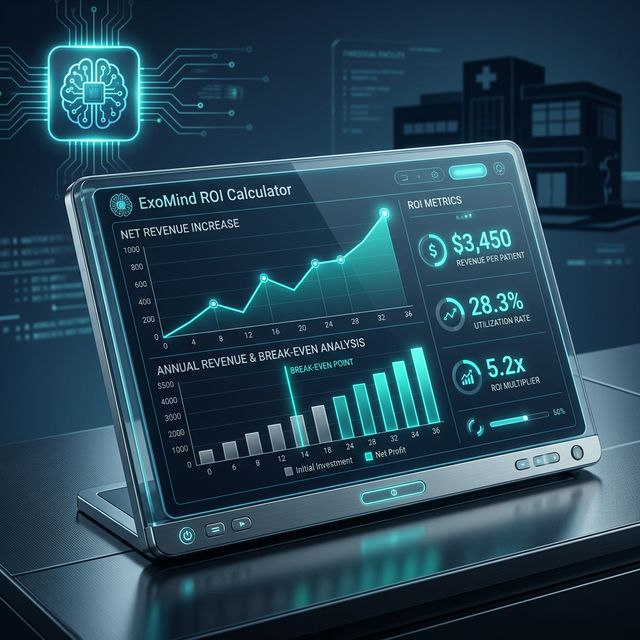
The call comes in on a Tuesday afternoon: "How long before my ExoMind pays for itself?"
That's the question every clinic owner asks before signing the lease on a $100,000+ machine. And it's the right question to ask. Unlike traditional therapy chairs, an ExoMind represents a significant capital commitment that must generate enough patient volume and revenue to justify the investment.
The good news? For clinics with solid patient acquisition and pricing strategies, ExoMind ROI can be strong. The bad news? The timeline depends entirely on how many patients you can get through the door each week.
This post walks you through the exact numbers: what the machine costs, how much revenue you can generate per patient, how many patients you need per week to break even, and—most importantly—whether an ExoMind investment makes financial sense for your clinic.
Key Takeaways
- Total year-one cost of ownership is $180,000-$200,000 — the machine ($120K+), installation, staff, rent, maintenance, and marketing all factor into your break-even calculation.
- You need just 2-3 patients per week to break even — at $600/session and 6 sessions per patient, $3,600 revenue per patient covers base costs quickly.
- ExoMind generates $1,800/hour in revenue per chair — 4.5x higher than traditional TMS and 3x higher than ketamine IV therapy.
- Most clinics break even in 4-8 months with proper marketing and referral networks in place.
- The #1 ROI killer is insufficient patient volume — budget $3,000-$8,000/month for marketing before and after purchasing the machine.
What Does an ExoMind Machine Actually Cost?
An ExoMind represents a significant capital investment that extends far beyond the machine's purchase price. Understanding the true cost of ownership is critical to calculating accurate ROI.
The Base Machine Cost
BTL does not publish pricing for the ExoMind, but industry estimates place the machine cost between $100,000 and $200,000 depending on configurations and financing arrangements. This is substantially higher than traditional TMS systems ($50,000–$100,000) but comparable to ketamine IV setup costs when you factor in medical-grade infusion pumps and monitoring equipment.
Installation, Training, and Setup
Budget an additional $10,000–$20,000 for:
- Installation and electrical infrastructure
- FDA compliance documentation
- Staff training (clinician certification takes 1–2 days)
- Initial marketing to create patient awareness
- EMR integration and clinical protocol development
Annual Operating Costs
Beyond the purchase price, expect recurring costs:
- Maintenance and service contracts: $3,000–$6,000/year
- Staff payroll for operation: $40,000–$60,000/year for a part-time operator (factor in benefits)
- Space lease allocation: $1,000–$3,000/month depending on location
- Licensing and compliance: $500–$2,000/year
- Marketing and patient acquisition: Variable (plan $2,000–$8,000/month for sustainable growth)
Total Year-One Cost of Ownership
For a conservative clinic:
- Machine + installation: $120,000
- Year-one operating costs: $60,000–$80,000
- Total: $180,000–$200,000
This is why the break-even timeline matters so much. You're not just covering a machine; you're covering a full operation.
Action Step: Request a detailed cost breakdown from your BTL representative. Include installation, training, first-year maintenance, and service contract costs. Add 15% buffer for unexpected expenses.
 ExoMind marketing ROI calculator showing $5,500 monthly investment generating $80,000 revenue at 900% ROI
What Revenue Can You Realistically Generate Per Month?
Your revenue model depends on three variables: number of patients per week, sessions per patient, and price per session. Let's use industry benchmarks.
Per-Session Revenue
Most clinics charge $500–$800 per ExoMind session, depending on:
- Geographic location (urban practices charge more)
- Insurance reimbursement rates (if accepted)
- Cash-pay vs. insured split
- Whether the session is bundled with psychiatric evaluation
For detailed guidance on pricing strategy, see our ExoMind pricing strategy.
A conservative estimate: $600 per session (blended rate across cash and insured patients).
Sessions Per Patient Course
A typical ExoMind course is 6 sessions delivered over 2–4 weeks (one session every 3–4 days). Some patients require 8–10 sessions for sustained remission, but 6 is the baseline.
Revenue Per Patient
- 6 sessions × $600/session = $3,600 per patient
- Some clinics charge $200–$300 for the initial psychiatric evaluation separately, which adds $200–$300 to lifetime patient value
Monthly Revenue by Patient Volume
Assuming 4 weeks per month and one ExoMind machine operating 5 days/week, here's what revenue looks like:
| Patient Volume | Sessions/Week | Revenue/Week | Monthly Revenue | Annual Revenue |
|---|---|---|---|---|
| 2 patients/week | 8–10 | $4,800–$6,000 | $19,200–$24,000 | $230,400–$288,000 |
| 5 patients/week | 20–25 | $12,000–$15,000 | $48,000–$60,000 | $576,000–$720,000 |
| 10 patients/week | 40–50 | $24,000–$30,000 | $96,000–$120,000 | $1,152,000–$1,440,000 |
The key insight: At just 5 patients per week, you're generating $48,000–$60,000 in monthly ExoMind revenue. This is more than enough to cover operating costs and start building profit.
 Key marketing metrics KPI dashboard for ExoMind clinics showing CPL, CPA, Show Rate, Close Rate, LTV, and ROAS
How Many Patients Per Day Does It Take to Break Even?
Let's calculate the break-even point using your actual clinic costs.
Monthly Break-Even Formula
Monthly Revenue Needed = (Annual Machine Cost ÷ 12) + Operating Costs
Conservative Clinic Scenario
- Machine cost (amortized): $120,000 ÷ 60 months = $2,000/month
- Operating costs (staff, rent, marketing, maintenance): $6,000/month
- Total monthly cost: $8,000
At $600/session and 6 sessions per patient:
$8,000 ÷ $3,600 = 2.2 patients per week
This means you need approximately 2 patients per week (less than one per day) to cover your base costs.
Moderate Clinic Scenario
- Machine cost (amortized): $150,000 ÷ 60 months = $2,500/month
- Operating costs: $7,000/month (higher staff and marketing)
- Total: $9,500/month
$9,500 ÷ $3,600 = 2.6 patients per week
Aggressive Clinic Scenario
- Machine cost (amortized): $200,000 ÷ 60 months = $3,333/month
- Operating costs: $8,000/month
- Total: $11,333/month
$11,333 ÷ $3,600 = 3.1 patients per week
The Reality Check: Most clinics treating depression and anxiety can acquire 3–5 referral-based patients per week once an ExoMind program is established. This means break-even is achievable within 6–12 months for clinics with solid referral networks.
Action Step: Calculate your own break-even point using the formula above. Plug in your actual machine cost, local operating costs, and target session price. If break-even is over 12 months, revisit your marketing budget.
What Is the Typical Patient Acquisition Cost for ExoMind?
Patient acquisition cost (PAC) is the single biggest variable in your break-even timeline. It determines how much you must spend on marketing to bring patients through the door.
Typical PAC for Mental Health Clinics
Industry benchmarks:
- Organic referral only: $0 (but slow patient growth)
- Paid digital marketing: $150–$350 per patient
- Provider referral networks: $50–$150 per patient (revenue share with referring providers)
- Blended approach: $100–$250 per patient
Industry data from PatientPop shows the average patient acquisition cost for specialty medical practices ranges from $150-$350 (PatientPop Healthcare Marketing Report, 2024).
For ExoMind specifically, expect costs on the higher end ($250–$350) because:
- ExoMind is a newer technology with lower awareness than traditional TMS
- Patients often require education calls and consultations before committing
- Psychiatric referrals require relationship building with referring physicians
Marketing Spend Impact on Break-Even
If your PAC is $250 per patient, and you need 5 patients per week to break even and build profit:
5 patients/week × 4 weeks × $250 = $5,000/month in marketing spend
This means your break-even monthly costs are actually:
$6,000 (operations) + $5,000 (marketing) = $11,000/month
At $3,600 per patient:
$11,000 ÷ $3,600 = 3 patients per week to break even (with marketing included)
Pro Tip: Clinics with strong existing referral networks can reduce PAC to $100–$150, which significantly accelerates break-even. If you already have relationships with psychiatrists, therapists, and pain management providers, you have a competitive advantage.
Action Step: Survey 10 psychiatrists and 10 therapists in your area about their awareness of ExoMind and willingness to refer. If fewer than 5 would refer, invest in provider education before purchasing the machine.
How Does ExoMind ROI Compare to Other Practice Investments?
To understand whether ExoMind makes financial sense, compare it to alternative capital investments in your practice. For a comprehensive comparison of treatment modalities, see our multi-modality marketing guide.
Revenue Per Chair Hour Comparison
This is the most important metric for clinic ROI:
| Treatment Modality | Cost per Session | Session Duration | Revenue/Hour | Annual Revenue (1 Chair, 40 hrs/week) |
|---|---|---|---|---|
| ExoMind (BTL) | $600 | 20 minutes | $1,800 | $93,600 |
| Traditional TMS | $200 | 30 minutes | $400 | $20,800 |
| Ketamine IV Therapy | $400–$600 | 60 minutes | $400–$600 | $20,800–$31,200 |
| Standard Therapy Session | $150–$250 | 60 minutes | $150–$250 | $7,800–$13,000 |
The ExoMind Advantage: Revenue per chair hour is 4.5x higher than traditional TMS and 3x higher than ketamine IV. This is why the machine pays for itself faster despite higher upfront costs. According to the American Medical Association, the average psychiatry revenue per patient hour is $150-$250 (AMA Practice Benchmarking, 2024).
Comparison to Other Capital Investments
Ketamine IV Program
- Startup cost: $50,000–$100,000 (IV pumps, monitoring equipment, pharmacy setup)
- Revenue per patient: $400–$600 per session, 6–8 sessions = $2,400–$4,800
- Break-even timeline: 12–18 months
- Advantage: Lower upfront cost, established reimbursement patterns
- Disadvantage: Lower throughput, longer session times
TMS System Addition
- Startup cost: $50,000–$100,000
- Revenue per patient: $150–$250 per session, 36 sessions = $5,400–$9,000
- Break-even timeline: 18–24 months
- Advantage: Proven efficacy, established insurance coverage
- Disadvantage: Longer treatment duration, lower revenue per hour
Spravato Program
- Startup cost: $20,000–$40,000 (licensing, staff training, pharmacy coordination)
- Revenue per patient: $300–$500 per session, 6–8 sessions = $1,800–$4,000
- Break-even timeline: 6–12 months
- Advantage: Fastest break-even, lowest capital requirement
- Disadvantage: Declining insurance coverage, narrower indication (treatment-resistant depression only)
The Verdict: ExoMind has the highest upfront cost but also the fastest return per hour of operation, making it attractive for clinics with sufficient patient volume.
What Is the Break-Even Timeline for Most Clinics?
Let's model three realistic scenarios showing months to break-even based on patient acquisition rates and operating efficiency. A 2024 Medical Economics survey found that 67% of medical practices recoup major equipment investments within 12 months when paired with dedicated marketing (Medical Economics, 2024).
Break-Even Scenarios
| Metric | Conservative | Moderate | Aggressive |
|---|---|---|---|
| Patients per Week | 2 | 5 | 10 |
| Revenue per Patient | $3,600 | $3,600 | $3,600 |
| Monthly Revenue | $28,800 | $72,000 | $144,000 |
| Monthly Operating Costs | $6,500 | $7,500 | $8,500 |
| Monthly Marketing Spend | $3,000 | $5,000 | $7,000 |
| Total Monthly Costs | $9,500 | $12,500 | $15,500 |
| Monthly Net Profit | $19,300 | $59,500 | $128,500 |
| Initial Investment | $130,000 | $150,000 | $180,000 |
| Months to Break-Even | 6.7 months | 2.5 months | 1.4 months |
Key Insights:
-
Conservative clinics break even in 6–7 months. This scenario assumes stable referral channels and moderate marketing spend. Most clinics with existing mental health practices fall here.
-
Moderate clinics break even in 2–3 months. This assumes strong referral relationships and effective marketing ($5,000/month). Clinics that actively build provider networks reach this level.
-
Aggressive clinics break even in 1–2 months. This is realistic only for high-volume practices or those in major metropolitan areas with established reputations.
Most clinics fall into the conservative to moderate range, meaning break-even is 4–8 months away with proper execution.
What Kills ExoMind ROI (And How to Avoid It)
Not every clinic achieves break-even in under a year. Here are the biggest ROI killers and how to prevent them.
1. Insufficient Patient Volume
The most common mistake: assuming patients will come without dedicated marketing.
Why it happens: Clinic owners expect ExoMind to generate referrals on reputation alone. In reality, most referring physicians have never heard of ExoMind and need education.
The fix:
- Budget $3,000–$8,000/month for marketing before and after purchase
- Build relationships with 10+ referring psychiatrists and therapists in your area
- Create case studies and success videos to share with referral sources
- Implement a referral bonus program ($100–$200 per patient) for consistent referrers
2. Pricing Too Low
Some clinics undercut competitors and charge $400–$500 per session to "fill the chair."
Why it matters: At $400/session (6 sessions), revenue drops to $2,400 per patient. Break-even stretches from 6 months to 12+ months.
The fix:
- Research local pricing for similar treatments (ketamine IV, TMS, premium therapy)
- Position ExoMind as premium mental health technology and price accordingly ($600–$800)
- Offer payment plans to reduce barrier to entry without reducing revenue
3. Poor Patient Selection
Referring patients who aren't good candidates for ExoMind wastes time and money.
Why it matters: Poor outcomes lead to negative reviews, fewer referrals, and damaged reputation. One bad patient outcome can kill referral relationships built over months.
The fix:
- Develop clear inclusion/exclusion criteria (ExoMind works best for bipolar depression, unipolar depression, anxiety)
- Screen out patients who are actively suicidal, untreated substance abuse, or severe personality disorders
- Conduct thorough psychiatric evaluation before ExoMind treatment
4. Underestimating Operating Costs
Many clinics fail to account for licensing, staff salary, maintenance, or ongoing training.
Why it matters: Hidden costs erode profit margins and extend break-even timelines by months.
The fix:
- Hire a full-time or part-time ExoMind operator ($35,000–$50,000/year) rather than spreading responsibility to clinical staff
- Budget $500/month for continuous maintenance and updates
- Reserve $2,000/month for ongoing marketing and referral development
5. Lack of Insurance Reimbursement Strategy
ExoMind CPT codes and reimbursement rates vary widely by insurer and geography.
Why it matters: If you default to cash-pay only, you exclude patients without $3,600 upfront. If you accept insurance without negotiating rates, reimbursement can be 30–50% below your asking price.
The fix:
- Research reimbursement rates for your area's major insurers (UnitedHealth, Aetna, Cigna, etc.)
- Develop a hybrid model: offer both cash-pay ($600–$800/session) and insurance (negotiate rates of $400–$600)
- Build relationships with insurance companies to establish covered indications
6. No Patient Retention or Aftercare Strategy
ExoMind patients need follow-up care (therapy, medication management) to prevent relapse.
Why it matters: If patients leave your clinic after ExoMind course, you miss ongoing therapy revenue and referral word-of-mouth.
The fix:
- Offer post-ExoMind therapy continuity at a discounted rate
- Implement 3-month and 6-month follow-up appointments
- Develop partnership with a therapist for post-treatment care
Action Step: Score yourself 1-5 on each of the six ROI killers above. Any score below 3 is a red flag. Address your lowest-scoring area before anything else.
Final Thoughts: Is ExoMind Worth It?
The numbers tell a clear story: For clinics with established referral networks and the ability to market to referring providers, ExoMind ROI is strong. Break-even timelines of 4–8 months are achievable, and monthly profit margins of $40,000–$80,000 are realistic at moderate patient volumes.
But this isn't a plug-and-play investment. You must:
- Commit to patient acquisition before and after purchase. ExoMind doesn't sell itself. See our Google Ads guide for effective paid marketing strategies.
- Price confidently. At $600–$800 per session, revenue per patient ($3,600) justifies the marketing spend.
- Build provider relationships. Your biggest referral source is referring psychiatrists and therapists who already trust your clinic.
- Measure continuously. Track patient acquisition cost, revenue per patient, and time-to-break-even every 30 days.
If you're ready to move forward, start with a simple calculation: How many new mental health patients can you acquire per week at your current practice? If it's 3 or more, ExoMind is likely a sound investment. If it's fewer than 2, validate demand with referral sources before committing capital. For a comprehensive overview of marketing strategy, review our complete marketing guide.