Your ExoMind clinic treats real patients. It delivers measurable results. But the moment you try to talk about it on Instagram or Facebook, the platform flags your content and your reach drops to zero.
This isn't a coincidence. Meta has strict rules about medical device advertising, brain stimulation claims, and mental health marketing. Most clinic owners don't know these rules exist until their posts are already gone. Others default to bland, non-educational content that doesn't convert.
Here's what we've learned from running social media for 40+ mental health clinics: you can build a thriving social presence with ExoMind content. You just need to understand the guardrails, use the right platforms, and know which content pillars actually drive patient bookings.
This post walks you through the exact strategy that works—with real post examples you can adapt immediately.
Key Takeaways
- Meta bans ExoMind content that claims treatment outcomes — use "FDA-cleared" (fact) instead of "effective" (claim), and "patient experience" instead of "patient results."
- Five content pillars drive ExoMind social media — technology education (35%), patient experience (25%), clinic logistics (20%), mental health awareness (15%), and comparative insight (5%).
- YouTube has the highest conversion potential — a 7-minute explainer video moves patients further down the decision funnel than any Instagram post.
- Every post needs a call-to-action — "DM us your biggest question" or "link in bio to book" turns followers into booked patients.
- Batch-produce content monthly — film or create 12-16 posts in one day, schedule throughout the month to reduce weekly pressure.
Why Does Meta Keep Banning ExoMind Clinic Accounts?
Meta (Facebook and Instagram) restricts content about medical devices, brain stimulation, and mental health treatments under three main policies: their Medical Device Policy, Claims Policy, and Mental Health Community Standards. Meta's advertising policies restrict medical device promotion, affecting over 42% of healthcare advertisers (Hootsuite Social Media Trends Report, 2024).
The core issue: Meta classifies ExoMind (any TMS device) as a medical device. Medical devices require special advertising approval. Mental health content, even if factual, often triggers automated moderation because Meta errs on the side of caution. If your post claims ExoMind "treats," "cures," or "fixes" depression, Meta assumes you're making a medical claim that bypasses their medical device advertising review process.
What gets flagged:
- Posts claiming ExoMind "treats" or "cures" depression
- Before-and-after testimonials suggesting disease outcomes
- Posts with symptom-based targeting language
- Direct comparisons to medications
- Posts using restricted health-related hashtags
What's allowed:
- Educational content about how the technology works
- Patient testimonials about their experience (without claiming outcomes)
- Clinic messaging about available treatment options
- General mental health awareness content
- FAQ-style posts answering patient questions
The practical reality: Facebook's automated systems flag brain stimulation and depression content aggressively. Even if your post complies with policy, it may still get deprioritized in feeds or restricted from appearing in the accounts of users under 18. This means reach plummets even when the post isn't technically removed.
Your solution is to build content that educates without claiming, informs without warning, and creates interest without triggering moderation systems.
Action Step: Audit your last 10 Instagram/Facebook posts. Flag any that use words like "treats," "cures," "effective for," or "will improve." Rewrite them using "FDA-cleared," "available for," or "patient experience" language.
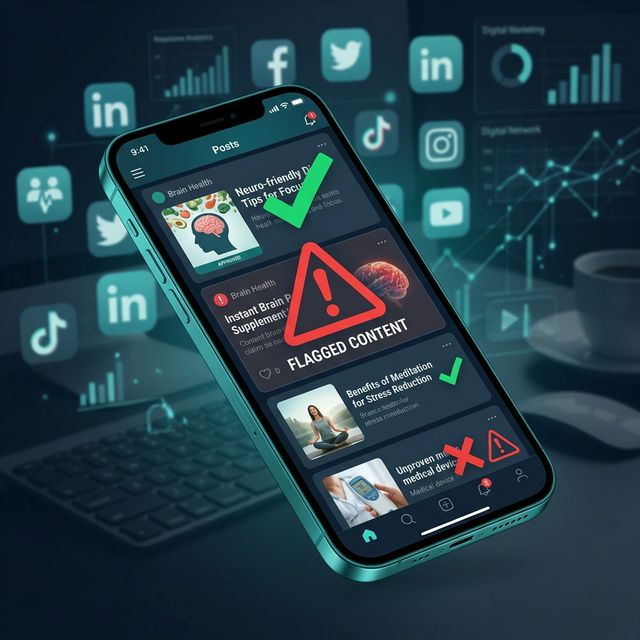
 ExoMind social media compliance guide showing approved and prohibited content practices
What Content Pillars Work for Brain Stimulation on Social Media?
The best-performing ExoMind social content fits into five content pillars. Each pillar serves a different stage of the patient journey—from awareness to booking.
Pillar 1: Technology Education
These posts explain ExoMind without claiming outcomes. They're about the science, the mechanism, the safety profile. Posts in this pillar get strong organic reach because they're informative without triggering policy violations.
Example: "How does ExoTMS actually work? It uses repetitive magnetic pulses to stimulate nerve cells in specific brain regions. This is a non-invasive, non-systemic approach—no medication, no downtime. Sessions are 20–30 minutes, FDA-cleared for major depressive disorder. Here's what happens during your first session..."
Pillar 2: Patient Experience
These are testimonials and patient stories that focus on the experience, not the outcome. The difference matters. A patient can say "I felt hopeful after my third session" (experience). They can't say "ExoMind cured my depression" (outcome claim).
Example: "Marcus came in after two years of struggling with depression. He decided to try something different. Here's what his first week of ExoMind looked like—from driving to the clinic to how he felt during treatment..."
Pillar 3: Clinic Logistics
How long are sessions? What does a typical week look like? How much does treatment cost? What insurance works? These posts answer the practical questions that prevent people from booking.
Example: "ExoMind treatment is 6 sessions, under 30 minutes each. Most patients come twice a week. You'll spend 3 weeks in treatment. Here's a sample schedule for someone working full-time..."
Pillar 4: Mental Health Awareness
General content about depression, treatment options, the importance of seeking help, stigma reduction. This content isn't specific to ExoMind but positions your clinic as a trusted resource.
Example: "If you've tried medication and it didn't work or caused side effects, you have options. Dozens of people come through our clinic every month looking for something different. You're not alone."
Pillar 5: Comparative Insight
These posts compare treatment modalities (therapy, medication, devices) without claiming ExoMind is "better." They help people understand their options.
Example: "Medication-based treatment, talk therapy, and brain stimulation all have different research profiles. Here's what the data shows about outcomes, side effects, and time to improvement for each approach..."
Allocation strategy: Your posting mix should be roughly 35% education, 25% patient experience, 20% logistics, 15% awareness, 5% comparative. This ratio maximizes reach while keeping compliance high. For a more detailed breakdown of how to understand your patient personas across these content pillars, see our patient persona breakdown.
Action Step: Create a content calendar template with five rows (one per pillar) and four columns (one per week). Fill in the topic and target for each post before you create any content.
How Do You Educate Without Making Medical Claims?
This is the critical skill. You can educate extensively about ExoMind. You just need precise language.
Banned language:
- "ExoMind treats depression"
- "ExoMind is effective for major depressive disorder"
- "ExoMind will improve your symptoms"
- "Clinical studies show ExoMind works"
Allowed language:
- "ExoMind is FDA-cleared for major depressive disorder"
- "The mechanism involves non-invasive brain stimulation"
- "ExoMind is an option for people who haven't responded to other approaches"
- "Patients experience the treatment like this..."
- "Research indicates brain stimulation has a safety profile of..."
- "Here's how the technology works"
The distinction: Stick to facts that don't imply outcome. "FDA-cleared" is a fact. "Effective" is a claim. "How it works" is education. "What it does to your depression" is a claim.
Your education framework:
- Explain the mechanism (magnetic pulse stimulation, brain regions involved)
- Provide context (FDA clearance, non-invasive, duration)
- Share the patient experience (what does 30 minutes feel like?)
- Offer the next step (book a consultation, ask your doctor)
Never jump from mechanism to outcome. The gap is where Meta's automated systems flag you.
Real example that works:
"How is ExoMind different from medication? It's not a system therapy—it targets specific brain regions with repetitive magnetic pulses. Patients don't take a pill; they come to our clinic for 20–30 minute sessions. It's FDA-cleared for major depressive disorder, non-invasive, and no downtime. If you're curious whether it might be a fit for your situation, we can talk through your history and what treatment looks like. DM us or call to schedule a consultation."
This post educates, positions the treatment, and moves people toward booking—without claiming ExoMind "treats" or "works." For a comprehensive framework on all aspects of ExoMind marketing, consult our complete ExoMind marketing guide.
What ExoMind Content Gets the Most Engagement?
Across 40+ clinics, certain content types consistently outperform. They get comments, shares, saves, and clicks.
Top performers:
-
"This is what a typical ExoMind session looks like" – Video or carousel showing the chair, the coil placement, the timeline. People engage because they're demystifying something unfamiliar.
-
"Here are 5 reasons patients choose ExoMind over medication" – Not claiming it's better, just walking through the comparison. People who've tried meds and struggled save this content.
-
Patient testimonials with specific detail – "I was on three medications and still struggling. Here's my ExoMind timeline and what I noticed..." Specificity drives engagement and shares because it feels real.
-
"Can I take medication while doing ExoMind?" – FAQ-style content performs because people are actively searching these answers.
-
Mental health awareness + ExoMind positioning – "You shouldn't have to choose between feeling better and dealing with side effects. Here's what we offer..." This frames ExoMind as one option within a larger conversation.
-
Cost and logistics clarity – "ExoMind costs $3,000–$4,800. Here's how insurance works, what your out-of-pocket might be, and payment plans we offer." Transparency removes friction. For pricing strategy details, see our ExoMind pricing strategy.
-
Comparison carousel posts – "Medication vs. therapy vs. brain stimulation: Timeline, side effects, cost, research support." People engage heavily with comparison content because it helps them decide.
What doesn't work:
- Generic mental health quotes without clinic context
- Posts that disappear into the mental health awareness void (no education, no call-to-action)
- Before-and-after testimonials that claim outcomes ("I was depressed, now I'm not")
- Overly clinical language that sounds like FDA paperwork
- Posts with no call-to-action (no reason to comment, share, or click)
Engagement mechanics: Posts get engagement when they educate someone stuck on a specific question. "What does a session feel like?" is a stuck question. "You should seek mental health treatment" is not—it's generic.
Should You Use TikTok or YouTube for ExoMind Education?
Meta is restrictive. TikTok and YouTube have different policies. They're worth your attention if you have the capacity.
TikTok:
Content moderation is lighter than Meta. Mental health content isn't restricted the same way. You can discuss depression and brain stimulation more openly. The audience is younger (Gen Z, younger millennials), which may or may not align with your patient demographic.
Best for: 20–40-second explainer videos, humor-based mental health content, patient testimonials in a more casual tone, quick Q&A.
Risk level: Low. TikTok allows mental health discussion. Medical device rules are less enforced than on Meta. However, you're building an audience that likely isn't your primary patient demographic.
YouTube:
Longer-form education dominates here. You can film 5–10 minute explainer videos, patient interview series, clinic tours, detailed Q&A. The algorithm prioritizes watch time and engagement. YouTube is the second-largest search engine, processing over 500 million hours of video daily (Statista, 2024).
Best for: Detailed "how ExoMind works" videos, patient interview series, physician Q&A, treatment timeline walkthroughs, side-by-side comparison videos, clinic culture content.
Risk level: Lowest of all platforms. YouTube's medical device policies are clear and straightforward. If you claim outcomes, they flag it. If you educate, you're fine.
Conversion potential: Highest on YouTube. People who watch a 7-minute explainer video are significantly further down the decision funnel than Instagram scrollers.
Practical recommendation: Start with Instagram and Facebook (where your audience likely is), master the content pillars and compliance framework, then expand to YouTube if you have video production capacity. TikTok is a bonus channel if you're targeting a younger demographic.
 Social media platform comparison matrix for ExoMind marketing showing reach, content type, and ROI by platform
How Do You Turn Social Media Followers Into Booked Patients?
Building followers means nothing if they don't book. Here's the conversion framework.
Stage 1: Awareness (Social Post)
Your content educates someone about ExoMind, addresses a pain point (tried medication, wants non-invasive, curious about TMS), or validates their experience.
Example post: "If your current treatment isn't working, that doesn't mean nothing works. It means you haven't found the right fit yet. We offer four different approaches to treatment. ExoMind is one of them. Here's what each one involves..."
Stage 2: Interest (Call-to-Action)
Every social post needs a reason to move to the next stage. Link to a landing page, ask them to DM, direct them to your website, offer a free consultation booking. Posts with specific calls-to-action generate 371% more clicks than those without (HubSpot Marketing Report, 2024).
Best calls-to-action:
- "DM us your biggest question about ExoMind treatment"
- "Click the link in bio to book a free 15-minute consultation"
- "Comment below if you've wondered whether TMS could help"
- "Read our complete ExoMind guide (link in bio)"
Stage 3: Consideration (Landing Page or Conversation)
They've clicked through or messaged. Now they need to understand what happens next. Your landing page or DM response should answer: What is ExoMind? Who is it for? What does treatment cost? How long does it take? How do I know if it's right for me? For detailed guidance on crafting persuasive landing page copy, review our website copy guide.
Stage 4: Decision (Free Consultation or Evaluation)
Remove friction. Offer a free consultation call (15–20 minutes), a free psychiatric evaluation, a no-pressure discovery session. Make it easy to say yes.
The bottleneck: Most clinics lose people between Stage 2 and Stage 3. They drive clicks but don't have a clear landing page or process for handling inquiries. You build followers but no patients.
Conversion optimization: Track which posts drive the most conversions, not just engagement. A post with 50 likes and 3 booked consultations is 10x more valuable than a post with 500 likes and 0 bookings. Most clinics optimize for the wrong metric.
Action Step: Add a booking link to your Instagram bio today. Every post should end with "link in bio to book your free consultation" or a specific DM prompt.
What Is the Right Posting Frequency for an ExoMind Clinic?
Posting frequency affects reach, algorithm performance, and team workload. There's a balance.
Recommended frequency:
- Instagram: 3–4 posts per week (Stories daily, Reels 2–3x weekly)
- Facebook: 4–5 posts per week
- TikTok: 3–4 videos per week (if you're using it)
- YouTube: 1–2 long-form videos per month
- LinkedIn: 2–3 posts per week (if targeting referring physicians)
Why these numbers? Instagram's algorithm rewards consistency. If you post 3–4 times weekly, you stay visible in followers' feeds. Posting once per week is too infrequent; posting twice daily leads to burnout and lower quality content.
Quality over frequency: A single, high-quality carousel post about "how ExoMind compares to medication" will outperform 10 generic mental health quotes. One excellent patient testimonial beats five mediocre clinic updates.
Realistic approach: If you have one person managing social media part-time, aim for Instagram/Facebook 3x per week, one YouTube video per month. Don't overcommit. Consistency beats intensity.
Content batching strategy: Spend one day per month filming or creating content. Batch-produce 12–16 posts at once. Schedule them throughout the month. This reduces weekly pressure and ensures consistency.
Four-Week ExoMind Social Media Content Calendar
Here's a template you can adapt for your clinic. This calendar balances education, patient stories, logistics, and calls-to-action.
Week 1:
Monday: Technology education carousel – "How does ExoTMS work? Here's the mechanism in 6 slides" (target: educate)
Wednesday: Patient testimonial video – "Sarah's first ExoMind session" (target: experience)
Friday: FAQ post – "Can I take my antidepressant while doing ExoMind?" (target: consideration)
Week 2:
Monday: Comparison post – "Medication vs. therapy vs. brain stimulation: Which might be right for you?" (target: awareness)
Wednesday: Clinic logistics – "A typical ExoMind week looks like this" (target: consideration)
Friday: Mental health awareness – "If standard treatment didn't work, that's not failure. It's information." (target: awareness)
Week 3:
Monday: Video post – "Tour of our clinic: This is where your ExoMind treatment happens" (target: demystify)
Wednesday: Patient interview – "Marcus tried three medications before ExoMind. Here's what he noticed." (target: experience)
Friday: Cost and insurance – "ExoMind costs $3–4.8K. Here's how insurance and payment plans work." (target: consideration)
Week 4:
Monday: Troubleshooting FAQ – "What if I'm scared of brain stimulation? Here's what actually happens." (target: objection-handling)
Wednesday: Comparative insight – "Why some patients choose ExoMind over ketamine or Spravato" (target: education)
Friday: Call-to-action post – "Ready to explore whether ExoMind is right for you? Book a free consultation." (target: conversion)
This calendar mixes content pillars, ensures compliance, educates your audience, and drives conversions without repeating the same message.
Platform Comparison: Content Type, Risk, and Conversion Potential
| Platform | Best Content Type | Meta Risk Level | Conversion Potential | Effort Required |
|---|---|---|---|---|
| Reels, carousels, testimonials, education | High | Medium | Medium | |
| Longer captions, patient stories, community posts | High | Medium | Medium | |
| TikTok | Short videos, casual testimonials, humor | Low | Low | Low |
| YouTube | Long-form education, patient interviews, explainers | Very Low | Very High | High |
| Physician education, clinic insights, research | Low | Low (if B2B) | Medium |
Meta risk level explanation: High-risk platforms flag more aggressively. Instagram and Facebook have strict medical device policies. YouTube and TikTok allow more flexibility. However, high risk doesn't mean avoid; it means be precise with language.
Conversion potential: YouTube ranks highest because people who watch 7-minute ExoMind explainer videos are decision-ready. Instagram followers are in awareness/interest stage. TikTok users are often too early in the journey.
Strategy: Start where your patients are (Instagram, Facebook), master compliance and conversion, then expand to YouTube for higher-conversion content.
Action Step: Choose one platform to master first. If your patient demographic is 35+, start with Instagram and Facebook. If you have video production capacity, prioritize YouTube for highest conversion potential.