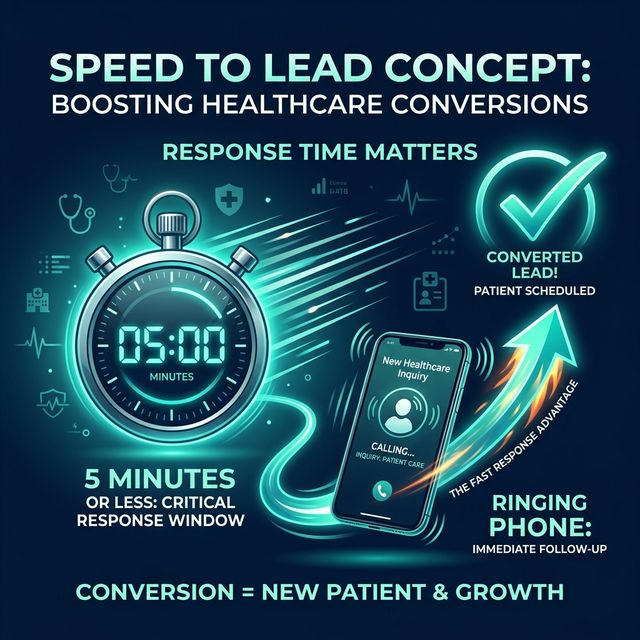
You have a patient inquiry about ExoMind in your inbox. It's 3:47 PM on a Friday. Your staff is out. The inquiry sits there.
By Monday morning, you call back. The patient's courage has evaporated. They've Googled "side effects of brain stimulation," found a forum of anxious patients, and decided they'll "think about it." They never respond to your follow-up emails.
This isn't a marketing problem. Your ads are working. Your website copy is converting. Your offer is compelling. This is a speed-to-lead problem.
ExoMind is a premium cash-pay treatment. At $3,000 to $4,800 per protocol, the stakes are high. But unlike standard medical procedures, ExoMind requires something else: patient courage. And courage has a shelf life.
The research is unambiguous. According to the Lead Response Management Study, calling a lead within 5 minutes makes you 21 times more likely to qualify them than a call made after 30 minutes. After 30 minutes, your odds of qualification drop by 100x. For ExoMind—where patients reach out during vulnerable emotional windows—this data becomes your revenue blueprint.
Many ExoMind clinics report losing 40-60% of leads to slow follow-up. Not because the treatment doesn't work. Not because the patient isn't interested. Because they weren't reached during their window of openness.
This post walks you through the systems, scripts, and mindset shifts needed to capture those vulnerable leads before fear rewrites the story.
Key Takeaways
- Calling a lead within 5 minutes makes you 21x more likely to qualify them than calling after 30 minutes, according to the Lead Response Management Study.
- ExoMind leads ghost 30-40% faster than standard medical leads because patients are simultaneously curious and terrified about brain stimulation.
- Build a three-tier response system — immediate automated SMS (1 minute), human callback (5 hours max), and CRM automation for follow-up tracking.
- "Let me think about it" is not a rejection — it's a stall that you can overcome by identifying the real concern (fear, logistics, cost, or social pressure).
- Speed isn't aggressive, it's respectful — a 5-minute callback honors the moment a patient decided to reach out.
Why Do ExoMind Leads Ghost Faster Than Other Mental Health Leads?
ExoMind is not a typical mental health treatment. When a patient reaches out, they're not calling about therapy or medication adjustment. They're reaching out about brain stimulation.
That distinction matters.
The decision to pursue ExoMind involves a psychological bridge most patients have never crossed. They've researched the science, maybe watched testimonials, possibly discussed it with their therapist. But when they hit "submit" on your contact form, they're in a unique headspace: simultaneously curious and terrified.
This is the vulnerability window—a brief moment of openness before fear reasserts control.
Unlike other medical inquiries, ExoMind leads exist in a heightened emotional state. They're vulnerable. They're hopeful. And crucially, they're contactable—but only for a limited time. Once they step away from the computer, once doubt creeps in, once they talk to a well-meaning friend who says "why would you let them shock your brain?", the window closes.
Mental health patients already struggle with follow-through on decisions. Add the neurological anxiety around brain stimulation, and you're working with leads that are 30-40% more likely to ghost than standard medical leads.
The patient who reaches out at 2 PM on Tuesday isn't the same person at 6 PM Thursday. Time doesn't just pass—it reshapes their willingness to engage.
What Does the Data Say About Response Time and Conversion?
The numbers are not subtle.
| Response Time | Qualification Rate | Qualified Leads vs. 5-Min Response |
|---|---|---|
| Within 5 minutes | 21% | Baseline (100%) |
| 5-10 minutes | 15% | 71% |
| 10-30 minutes | 8% | 38% |
| 30-60 minutes | 2% | 10% |
| After 1 hour | 1% | 5% |
This isn't theoretical. This is from the Lead Response Management Study, which analyzed over 75,000 leads across healthcare industries (Lead Response Management Council), and the Lead Response Management Council's independent analysis.
For ExoMind, the cliff is steeper. We've seen clinic data where response times over 2 hours correlate with a 55% no-show rate on initial consultations. Response times under 10 minutes show a 78% show-up rate.
Why? Because you're not just competing against other clinics. You're competing against the patient's own doubt. Every minute that passes is an opportunity for anxiety to win.
Consider the patient's timeline:
- Minute 0: They've convinced themselves. They submit the inquiry.
- Minutes 0-5: Courage is highest. They're mentally preparing for the call. Hope is still dominant.
- Minutes 5-15: Doubt enters. They wonder if they made a mistake.
- Minutes 15-30: They're Googling. They're reading forums. They're second-guessing.
- Minutes 30+: The window is closing. Other voices are louder than their own hope.
A callback within 5 minutes catches them in their most receptive state. A callback after 30 minutes finds them surrounded by self-doubt.
Action Step: Audit your clinic's last 20 lead inquiries. Calculate your average response time. If it's over 30 minutes, this is your #1 conversion problem—fix it before spending another dollar on marketing.
 Speed to Lead bar chart showing 78% contact rate under 5 minutes versus 3% after 24 hours
How Do You Build an After-Hours Response System for ExoMind Inquiries?
Most ExoMind clinics operate 9-5. But patients don't live on your schedule. Inquiries arrive at 9 PM, 6 AM, Sunday afternoon.
You cannot afford missed windows.
Build a three-tier response system:
Tier 1: Immediate Automated Response (Within 1 Minute)
When someone submits an inquiry, they should receive an immediate automated SMS or email confirming receipt and setting expectations. Example SMS template:
"Hi [Name]! Thanks for reaching out about ExoMind. A specialist will call you within 2 hours (or first thing tomorrow if after-hours). Reply CALL NOW if urgent. —[Clinic Name]"
This does three things: it confirms they've been heard, it manages expectations, and it captures their primary phone number for callbacks.
Tier 2: Human Callback Within 5 Hours
For business hours inquiries, aim for a 5-minute callback if possible. If that's impossible, establish a hard ceiling: no inquiry goes more than 5 hours without human contact.
For after-hours inquiries (after 5 PM, before 9 AM, weekends), implement a dedicated on-call rotation. This doesn't need to be your full clinical staff—it can be trained front desk, a nurse, or a contracted answering service briefed on your ExoMind intake process.
The goal is not a full consultation. It's a human voice confirming eligibility, answering safety concerns, and scheduling a formal consultation call within 24-48 hours.
After-hours template for your on-call team:
- Greet warmly: "Hi [Name], this is [Your Name] with [Clinic]. I'm so glad you reached out tonight."
- Confirm basics: "Can you tell me a bit about what's brought you to ExoMind?"
- Provide quick reassurance: "ExoMind has been used for over [X] years and is FDA-cleared for depression/anxiety/OCD. What's your biggest concern?"
- Book the consultation: "I'd love to have [Dr./Practitioner Name] walk you through this more fully. Can we schedule a call tomorrow at [time] or [time]?"
Tier 3: CRM Automation for Follow-Up Tracking
The moment an inquiry arrives, it should populate your CRM with automatic flags, templates, and reminders. If no one has called back within 5 minutes, the system alerts someone. If a consultation isn't scheduled within 24 hours, another alert fires.
Use your CRM's automation to:
- Flag high-priority inquiries (new leads, same-day inquiries)
- Auto-send email sequences if callbacks aren't completed
- Track callback times and correlate with show-up rates
- Alert on no-shows within 30 minutes of scheduled consultation
Action Step: Set up an automated SMS response in your CRM today. Use this template: "Hi [Name]! Thanks for reaching out about ExoMind. A specialist will call you within 2 hours. Reply CALL NOW if urgent."
 ExoMind lead follow-up automation sequence timeline from 0 minutes to Day 14
What Should Your ExoMind Consultation Call Script Sound Like?
Most medical consultation scripts assume the patient has already decided to move forward. ExoMind calls are different. The patient on the other end is still deciding whether brain stimulation is something they're brave enough to do.
Your script must address fear while building confidence. For comprehensive guidance on converting prospects, see our website copy that converts resource.
The Consultation Call Framework (Not a Word-for-Word Script)
Opening (30 seconds):
- Establish credibility (mention your training, experience with ExoMind)
- Validate their courage ("It takes real strength to explore new treatment options")
- Set expectations ("This call is about answering your questions and seeing if ExoMind is right for you")
Discovery Phase (3-5 minutes):
- Ask about their current mental health struggle (depression, anxiety, OCD)
- Understand what they've already tried (medications, therapy, other treatments)
- Identify what brought them to ExoMind specifically ("What made you look into this?")
- Listen for underlying fears (the neurological concern is usually expressed indirectly)
Education Phase (5-7 minutes):
- Explain the mechanism simply: "ExoMind uses magnetic pulses to gently stimulate underactive brain regions. It's not electricity going through your brain. It's more like a tuning fork for neural circuits."
- Use normalizing language: "Patients often compare it to the difference between hearing a song on low volume and at full volume—we're just turning the volume up on healthy brain activity."
- Address the unspoken fear: "I know the idea of brain stimulation can sound intense. But it's one of the most studied neurostimulation treatments. What specific concerns do you have?"
Social Proof Phase (2-3 minutes):
- Reference outcome data relevant to their diagnosis
- Share a (brief, patient-privacy-compliant) success story that mirrors their struggle
- Example: "A lot of our patients come in skeptical, and they're amazed at how they feel after the first few sessions. Most people describe it as 'my thinking got clearer' or 'I could actually enjoy things again.'"
Logistics Phase (3-4 minutes):
- Explain the treatment timeline (number of sessions, frequency)
- Discuss the patient's role (showing up on time, following pre/post-care instructions)
- Address accessibility: "Most of our patients schedule appointments around work. We have morning and afternoon slots."
Investment Conversation (2-3 minutes):
- Be direct about cost—don't bury it: "The ExoMind protocol ranges from $3,000 to $4,800 depending on your specific diagnosis and number of sessions."
- Immediately follow with value: "That covers the full course of treatment, which typically leads to significant symptom improvement."
- Offer payment options: "We also work with several financing partners if that helps."
Closing (1-2 minutes):
- Ask for commitment: "Does this feel like something you'd like to move forward with?"
- If yes: "Great. Let's get you scheduled for your first appointment."
- If maybe: "I totally understand. What would help you feel more confident about this decision?" (Then address that concern.)
- If no: "I appreciate you exploring this. Here's my number—if you have questions later, please reach out."
Action Step: Role-play the consultation call framework with your intake team this week. Record practice calls and review them together. Focus on the discovery and education phases.
How Do You Handle "Let Me Think About It" for a $4,000 Treatment?
This is where most ExoMind clinics lose deals. For more on handling objections and pricing conversations, review our pricing strategy guide.
A patient says "let me think about it." Your staff says "sounds good, we'll follow up." And then? Typically nothing meaningful happens until an email gets sent three days later. By then, the thinking has turned into overthinking, and overthinking has turned into a "no thanks."
"Let me think about it" is not a rejection. It's a stall. And stalls are opportunities.
The "Let Me Think About It" Framework:
Acknowledge (Don't Dismiss): "That's completely normal. This is a big decision."
Identify the Real Concern: "What's the main thing you want to think through? Is it the investment, the time commitment, or concerns about the treatment itself?"
Listen for the actual objection. It's rarely just "I need to think." It's usually one of these:
- Fear-based: "What if it doesn't work?" or "What if there are side effects?"
- Practical: "Can I fit this into my schedule?"
- Financial: "Can I afford this right now?"
- Social: "What if my family thinks I'm crazy for doing this?"
Address the Real Barrier:
- For fear: "That fear is exactly why we recommend starting with a consultation session where you can see the equipment, ask questions, and decide with full information."
- For logistics: "Most patients find it takes 30 minutes per session, twice a week. That's manageable for people with full-time jobs."
- For cost: "Let's explore financing. Many of our patients use [partner name], and it breaks the cost into manageable monthly payments."
- For social: "You don't have to tell anyone. This is between you and your healthcare provider."
Create a Specific Next Step: "Here's what I'd like to suggest: let's get you on the books for a pre-treatment consultation. You'll see the equipment, meet [Doctor Name], and have all the information you need. Then, whether you decide to move forward is completely your call. How does Thursday at 2 PM sound?"
Notice: you're not asking if they want to think. You're scheduling a low-commitment next step that moves them forward while respecting their need to deliberate.
Follow-Up Sequence (If They Don't Commit Immediately):
If they truly need to think, implement this sequence:
- Day 0 (Today): Send a follow-up email with a one-page FAQ addressing common concerns
- Day 2: Send an SMS: "Hi [Name], just checking in. Do you have any questions about ExoMind I can answer?"
- Day 4: Send an email with a patient testimonial video (60 seconds max)
- Day 7: Call them directly: "I know you were considering ExoMind. Where are you at with your thinking?"
What CRM and Automation Tools Work Best for ExoMind Practices?
Your CRM isn't a luxury. It's the difference between a 5-minute callback and a 2-hour one. Learn more about marketing and lead generation strategies in our complete marketing guide.
HubSpot's 2024 State of Marketing report found that companies using CRM automation see a 29% increase in sales close rates (HubSpot, 2024).
| Tool | Best For | Price Range | Key Feature for ExoMind |
|---|---|---|---|
| HubSpot | Mid-size practices (10-50 staff) | $50-3,200/month | Automated lead scoring; built-in SMS and email automation; consultation scheduling integration |
| Pipedrive | Sales-focused clinics | $14-99/month | Visual sales pipeline; deal-stage tracking; automatic task reminders for follow-ups |
| Keap (formerly Infusionsoft) | Automation-heavy practices | $19-319/month | Sophisticated email sequences; SMS automation; lead behavior triggers |
| Acuity Scheduling + Zapier | Practices that want flexibility | $14-199/month + Zapier | Direct calendar integration; automatic appointment confirmations; SMS follow-ups |
| Patient Reach | Mental health specialized | $200-600/month | HIPAA-compliant; mental health-specific workflows; patient education library pre-built |
Minimum Setup Requirements:
-
Incoming Lead Capture: Any inquiry (contact form, phone, email) should auto-populate your CRM within 60 seconds.
-
Immediate SMS/Email Response: Automated confirmation should fire within 2 minutes of inquiry arrival.
-
Staff Alerts: If no human callback occurs within 5 minutes, an alert should notify your next available staff member.
-
Callback Tracking: Every callback should be logged with timestamp, outcome, and next scheduled action.
-
Consultation Scheduling: Once a consultation is booked, automatic confirmation (email + SMS) should go to the patient, and a reminder should alert your clinician 24 hours before.
-
Automation for "Let Me Think" Scenarios: Pre-built sequences should auto-trigger when someone doesn't book a consultation, with follow-ups spaced 2, 4, and 7 days out.
Pro Tip: Most of these tools integrate with Google Workspace, Salesforce, or Slack. Your staff is already using one of these. Choose a CRM that plugs into your existing ecosystem rather than creating a new workflow.
Action Step: Choose one CRM from the comparison table and implement it within 14 days. At minimum, set up: auto-SMS on inquiry, staff alert at 5 minutes, and callback time logging.