TL;DR
- The Maps 3-pack is the entire game. Position 1 to 3 captures the vast majority of "near me" clicks for pelvic health searches. Position 4 might as well be invisible.
- Your GBP is your homepage now. Most Emsella patients decide to call before they ever visit your website. Photos, hours, services, and reviews drive the call.
- Reviews are the #1 ranking factor. You need a privacy-respecting capture system because asking incontinence patients for reviews without script structure produces nothing.
- NAP consistency is non-negotiable. Every directory must show identical Name, Address, and Phone across the entire web.
- AI Overviews now sit above the 3-pack on half of healthcare queries. Schema markup and FAQ structure get you cited; marketing fluff does not.
- Local SEO compounds. Ads don't. Three to six months of ranking work pays out for three to five years. Three months of ad spend pays out for three months.
Most Emsella clinic owners spend the first 90 days after the chair lands obsessed with one channel: paid ads. Meta, Google Search, sometimes a Groupon experiment that ages badly. The math feels comprehensible. Spend $5,000, get X leads, close Y packages, repeat.
Then they ignore the asset that actually compounds.
When a woman in your city types "pelvic floor treatment near me" or "urinary incontinence specialist [city]" into Google at 11pm on a Tuesday, the only three results that matter sit inside the Google Maps "Local 3-Pack." That is the panel of three businesses with the map pin, the star ratings, and the phone numbers Google shows above the organic results. Everything below that pack is a rounding error.
99.5% of users never click past page 1 of Google. The local 3-pack captures the majority of clicks on local-intent healthcare searches. The #1 position alone takes a disproportionate share of those clicks. And for an Emsella clinic specifically, where 75% of women with incontinence suffer in silence and 33.3% cite embarrassment as the primary barrier to seeking help, the privacy of typing a search query and clicking a result without ever calling makes Maps the single highest-intent acquisition surface you have access to. They have lived with this for an average of 6.5 years before reaching out for help. When they finally search, they are not browsing.
This is the exact playbook to dominate that pack for Emsella. Zero ad spend required. The work compounds for years.
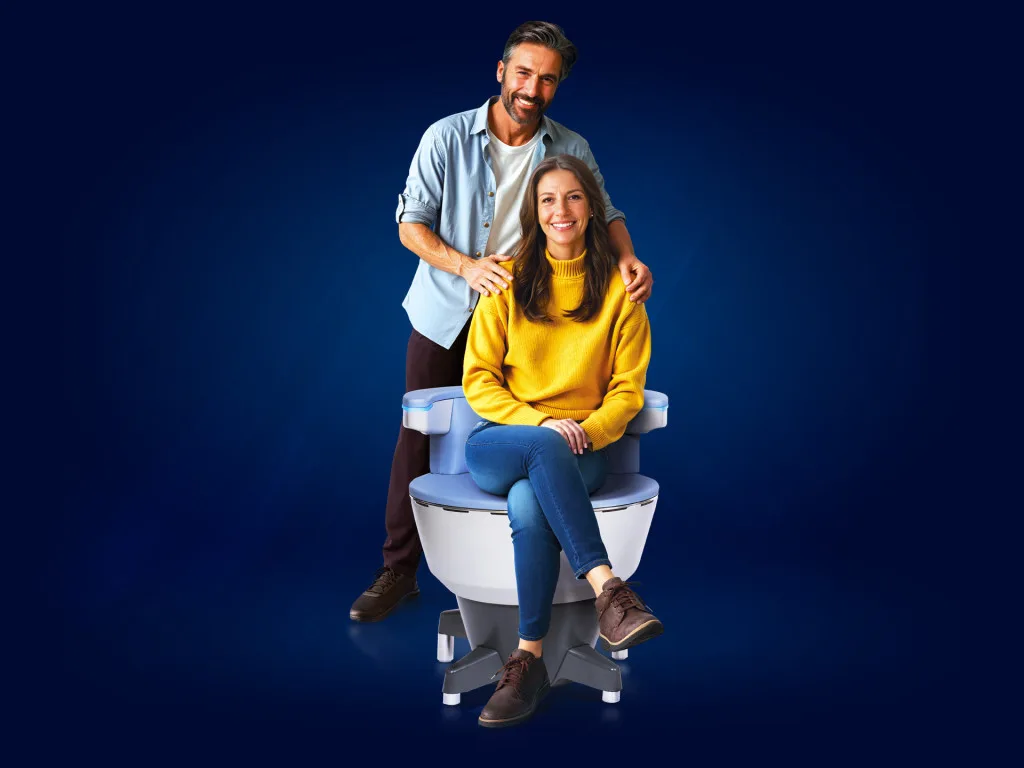 BTL Emsella chair, the service that anchors local search
Why Does the Maps 3-Pack Matter More for Emsella Than Almost Any Other Treatment?
The 3-pack matters everywhere. For Emsella it matters more.
What's happening: A 54-year-old woman in your service area has had stress urinary incontinence for years. She has not told her primary care doctor. She has not told her partner. She has Googled it three times in the last six months and closed the tab each time. Tonight, after another laundry change, she opens Google and types "pelvic floor treatment near me" or "urinary incontinence specialist [city]." She does not click ads. She does not click sponsored results. She wants the closest, highest-rated, most credible option that does not require her to explain her body to a stranger over the phone.
She clicks the 3-pack. She reads two reviews. She taps the call button or, more often, taps the website link and books on the page if booking is one click away.
Why it fails for most clinics: Local SEO requires patience that most clinic owners do not have after they just spent $180,000 to $210,000 on a chair. It does not produce leads in the first 30 days. It produces leads in months 4, 5, 6, and forever after that, with zero per-lead cost. Most owners give up at month 2 and double down on Meta ads instead. Two years later they have spent $80,000 on ads, generated 400 leads, and built no compounding asset. The clinic next to them, that quietly executed local SEO instead, now ranks #1 and gets 30 to 60 free leads per month with no ad budget at all. You can see the lead math broken down in our Emsella patient acquisition cost guide.
The fix: Treat local SEO as infrastructure, not a campaign. Budget 90 days of compounding work before you measure ROI. Pair it with paid search short-term so the lead flow does not sit at zero while you wait, but never stop the local SEO work to fund more ads.
Action Step: Open Google Maps right now in incognito mode. Search "Emsella near me," "urinary incontinence treatment [your city]," and "pelvic floor specialist [your city]." Screenshot the current 3-pack. That is your competition. You need to beat the median review count, beat the GBP completeness, and earn citations these clinics do not have.
How Do You Optimize a Google Business Profile Specifically for Emsella?
Most Emsella clinics treat their GBP like a phonebook entry. The 3-pack winners treat it like a landing page.
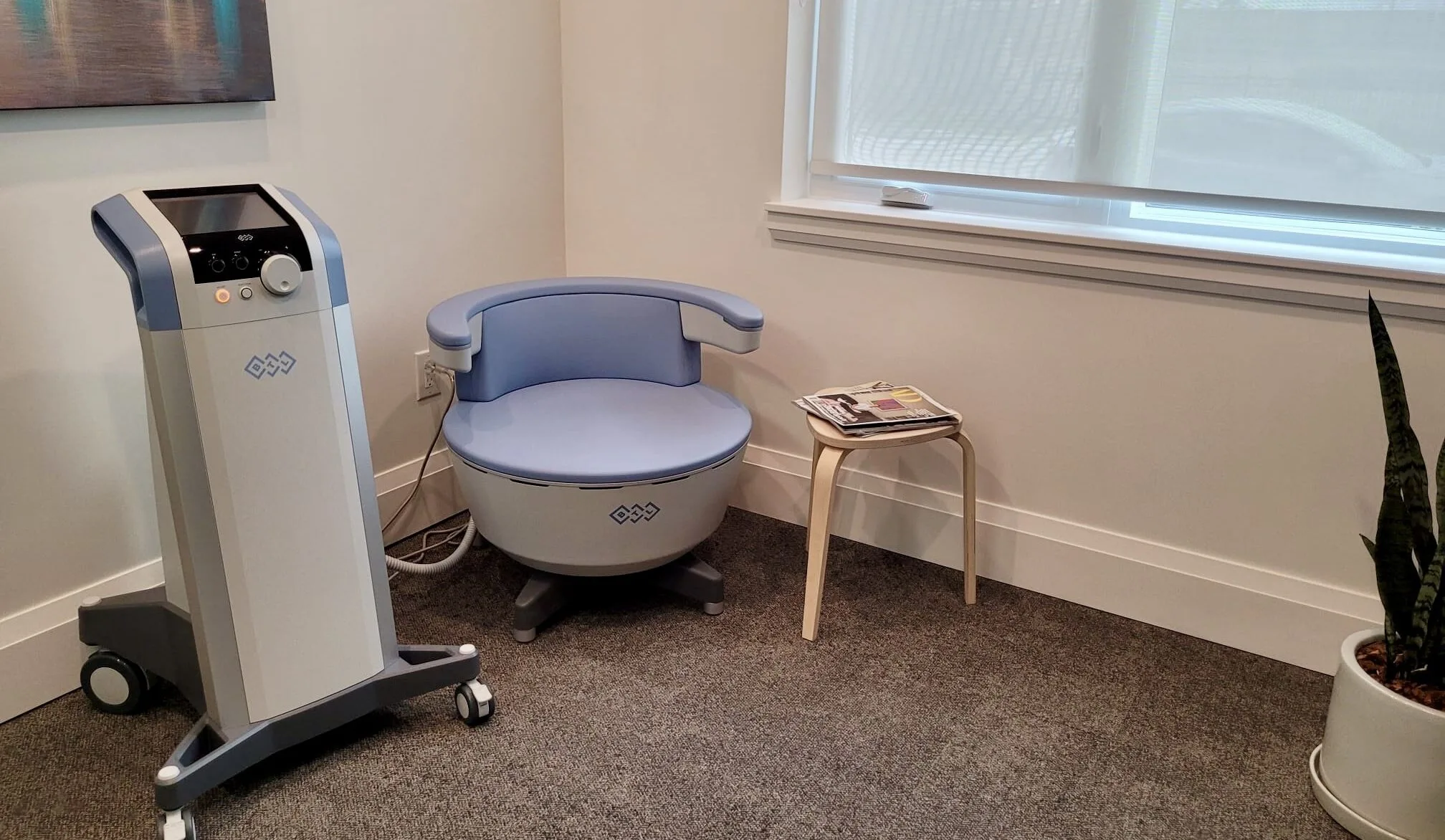 Emsella treatment room, the local clinic experience patients review
What's happening: Most clinic GBPs have the basics filled in. Address, phone, a single category, hours, maybe four exterior photos shot on an iPhone three years ago. The "Services" tab is empty. The "Q&A" section has zero entries. The business description is 80 generic characters that say nothing about Emsella, pelvic floor, or urinary incontinence. Posts have not been published in 11 months.
Why it fails: Google's local algorithm uses GBP completeness as a major ranking signal. According to Google's own business documentation, complete profiles are 2.7 times more likely to be considered reputable by consumers, and Google shows them more often in the 3-pack. A half-empty profile competing against a fully filled-out one loses every time, no matter how good your reviews are. Worse, an underbuilt profile is what AI Overviews scan first when deciding whether to cite you in a generative answer.
The fix: Fill every single field Google offers, then maintain it weekly. Specifically for Emsella:
- Primary category: Match your buyer. Medspa primary, Medical Clinic primary for urology, Physical Therapy Clinic primary for pelvic floor PT. Add Wellness Center as secondary regardless.
- Business description (750 characters): Lead with the patient outcome, not the device. "We help women in [City] regain confidence and stop planning their day around bathrooms. Our practice offers BTL Emsella, an FDA-cleared (510(k) K181497) treatment for urinary incontinence and pelvic floor weakness." Embed your top 3 keywords naturally.
- Services tab: Add "BTL Emsella" as a specific service with its own 300-character description. Add separate entries for "Stress Urinary Incontinence Treatment," "Urge Incontinence Treatment," "Postpartum Pelvic Floor Recovery," "Post-Prostatectomy Pelvic Floor Rehab" if you treat men. Each service entry is a ranking surface.
- Photos: Upload 2 to 4 high-quality photos every month. Treatment room (clean, private, spa-grade), the chair itself, exterior signage, your provider in clinical attire. No stock images. Patients use these photos to decide whether your clinic feels safe.
- Q&A: Pre-seed your own profile with 6 to 10 common questions, then answer them yourself from the business account. "Is Emsella covered by insurance?" "Do I need to undress?" "How many sessions are needed?" Google's algorithm reads these as content; AI Overviews scan them for citations.
- Posts: Publish a Google Post every 7 to 10 days. Tie each post to a specific search intent: a new patient testimonial, an FAQ, a clinical study citation, an event.
Action Step: Audit your GBP this week against this checklist. If less than 95% of fields are filled, you are leaving rankings on the table that competitors will take. Most of this is a 90-minute one-time fix. Then 30 minutes a week to maintain.
What Is the Right Review Capture Strategy for a Treatment Patients Won't Discuss Publicly?
Reviews are the highest-leverage local SEO factor and the hardest one for Emsella clinics to scale.
What's happening: 94% of consumers check reviews before booking a healthcare service. Review count, star average, and review velocity (how recent the last review is) are the three biggest signals Google uses to break ties in the 3-pack. The clinic with 80 reviews and 3 new ones this month outranks the clinic with 200 reviews and zero in the last year. Yet most Emsella clinics have between 12 and 35 reviews on Google, none specifically about Emsella, because asking a 56-year-old woman to write publicly about her urinary incontinence is a non-starter.
Why it fails: Most clinics use the medspa playbook: text a Google review link 24 hours after every appointment. For Emsella that script gets a 3 to 5% reply rate at best, because patients are terrified of disclosing the condition by name. The few reviews that come in say "great experience" with no keywords, which still helps ranking but ignores the much larger pool of patients who would happily review the clinic if asked correctly.
The fix: Reframe the ask. Patients are not reviewing their incontinence; they are reviewing the experience of being treated with dignity. Use this script at the end of session 4 or 5 (after patients are already feeling improvement, but before they are completely done with the protocol):
"Many women are nervous about coming in here because they don't know what to expect. It would help them tremendously to read about how comfortable our private treatment rooms are, how kind our team is, and how respected they felt. Would you be willing to write a quick Google review focused on the staff and environment, not the specific treatment? Your privacy is fully protected and you do not need to mention what brought you in."
Reply rate jumps from 4% to 35 to 50%. Patients write things like "Best clinic experience I have ever had. The team makes you feel completely at ease and the private rooms are beautiful." That review carries the same SEO weight as one that mentions Emsella by name, because Google trusts review velocity and authenticity more than keyword stuffing.
For the small subset of patients who explicitly want to mention Emsella (and roughly 10 to 15% will, especially men post-prostatectomy who are already more open about it), let them. Those reviews supercharge your "Emsella" keyword rankings inside Maps.
Action Step: Print the script above. Train every staff member on it. Track the ask rate (how often it gets asked) and the reply rate weekly. The bottleneck is almost always the ask, not the patient.
Why Is NAP Consistency the Most Boring, Highest-ROI Local SEO Task?
NAP consistency is unglamorous and decisive.
What's happening: Your Name, Address, and Phone Number are written 47 different ways across the internet right now. Your GBP says "123 Main St., Suite B." Your website footer says "123 Main Street #B." Your Yelp profile says "123 Main." Your Healthgrades listing has the old phone number from 2022. The BTL provider locator has the address from your previous office. Every inconsistency makes Google less confident that your business is real, and less confident businesses get suppressed in the 3-pack regardless of review count.
Why it fails: Most clinics build their GBP on day one and never audit anything else. Citations age. Phone numbers change. Addresses move when you take Suite C instead of Suite B. Each unfixed inconsistency is a small ranking penalty. Stack 30 of them and you cap your own ceiling.
The fix: Pick one canonical NAP format. Use it everywhere. Audit and update the directories that actually matter. Here is the citation priority order for Emsella clinics:
| Citation source | Why it matters | Priority |
|---|---|---|
| Google Business Profile | Primary ranking surface | Critical |
| BTL Emsella provider locator | Brand-authority backlink | Critical |
| Healthgrades | High-DA healthcare directory | High |
| Vitals | Cited by AI Overviews | High |
| Yelp | Top 5 review platform | High |
| Bing Places | Powers DuckDuckGo + ChatGPT search | High |
| Apple Maps (Apple Business Connect) | iOS default search | High |
| WebMD Care | Healthcare-specific authority | Medium |
| Local Chamber of Commerce | Local trust signal | Medium |
| RealSelf | Aesthetic device authority | Medium |
| Facebook Page | Indexed; phone number visibility | Medium |
| Local newspaper directory | Geographic relevance | Low |
Action Step: Use a tool like BrightLocal or Whitespark to scan your current citations, identify inconsistencies, and submit corrections. Budget 4 to 8 hours one-time, then a quarterly 30-minute audit thereafter. Anything you save by skipping this is forfeited 10x in lost ranking.
How Do AI Overviews Change Emsella Local SEO in 2026?
The 3-pack used to sit at the top of the page. Now AI Overviews often sit above it.
What's happening: When a user searches "what is the best treatment for stress urinary incontinence near me" or "is Emsella worth it [city]," Google increasingly returns a generative AI answer at the very top of the page. That answer cites 3 to 8 sources. The clinics, sites, and studies cited inside that AI Overview get massive visibility and a click-through rate roughly 2 to 4 times higher than position #1 in organic.
Why it fails: Most clinic websites are not structured for AI Overview citation. They have no FAQ schema, no FAQPage JSON-LD, no clinical citations, no clear authority signals. The AI scans the page, finds marketing copy with no extractable answers, and cites a competitor or a national directory instead.
The fix: Structure every page on your Emsella site (or every section of your /emsella landing page) for AI extraction. The exact moves:
| Element | What it does | Effort |
|---|---|---|
| FAQPage JSON-LD schema | Makes Q&A blocks AI-readable | Low |
| 8 to 12 FAQ entries with full answers | Direct AI citation source | Medium |
| Authoritative external citations (FDA, PubMed) | Earns AI trust | Low |
| Clear H2 questions matching search queries | Signals topical structure | Low |
| Internal cross-links to related Emsella content | Builds topical authority | Low |
| Canonical /emsella URL with city in copy | Geographic relevance | Low |
The FDA 510(k) clearance K181497 from November 2018 and the Samuels et al. (2019) study in Lasers in Surgery and Medicine showing 95% quality-of-life improvement and 75% pad-usage reduction are gold for AI citations. Cite them with proper attribution on your Emsella page and AI Overviews start including your domain in the source list.
This is the same dynamic covered in the BTL Emsella marketing mistakes guide. Clinics that send paid traffic to a homepage with no schema, no FAQ, and no citations get neither paid conversion nor organic AI Overview citation. The fix on both sides is the same: a properly structured /emsella landing page.
Action Step: Add FAQPage schema to your Emsella page this week. Use Google's Rich Results Test to confirm it parses. Then publish 8 to 12 FAQ entries answering the actual queries you see in Google Search Console. AI Overviews start citing within 30 to 60 days of indexing.
What's the Right Way to Pair Local SEO With Google Ads for Emsella?
The two channels are not substitutes. They are multipliers.
What's happening: Most clinic owners think of local SEO and Google Ads as alternatives. Either we run ads, or we focus on SEO. They pick one based on which feels cheaper or faster, then wonder why their lead flow plateaus.
Why it fails: Patients in different stages of the buying decision use Google differently. The patient who has just realized Emsella exists searches informationally and clicks an organic result or an AI Overview. The patient who has decided to book searches commercially and clicks a Maps listing or a Google Ad. If you only show up in one of those moments, you forfeit roughly 40 to 60% of available patient flow in your market. Healthcare paid search averages a 3.52% click-through rate, which means 96.48% of paid impressions cost you nothing and produce no click; you need organic and Maps presence to capture those impressions too.
The fix: Run both. Ads pay for now-leads. Local SEO compounds for forever-leads. Specific tactical pairings:
- Use ads to fund your initial review velocity. Drive paid traffic to /emsella, convert at the consult, and execute the review-capture script. The reviews you earn in months 1 to 3 are what unlock 3-pack rankings in months 4 to 6.
- Match landing page NAP exactly to GBP NAP. Google rewards this match in Quality Score and in Maps ranking simultaneously.
- Bid on your own clinic name as a brand defense term. Competitors will bid on it; you need top-of-page coverage above the 3-pack.
- Use call-only ads on mobile during high-intent hours (evenings, weekends). Speed-to-lead matters massively for Emsella; the vulnerability window guide explains why responding within 5 minutes vs 24 hours produces 21x higher qualification.
The full Google Ads strategy lives in our Google Ads for Emsella clinics 2026 guide. Pair it with this local SEO playbook and your cost per booked package drops 30 to 50% inside 90 days.
Action Step: Audit how many of your current Emsella leads come from each source: Maps, organic, paid search, paid social, referrals. If any single channel is over 70% of leads, you are over-concentrated and one algorithm change away from a problem. The healthy mix for an established Emsella clinic is roughly 30% Maps, 20% organic, 25% paid, 15% referral, 10% social.
How Do You Measure Local SEO Performance for an Emsella Clinic?
If you cannot measure it, you cannot improve it, and you cannot defend the budget.
What's happening: Most Emsella clinics measure local SEO with vibes. "Reviews are growing." "We saw a few new patients say they found us on Google." There is no dashboard, no benchmark, no monthly report.
Why it fails: Without measurement, every plateau feels like a failure. Owners give up at month 2 because the chart in their head is flat, when in reality rankings have moved from position #14 to position #7 and the next 90 days would have crossed the 3-pack threshold. Local SEO compounds nonlinearly; the last 30 days of the first six months produce more leads than the first 90 days combined.
The fix: Track these specific metrics monthly:
- 3-pack rank for top 5 keywords: "Emsella [city]," "urinary incontinence treatment [city]," "pelvic floor specialist [city]," "Emsella near me," "BTL Emsella [city]." Use a rank tracker like Local Falcon or BrightLocal that runs grid searches across your service area.
- GBP profile views, calls, direction requests, website clicks: All native in GBP Insights. Plot the trend monthly.
- Review count and review velocity: Total Google reviews, new reviews per month, average rating. Anything below 4.7 stars compounds against you.
- Citation count and consistency score: Use BrightLocal or Whitespark monthly.
- Organic landing page traffic to /emsella: Google Analytics and Google Search Console. Track impressions, clicks, average position, and conversion rate.
- AI Overview citation frequency: Manually search your top 10 keywords monthly and screenshot whether your domain is cited.
According to the Google Search Central documentation on local search ranking factors, the three primary signals are relevance, distance, and prominence. Your dashboard should show movement on all three. If reviews are growing but rankings are flat, distance or relevance is the bottleneck. If everything is flat, your GBP is incomplete.
Action Step: Build a one-page monthly dashboard with these metrics. Review it the first Monday of every month. If three consecutive months show no movement on 3-pack rank for at least one keyword, audit your category selection and citation consistency before doing anything else. That diagnostic almost always finds the bottleneck.
Book a free Emsella growth strategy call and we will audit your Google Business Profile, citation consistency, and review velocity against your top 3 local competitors.
Read Next
- 7 BTL Emsella Marketing Mistakes That Empty Your Schedule - The marketing mistakes that undo your local SEO gains
- Google Ads for Emsella Clinics: The 2026 Guide - Pair local SEO with paid search for full-funnel coverage
- Emsella Patient Acquisition Cost: The Real CAC Numbers - Channel-by-channel CAC math including organic local search