TL;DR
- Price is rarely the real objection. It is usually a smokescreen for fear, shame, or a value gap.
- Never defend the package price. Empathize, isolate the concern, and pivot to the alternative cost (surgery, lifetime pads, lost workdays).
- Sell the protocol outcome, not the chair. A patient is not paying for 28-minute sessions. She is paying to stop calculating where every bathroom is.
- The shame objection compresses the buying window. She has been silent for 6.5 years. You have 24 hours from her first call before she shuts the door again.
- Evidence beats enthusiasm. Samuels et al. (2019), 81.33% UI symptom reduction, 86.7% sustained at six months. Cite the data.
- The consult is the screen, not the sell. Tell her the consult is when you decide together if she is a candidate. That sentence alone removes the "waste my money" friction.
The phone rings. Your front desk picks up. The woman on the other end has been holding this in for years, possibly six and a half years (NIH/NIDDK reports the average delay between incontinence symptom onset and seeking help is 6.5 years). She finally gathered the courage to call.
She asks the question every clinic owner has heard a thousand times: "How much is it?"
Your staff says, "The full six-session package is $2,400."
Silence. Then: "Oh. Let me think about it and call you back."
She does not call back. She has spent six years building up the nerve to make that call, and your pricing response just sent her back into silence. That is not a pricing failure. That is a sales container failure.
If your Emsella consult close rate is below 35%, the chair is not the problem. The price is not the problem. The script is the problem. This guide is the seven objections every Emsella consult faces, the evidence-backed responses, and the consult flow that converts $250 trial sessions into $1,800 to $2,400 packages without discounting clinical value.
Why Are Emsella Consults So Different from Other Aesthetic Consults?
This is not a Botox consult. It is not a CoolSculpting consult.
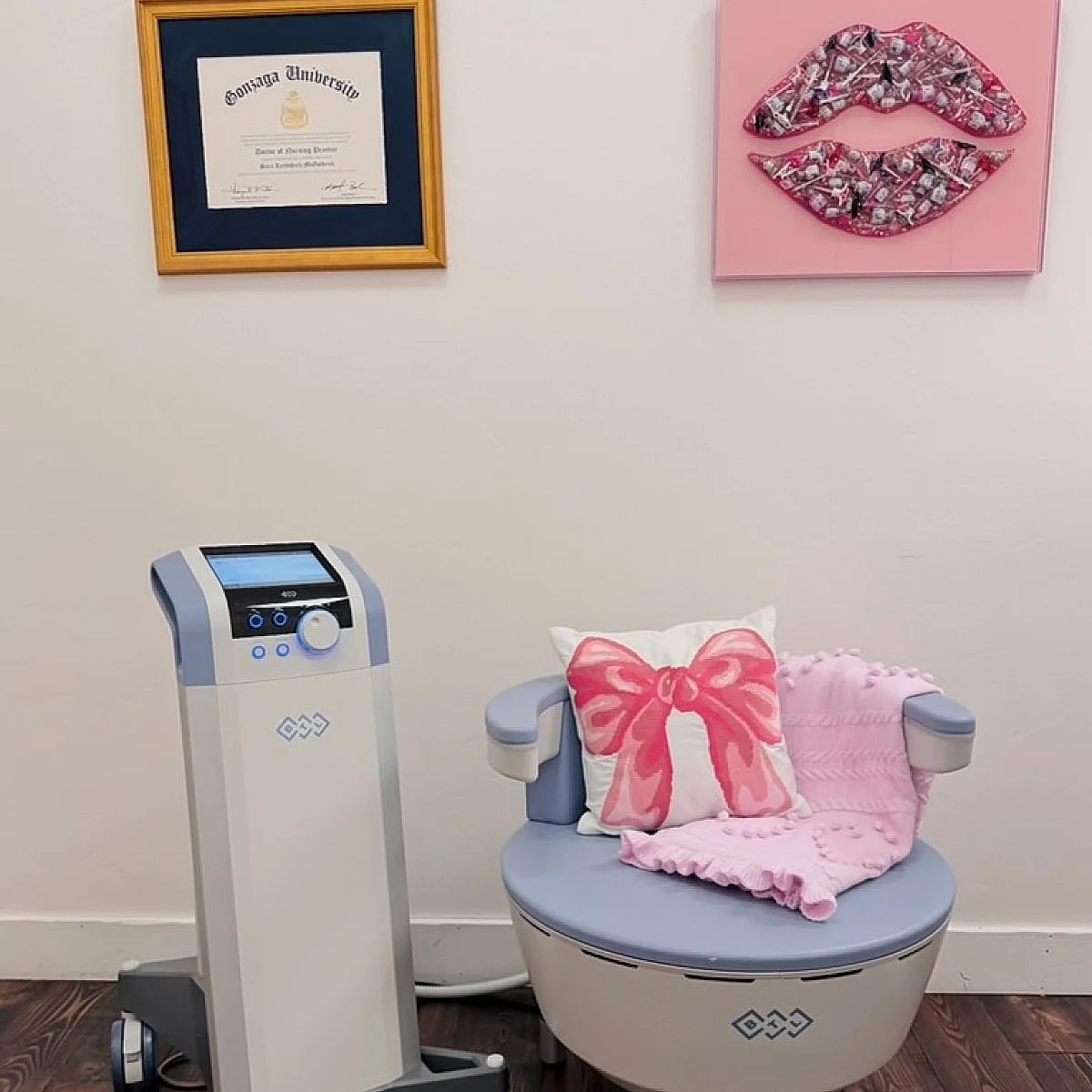 BTL Emsella chair, the device behind the consult
The patient walking into your room is carrying years of suppressed shame about a bodily function she cannot control, and 33.3% of women with pelvic health issues cite embarrassment as the primary barrier to seeking treatment.
BTL Emsella chair, the device behind the consult
The patient walking into your room is carrying years of suppressed shame about a bodily function she cannot control, and 33.3% of women with pelvic health issues cite embarrassment as the primary barrier to seeking treatment.
That changes the script.
What is happening: The patient is in a state of compressed vulnerability. She has rehearsed this conversation in her head for months, possibly years. She is hyperalert to any sign of judgment, any sense that the staff thinks her problem is unusual or gross. One eye-roll from the front desk and she is gone.
Why most consults fail: Clinic staff treat the Emsella consult like an aesthetic upsell. They lead with "HIFEM technology" and "11,200 supramaximal contractions" because that is what the BTL training deck says. The patient does not care about contractions. She cares about whether she can pick her granddaughter up without leaking.
The fix: Reframe the entire consult around the life she gets back. Mechanism gets one sentence. Outcome gets the rest of the call. See the related breakdown on the Emsella consultation vulnerability window for why speed-to-lead matters more in this vertical than any other.
Action Step: Sit in on your next 10 in-clinic Emsella consults. Track on a tally sheet: every time the provider explains the device (HIFEM, contractions, FDA), one mark. Every time the provider describes the patient's life after treatment (Saturday without bathroom mapping, jumping with grandkids, sleeping through the night), one mark. If life-outcome marks are not at least 5x device-spec marks, your in-clinic script is upside down.
Objection 1: How Do You Handle "It Is Too Expensive"?
The $1,800 to $2,400 package is the single most common stall point on an Emsella consult. Here is the script that works.
What is happening: The patient is using "too expensive" as cover. The real reason is one of three things: (1) she does not have the cash, (2) she does not believe it will work for her, or (3) she is terrified of starting and failing again. Your job is to figure out which.
Why most clinics fail: Staff jumps to "We offer financing!" the second the price objection lands. That assumes it is a logistics problem. If it is fear or value, financing makes the call feel pushy and she shuts down.
The fix: Use the A.I.R. framework borrowed from the ketamine cost objection playbook and adapted for pelvic health.
- Acknowledge: "I completely understand. It is a real investment, especially for something insurance refuses to cover."
- Isolate: "Setting the money aside for a moment, do you feel the six-session protocol is the right path for what you are dealing with?"
- Reassure: If yes, walk her through HSA/FSA eligibility (Emsella is HSA-eligible with an LMN), CareCredit, in-house payment plans, and the cost comparison below.
The cost comparison is what closes. Show her this table during the consult.
| Treatment Option | Total Cost | Recovery | Complication Rate |
|---|---|---|---|
| Emsella six-session package | $1,800 to $2,400 | Same day, no downtime | Effectively zero (per FDA 510(k) K181497) |
| Surgical sling / colporrhaphy | $6,000 to $12,000 | 18.7 days off work | 34.6% (Sacarin et al. 2025) |
| Pelvic floor PT (12 sessions) | $1,200 to $2,000 | None | None, but 30 to 50% cannot isolate muscles |
| Pads and liners (lifetime) | $1,400 to $2,800 every 5 years | Daily friction | Skin breakdown, odor |
Action Step: Print this table on a one-page consult handout. When the patient says "too expensive," slide it across the desk. Let the math do the talking.
Objection 2: How Do You Answer "Will It Actually Work for Me?"
This is the value objection in disguise. She is not asking for statistics. She is asking for permission to hope again after years of half-working solutions.
What is happening: She has tried Kegels. She has tried apps. She has tried bladder retraining. She has tried cutting caffeine. None of it fully worked. She is asking you to convince her that this time is different without setting her up for another disappointment.
Why most clinics fail: Staff cite a single statistic ("95% of patients improve!") and leave it there. The patient discounts it because she has heard 95% claims before about Kegels and biofeedback that did not work for her.
The fix: Layer the evidence and concede the limitation in the same breath.
- Lead stat: Samuels et al. (2019) in Lasers in Surgery and Medicine reported 95% of patients experienced improved quality of life and 81.33% reported significant urinary incontinence symptom reduction after the standard six-session protocol (PubMed).
- Durability stat: At six months post-treatment, 86.7% of Emsella patients still showed improved pad use, compared to 62.5% on PFMT alone (Silantyeva et al. 2021, Female Pelvic Medicine and Reconstructive Surgery).
- Concession: "We do not promise. We measure at session four. If we are not seeing change, we tell you, and we adjust or refund the remaining sessions."
That last line is what closes the value objection. The patient's fear is not that it will not work. It is that it will not work and you will keep her money anyway.
Action Step: Build a written four-session checkpoint into your protocol. Have the patient sign that you will reassess at session four. Use it as a sales asset.
Objection 3: How Do You Handle "I Am Too Embarrassed"?
This is the objection patients almost never say out loud. They cancel instead.
What is happening: She is afraid the consult will involve a pelvic exam, that she will have to disrobe, that the provider will look at her and judge, that she will leak in the chair, or that the receptionist will know. Any one of those fears is enough to cancel.
Why most clinics fail: Clinic websites lead with the device photo. The chair looks medical, slightly intimidating, and offers no signal that the experience is dignified. The patient sees the image and projects every fear onto it.
The fix: Strip the friction and say the words out loud during the consult.
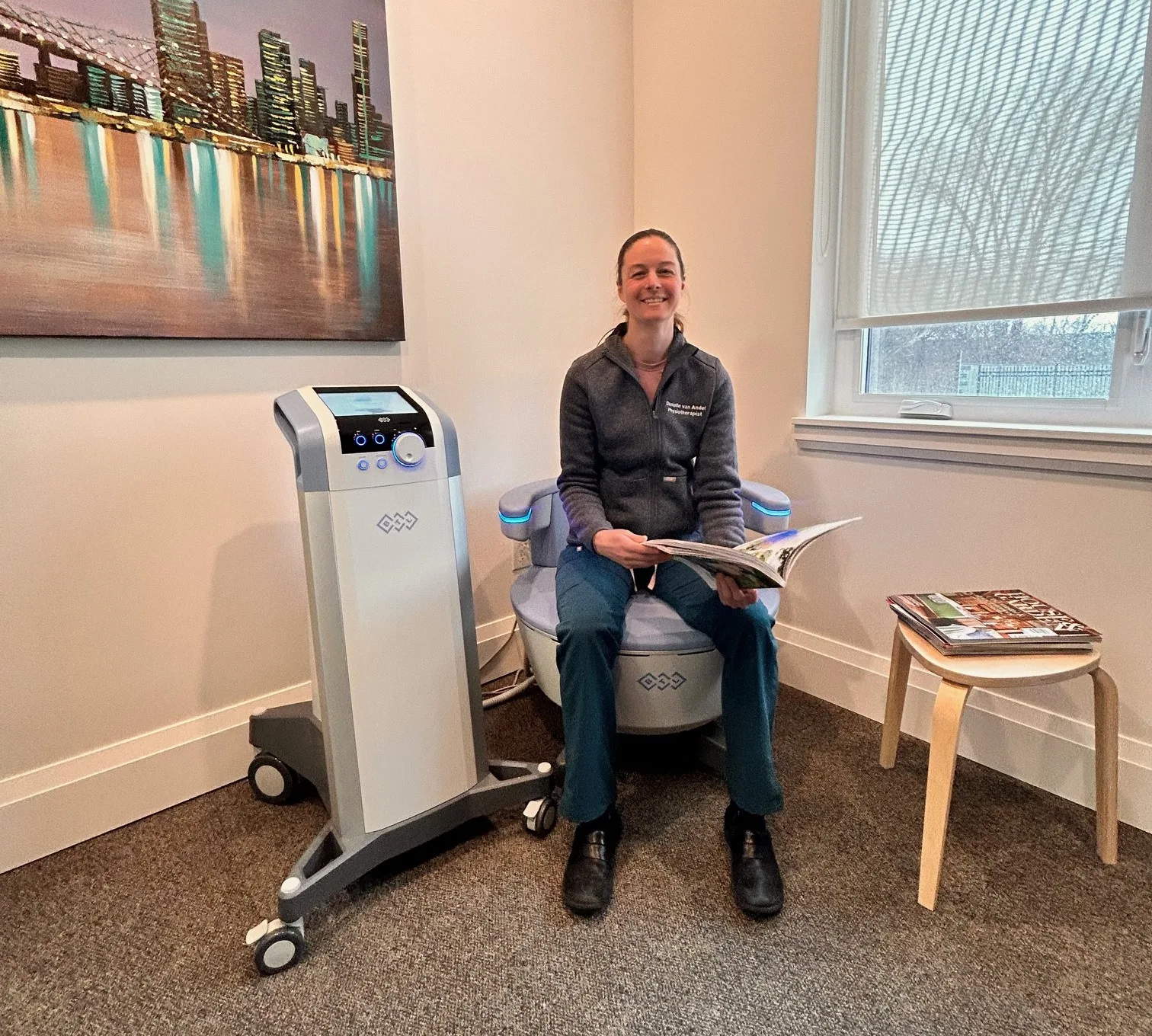 Emsella session: fully clothed, dignified, 28 minutes
- "You stay fully clothed. The session is 28 minutes."
- "There is no pelvic exam. No disrobing. No medication."
- "The provider is not in the room during treatment. You sit, you read, you scroll your phone."
- "You walk out the way you walked in. No bruising, no marks, no recovery."
- "Most patients book during a lunch break."
That sequence, in that order, dissolves the embarrassment objection.
Action Step: Add a one-paragraph "What the session feels like" section to your consult page and your intake email. Read it out loud during the first 90 seconds of every consult.
Objection 4: How Do You Counter "I Tried Kegels and They Did Not Work"?
This objection is gold. The patient is telling you exactly what failed and asking you to explain why this is different.
What is happening: She did Kegels for months, possibly years, and the leaking did not stop. She concluded the muscle is broken or that nothing will work for her.
Why most clinics fail: Staff says "Emsella is more powerful than Kegels!" without explaining the mechanical reason. The patient hears marketing.
The fix: Give her the science in plain language.
The 2018 Cochrane Review (Dumoulin et al.) on pelvic floor muscle training found that 30 to 50% of women cannot correctly isolate the pelvic floor when attempting Kegels. Even women who can isolate them generate roughly 30 to 40% of maximal contraction intensity voluntarily. The muscle simply cannot reach the contraction threshold required to remodel through voluntary effort alone.
Emsella delivers approximately 11,200 supramaximal contractions in a single 28-minute session via High-Intensity Focused Electromagnetic (HIFEM) technology, at 100% intensity. That is the equivalent of 11,200 perfect Kegels in 28 minutes, except the muscle has no choice but to fire.
The line that closes: "Kegels did not fail because you failed. They failed because voluntary contraction cannot reach the threshold the muscle needs."
For the full mechanism comparison, see Emsella vs Kegels vs Surgery: the honest comparison.
Action Step: Write a one-page handout titled "Why Kegels stopped working for you." Hand it to every consult patient who has tried PFMT.
Objection 5: How Do You Handle "What If I Am Not a Candidate?"
This is the "what if I waste my money" objection in clinical language.
What is happening: She is afraid she will pay the trial-session fee, the package deposit, or the full $2,400, and then find out she is not a candidate after the money is gone.
Why most clinics fail: Staff says "Don't worry, almost everyone is a candidate!" That feels dismissive and does not address the underlying fear.
The fix: Walk her through the contraindications openly, then reframe the consult itself as the screen.
Absolute contraindications for Emsella (per BTL provider materials and FDA 510(k) clearance K181497):
- Electronic implants in the treatment area (pacemakers, defibrillators, drug pumps, implanted hearing devices)
- Metal implants in the treatment area
- Pregnancy
- Active malignant tumor
- Hemorrhage disorders or active anticoagulation requiring caution
- Fever or active infection
- Copper IUD (case-by-case provider decision; some clinics treat, some defer)
Then say: "The consult is the screen. We review your history during the first call, and if you are not a candidate, we tell you that day. Any deposit comes back the same week. The only money you ever risk is the consult fee, and most patients credit that toward the package if they move forward."
That sentence eliminates the objection by making the screening process the first promise of the consult, not the last.
Action Step: List the contraindications on your consult page in plain English. Patients who screen themselves out before the call save your staff hours and never feel rejected.
Objection 6: How Do You Respond to "I Do Not Want My Partner to Know"?
More common than clinics realize. The patient is in a relationship where she has not disclosed the incontinence, and she does not want the treatment to force the conversation.
What is happening: She is managing two layers of shame at once. The leak itself, and the fact that she has been hiding it. She wants treatment without disclosure.
Why most clinics fail: Staff says "It is private!" without explaining what makes it private.
The fix: Walk her through the privacy architecture point by point.
- "You walk in fully clothed and walk out fully clothed."
- "There are no marks, no bruising, no swelling, no recovery."
- "There is no medication you have to explain or store at home."
- "Same-day return to all activities, including intercourse and exercise (Samuels et al. 2019)."
- "Sessions are 28 minutes. You can book during a lunch break or between errands."
- "We do not call the house. We text only the number you give us. We never leave details on voicemail."
For most patients, that sequence is enough. For patients managing more sensitive home situations, offer cash payment or HSA/FSA so the charge does not appear on shared statements.
Action Step: Update your intake form with a "preferred contact method" field that explicitly includes "text only" and "do not leave voicemail." Make it the first question.
Objection 7: How Long Will Results Last and What Is the Maintenance Plan?
This is the smartest objection. The patient is doing the lifetime math.
What is happening: She is calculating whether $2,400 today is a one-time investment or the first of many. She wants to know the durability before she signs.
Why most clinics fail: Staff says "Results last forever!" That is not what the data says, and savvy patients catch the overreach immediately.
The fix: Tell the truth, then position maintenance as a feature.
The Samuels et al. (2019) study showed sustained improvement at six months in 86.7% of treated patients. Real-world clinic data and BTL provider guidance recommend a maintenance session every 3 to 12 months depending on symptom return, with most patients settling into a 6-month cadence. Maintenance sessions in the U.S. price between $300 and $400 each.
The line that closes: "The protocol gives you your life back. Maintenance keeps it. Plan for one or two visits a year, the same way you plan a dental cleaning. Lifetime cost over five years runs roughly $4,000 all-in. Compared to surgery at $6,000 to $12,000 with an 18.7-day recovery, this is the conservative path."
That reframe wins. She is not buying a $2,400 package. She is buying her body back, with a maintenance plan that costs less per year than her cable bill.
For the full ROI math behind the package and maintenance funnel, see the Emsella ROI and payback period guide.
| Year | Investment | Cumulative Cost |
|---|---|---|
| Year 1 (six-session protocol) | $1,800 to $2,400 | $1,800 to $2,400 |
| Year 1 (one maintenance) | $300 to $400 | $2,100 to $2,800 |
| Years 2 to 5 (two maintenance per year) | $600 to $800 per year | $4,500 to $6,000 over five years |
Action Step: Build a maintenance reminder system into your CRM. Text the patient at month five and month eleven. Patients who miss maintenance windows do not return.
What Does the Actual Consult Flow Look Like End to End?
Tactics fail without sequence. Here is the consult flow that ties all seven objections together.
Minute 1 to 3: Empathy and reframe. Acknowledge the courage it took to call. Name the 6.5-year average delay so she knows she is not alone. Set the stakes: "The consult is when we decide together if you are a candidate."
Minute 4 to 10: History and screening. Walk through the contraindication list openly. Ask about prior treatments (Kegels, PFMT, surgery, pads). Take notes she can see.
Minute 11 to 18: Evidence and outcomes. Cite Samuels (2019), Silantyeva (2021), and the FDA clearance K181497. Hand her the cost comparison table. Describe the session itself in detail (clothed, 28 minutes, walk in walk out).
Minute 19 to 24: Objection sweep. Ask: "What is the one thing that would stop you from starting next week?" Whatever she names, run the corresponding script above.
Minute 25 to 30: Close and book. Offer the package at the standard price. Do not discount. If she hesitates, offer the trial session at $250 to $500 with that fee credited toward the package if she upgrades within 14 days. Book the next appointment before the call ends.
If she leaves without booking, the follow-up sequence has 7 touches over 21 days. That cadence and the psychology behind it is documented in the Emsella vulnerability window playbook.
Action Step: Shadow your next 10 in-clinic consults with a printed copy of this 5-block flow on a clipboard. Mark each block as the provider hits it. Most clinics find their consults skip the screening and evidence blocks entirely and jump straight to pricing. That is the conversion leak. After the consult, debrief with the provider for 5 minutes. Two weeks of this lifts close rate by 15-25 percentage points.
If your in-clinic Emsella close rate is under 35%, the chair is fine. The script is the bottleneck. Book a free Emsella growth strategy call and we will build the consult flow, the printed objection handouts, and the in-clinic shadow protocol with you.
Read Next
- Emsella vs Kegels vs Surgery: The Honest Comparison - The mechanism breakdown patients ask about during every consult
- The Emsella Consult Vulnerability Window: Why Speed Wins - Why the 6.5-year decision compresses to a 24-hour booking window
- Emsella ROI: When Does the BTL Chair Pay Itself Back? - The math behind packages, maintenance, and chair-hour utilization