
TL;DR
- The decision is years in the making and 24 hours from being unmade. 75% of women suffer in silence, average 6.5 years to seek help, 33.3% cite embarrassment as the primary barrier.
- Speed-to-lead matters more here than in any other vertical. Leads contacted within 5 minutes are 21 times more likely to qualify. The first clinic to respond wins 78% of the time.
- The 60-second SMS is the highest leverage automation in your funnel. It must validate her courage, name a human, and remove the exam fear in the first message.
- Day 7 and Day 21 are the most underrated touch points. Many Emsella patients book after the shame loop resolves, not after the first call.
- 20 to 30% of leads die at the missed-call stage. Automated missed-call SMS plus a 3-minute human callback recovers most of the leak.
- The consult conversation is a separate skill from speed-to-lead. Speed opens the door. The right script walks her through it.
When a woman fills out a consultation form on your Emsella page, she is not comparison-shopping a service. She is ending a 6.5-year internal argument.
The Cleveland Clinic, the National Association for Continence, and peer-reviewed urogynecology data converge on the same number: roughly 75% of women with urinary incontinence suffer in silence, and the average woman waits 6.5 years from symptom onset before she asks for professional help. By the time she clicks Submit on your form, she has rehearsed that decision through years of canceled girls' trips, pads in her purse, mapping the closest bathroom in every restaurant, and a slow erosion of how often she laughs hard, jumps, or runs.
That click is not casual. It is the climax of a long, private fight.
 Woman considering pelvic health treatment, the vulnerability window
And it is reversible inside 24 hours.
This is the Emsella Vulnerability Window, and it is tighter than any other clinical vertical we have measured. The shame factor compresses everything. The decision is made in years and unmade in minutes. Miss the response window and she does not just go to your competitor. She often retreats entirely and tells herself she will deal with it next year.
Here is the psychology of the incontinence shame loop, the exact 60-second SMS system that holds the window open, and the 7-touch follow-up cadence that recovers leads who go silent on Day 1.
Why Is the Emsella Vulnerability Window Tighter Than Any Other Vertical?
The window length looks similar on paper (5 to 30 minutes), but the underlying psychology compresses it harder than ketamine, TMS, aesthetic, or weight-loss inquiries.
What is happening: A 54 year old woman has been planning errands around bathroom maps for 8 years. She finally sees an Instagram ad about a fully-clothed, 28-minute pelvic floor treatment with FDA clearance. She watches it three times across two weeks. She googles your clinic at 9:47 PM on a Tuesday. She fills out the form at 9:52 PM. By 9:54 PM her nervous system is flooded with cortisol because she just told a stranger something she has not told her own husband, daughter, or primary care doctor.
Why it fails: Every clinic in the area is set up to respond to her tomorrow at 10 AM. By 10 AM Wednesday she has rebuilt the shame wall. She tells herself the form was a moment of weakness, that she should "try Kegels harder first," that she does not want to be on a list, that the clinic looks too expensive, that her husband would not understand the bill. The protective pessimism reactivates inside one sleep cycle.
For ketamine and TMS, the patient is fighting depression but the topic itself is socially acceptable. For Emsella, the topic is the shame. There is no separation between the diagnosis and the embarrassment. That is what makes the window so fragile.
The published peer-reviewed data on the delay-to-care problem (which we cite from the Samuels et al. 2019 multicenter Emsella study and Cleveland Clinic urogynecology references) shows incontinence patients describe the decision to seek care as "the hardest call I ever made," not "an item on my to-do list."
The fix: Treat every Emsella inquiry as a 30-minute window with a hard close. Build operations around the assumption that a 60-minute delay is a permanent loss. The clinics that hit 65 to 80% lead-to-consult conversion treat speed as clinical triage, not customer service.
Action Step: Submit a fake Emsella inquiry on your own website Friday at 6:30 PM. Time the first response. Time the first human voice. Grade the tone. If anything takes longer than 5 minutes or sounds like an autoresponder, you have already identified your single highest-ROI fix this quarter.
What Should the First 60-Second SMS Actually Say?
The autoresponder is the single most important asset in your Emsella funnel, and most clinics have it set to a default they have never read.
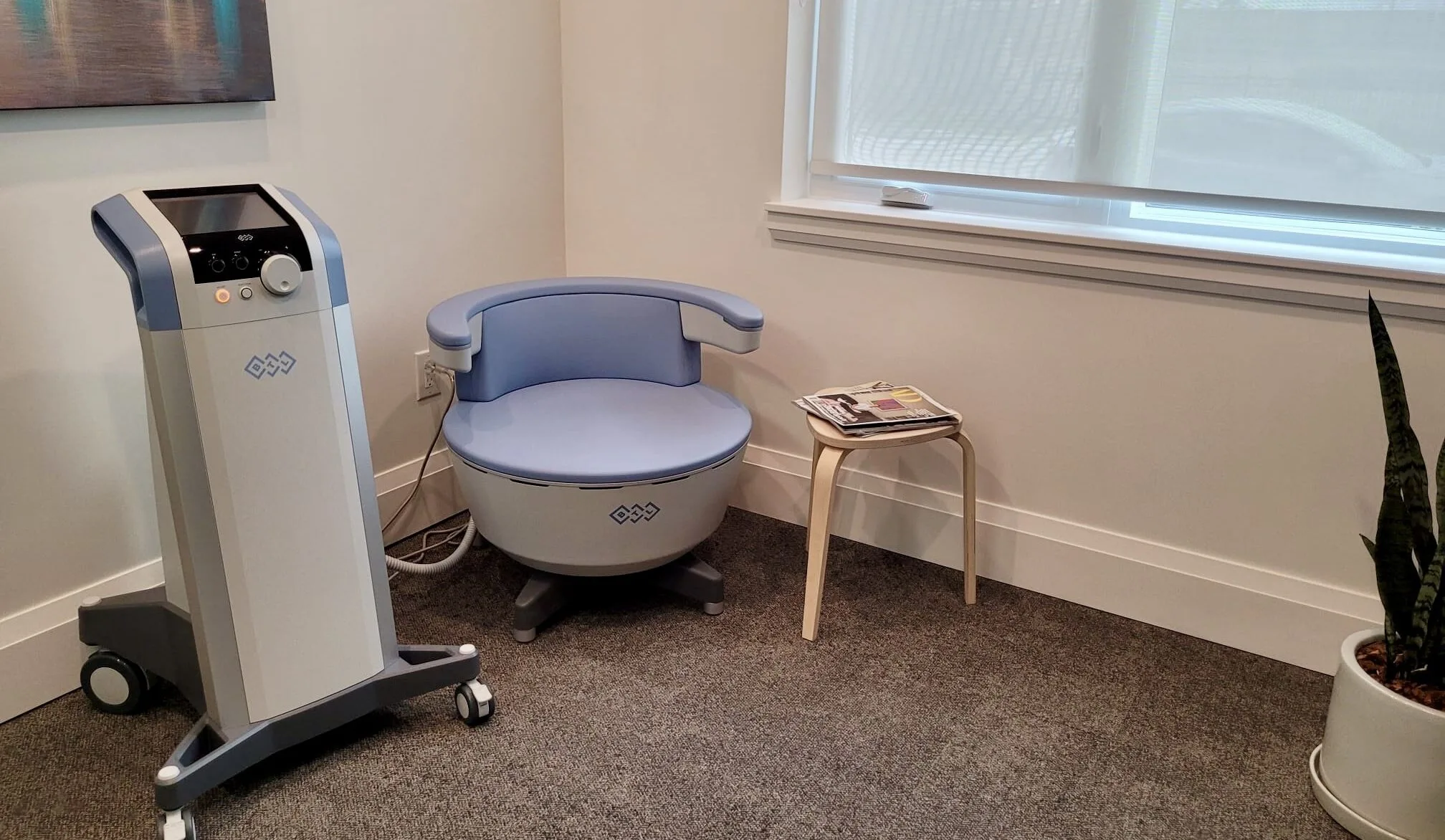 Emsella treatment room, where the vulnerability window closes
What is happening: Your CRM is sending "Thank you for your inquiry. Our team will contact you within 24 hours." That is a corporate trust killer in any vertical. For Emsella it is fatal.
Why it fails: The patient just disclosed a medical and emotional vulnerability. The "we will contact you in 24 hours" line confirms her worst internal narrative: that she is one of many, that her problem is routine paperwork, that no one is actually paying attention. Her finger is already over the close-tab gesture.
The fix: Write an SMS that does five specific things in under 320 characters.
- Names a real human at your clinic by first name.
- Explicitly validates the courage of the action without being saccharine.
- Removes the most common fear (the exam, being seen, being judged) in one sentence.
- Hands her control via a calendar booking link.
- Closes with a low-pressure line that does not promise a sales call.
Bad SMS (loses 30 to 50% of leads):
"Your Emsella inquiry has been received. Our team will contact you within 24 hours."
Good SMS (converts at 2 to 3 times the rate):
"Hi [Name], this is Sarah at [Clinic]. We just got your message and I wanted to reach out right away. I know this kind of inquiry can feel uncomfortable to send. The Emsella treatment is fully clothed, 28 minutes, no exam. I will call you in the morning, or grab any time on my calendar that feels easy: [Link]. No scripts, no pressure."
The "fully clothed, 28 minutes, no exam" line is the single highest-converting phrase we have tested in Emsella copy, because it answers the unasked question every woman is sitting with: what will I have to take off in front of a stranger.
This is the same principle covered in our breakdown of the BTL Emsella marketing mistakes that keep schedules empty. The clinics that fix tone in the first SMS recover the leads the rest of the market loses.
Action Step: Open your CRM right now. Read your current Emsella autoresponder out loud as if you were the patient. If it sounds like a receipt, rewrite it before Monday. Use the structure above and put a real first name in the From field, not "The Team."
How Fast Does the Human Callback Need to Happen, and Who Should Make It?
The SMS holds the window open. The human voice closes it.
What is happening: Your front desk picks up Emsella inquiries between other tasks, sometimes 2 hours later, sometimes the next morning, depending on volume. The call is professional but generic.
Why it fails: Two compounding problems. First, the delay itself: by the time someone calls, the patient has talked herself out of two-thirds of the conversation. Second, the wrong person is calling. A receptionist trained to schedule cleanings or aesthetic consults is not equipped to validate a woman who is on the verge of canceling her own decision.
The MIT and InsideSales benchmark data is unambiguous: a 5-minute callback converts at roughly 21 times the rate of a 30-minute callback, and the first clinic to make contact wins 78% of the time. Those numbers were collected across industries. For Emsella we see the multiplier effect compound further because the alternative for the patient is not a competitor, it is silence.
The fix: Designate one human as your Emsella Care Coordinator and protect her schedule.
She should:
- Sit close to the inbound channel during business hours.
- Have authority to schedule consults without checking with anyone.
- Be trained on the objection handling library for the $1,800 to $2,400 package conversation, not just on calendar logistics.
- Open every callback with a 15-second validation, not a clinical screening.
The opening line that converts:
"Hi [Name], this is Sarah from [Clinic]. I just saw your message come in and I wanted to call right away because I know reaching out about this takes courage. Did I catch you at an okay time?"
That sentence does three jobs at once. It signals speed (she just saw the message). It validates the courage. It hands the patient control over whether the conversation continues. Compare it to "Hi, this is Sarah from [Clinic], I am calling about your inquiry, do you have a few minutes?" The second version is clinically correct and emotionally tone-deaf.
Action Step: Identify one staff member this week and assign her the Emsella Care Coordinator role. Block 90 minutes per day on her calendar specifically for Emsella callbacks. Train her on the validation opening above before she takes the next call.
What Does the Full 7-Touch Follow-Up Sequence Look Like?
Most clinics give up at touch 3. The Emsella patient often books at touch 5, 6, or 7 because the shame loop runs on a longer timeline than a buying decision.
What is happening: The patient does not answer Day 1. The Care Coordinator leaves one voicemail, sends one email, and marks the lead "unresponsive" by Day 4.
Why it fails: Silence on Day 1 is almost never a no. It is the patient retreating into her shame wall to process the fact that she actually filled out the form. She will read every text, listen to every voicemail, open every email. She just cannot respond yet. If your sequence ends on Day 4, you abandon her exactly when she would have come back to you.
The fix: Run a structured 7-touch cadence over 21 days. Persistent without being pushy. Empathetic without being saccharine.
| Touch | Day | Channel | Message Purpose |
|---|---|---|---|
| 1 | Min 0 | SMS | Validate courage, offer calendar link, remove exam fear |
| 2 | Min 5 (business hrs) | Phone | Live call, validation opening, soft consult booking |
| 3 | Hour 6 | FAQ on what the session feels like, FDA clearance reference, direct cell | |
| 4 | Day 2 | Phone + SMS | Warm voicemail, light SMS check-in, no urgency language |
| 5 | Day 4 | Treatment room photo, 60-second patient testimonial, no sales ask | |
| 6 | Day 7 | SMS | Respectful close, save the number, door stays open |
| 7 | Day 21 | SMS or email | Seasonal hook, low-pressure invitation back |
We see Emsella patients respond to Touch 5 (Day 4 educational email) and Touch 7 (Day 21 seasonal hook) at meaningfully higher rates than the comparable cadence in ketamine or TMS funnels. The reason is the timeline of shame resolution. She needed those extra weeks to convince herself that calling you was not a moral failing.
The Day 7 message is the most underrated asset in the entire sequence. The exact phrasing matters:
"Hi [Name], we have not connected yet, so I am going to stop reaching out. Save this number though. Whenever you are ready, we are here. No pressure, no judgment."
That message routinely produces replies along the lines of "I am so sorry, this has been a hard week, can I call you tomorrow?" The patient is not gone. She is processing.
This same persistence philosophy underpins how we build the end-to-end Emsella patient acquisition cost model: a clinic that abandons leads on Day 4 has a CAC of $300, a clinic that runs the full 21-day sequence has a CAC of $140 because the recovered leads come at zero additional ad cost.
Action Step: Map your current follow-up sequence on a whiteboard. If you have fewer than 6 touches across 21 days, build the missing ones today. The Day 7 and Day 21 messages take 10 minutes to write and recover patients you currently consider lost.
Are Missed Phone Calls the Biggest Hidden Leak in Your Funnel?
If a patient calls your main line and reaches voicemail, the Vulnerability Window does not close. It evaporates.
What is happening: Your main clinic line rings 4 to 6 times during a busy moment, the call rolls to voicemail, the patient does not leave a message, and your team never knows she called.
Why it fails: A patient who finally found the courage to call about incontinence interprets a voicemail as a verdict. Her internal voice says "they are too busy, my problem is not important, this was a mistake." The next clinic she calls has a 90% chance of getting the booking, regardless of whether they are actually better than you.
Industry benchmarks across small medical practices show 20 to 30% of inbound leads die at the missed-call stage. For Emsella we expect the loss rate to run higher because the caller's emotional state is more fragile than in routine medical inquiries.
The fix: Two mechanical components, no human discretion required.
- Automated missed-call SMS within 30 seconds. Tools like Twilio, Telnyx, or your VoIP provider can fire an SMS the moment a call rolls to voicemail without a message left. Sample: "Hi, we just missed your call at [Clinic]. Text or call this number back, this is my direct line. I will pick up. Sarah." The "this is my direct line" framing is the conversion lever.
- Human callback inside 3 minutes. Your Care Coordinator returns the call from her direct extension before the patient has time to dial the next clinic.
Together these two steps recover most of the missed-call leak. The first step costs $20 a month in tooling. The second step costs whatever you already pay your Care Coordinator. Neither requires more leads.
For deeper context on how this ties to local search behavior (since "near me" Emsella searches are dominated by direct phone clicks), see our breakdown of Emsella Google Maps and local SEO strategy.
Action Step: Call your own clinic main line three times this week at random hours. Track how many calls reach a human within 4 rings, how many roll to voicemail, and whether any automated SMS fires. If the answer is "we have no idea," that is your leak.
How Does the Inquiry Form Itself Affect the Vulnerability Window?
The form is not a data-capture tool. It is a trust contract.
What is happening: Your /emsella consult page form has 9 fields, asks for date of birth and insurance information, and sits below the fold of the landing page.
Why it fails: Every additional field is an off-ramp. A patient in a fragile decision state will abandon a 9-field form at roughly 3 times the rate of a 4-field form. Asking for insurance information when Emsella is a cash-pay service signals that the clinic does not actually understand the product, which is a small but measurable trust hit. Burying the form below the fold tells her your sales process matters more than her time.
The fix: Strip the form to 4 fields: First name, last name, email, mobile phone. Move it above the fold. Make the submit button copy explicit and human. "Send my message securely" or "Talk to Sarah" outperforms "Submit" or "Request Consultation" by a meaningful margin.
The confirmation page after submit is equally important. Replace the generic "Thank you, we will be in touch" page with an immediate calendar booking widget, the same first SMS preview, and one sentence reassurance: "Your message went through. Sarah will text you in the next 60 seconds. If you would rather pick a time yourself, here is her calendar."
That confirmation page recovers patients who would otherwise close the tab and re-question the decision.
Action Step: Open your /emsella page on your phone right now. Time how long it takes to find the form. Count the fields. If it is more than 4 fields or below the fold, that is your fix this week.
Where Does Speed-to-Lead Sit in the Larger Emsella Funnel?
Speed-to-lead is the first mile of Emsella patient acquisition. The full funnel runs longer than most clinics map.
What is happening: You optimize ad spend, landing pages, and consult scripts independently. Speed-to-lead lives somewhere in operations, not in marketing.
Why it fails: The funnel is a chain. The strongest ad in the world produces zero patients if your response time is 4 hours. Conversely, a 60-second response system on top of mediocre ads outperforms a beautiful campaign with a 24-hour response delay. Speed is the multiplier on every other investment.
The fix: Map your funnel as a sequence and put a real-time number on each stage.
- Ad impression → click-through rate (CTR)
- Landing page view → form submission rate
- Form submission → first SMS sent (target: 60 seconds)
- First SMS → human callback (target: 5 minutes)
- Human callback → consult booked (target: 65 to 80%)
- Consult booked → consult attended (target: 80%+ show rate)
- Consult attended → package purchased (target: 65 to 80%)
For each stage, the speed-to-lead system specifically influences stages 3 through 5. Those three stages are where most clinics quietly lose 50% of their pipeline without ever knowing.
The cross-functional view shows up in our other batch posts. The Google Ads Complete Guide for Emsella Clinics covers stages 1 and 2. The objection handling guide covers stage 7. This post covers the operational middle that ties them together.
Action Step: Build a 7-stage funnel dashboard for your Emsella service line. Pull the actual numbers for the last 30 days. The stage with the worst conversion rate is your fix list, in priority order.
What Should You Audit This Week to Find Your Speed Leak?
Before you spend another dollar on Emsella ads, audit your response system. Most clinics losing patients are not losing them to insufficient lead volume. They are losing them to operational failure on leads they already have.
The 5-step audit:
- Submit a fake Emsella inquiry on your own website Friday at 6:30 PM. Use a real phone number you can monitor.
- Time every response. First SMS, first email, first phone call. Note the exact minute on each.
- Grade the tone. Read each message out loud. Does it validate her courage, name a human, remove the exam fear? Or does it feel like a receipt?
- Test the missed-call path. Call your main line during a busy hour. Let it roll to voicemail without leaving a message. Track whether any SMS fires and whether anyone calls you back inside 3 minutes.
- Calculate the revenue loss. If you generate 30 Emsella inquiries per month and your best-case package value is $2,400, even a 25% improvement in lead-to-consult conversion is $18,000 in monthly revenue you are currently leaving on the table.
That audit takes 90 minutes. The fixes take 1 to 2 weeks. The ROI lands inside the next billing cycle.
If you want help installing the full speed-to-lead system, the missed-call recovery automation, the 7-touch follow-up cadence, and the Care Coordinator training package into your existing CRM, book a strategy call and we will run your numbers and show you the exact gaps in your funnel before we ever quote a service.
Read Next
- 7 BTL Emsella Marketing Mistakes That Keep Your Schedule Empty - The acquisition gaps that compound with slow response times
- Emsella Sales Objection Handling: Close the $2,400 Package - What the consult conversation actually needs to do once speed gets her on the phone
- Emsella Patient Acquisition Cost: The Real CAC Numbers - Why a 21-day follow-up cadence cuts your CAC in half