TL;DR
- A new BTL Emsella chair costs $155,000 to $195,000 in the U.S. (BTL dealer quotes, 2025 to 2026), with all-in CAPEX closer to $180,000 to $210,000 once you add freight, install, and provider training.
- Six-session packages price at $1,800 to $3,000 ($1,800 to $2,400 most common). Single trial sessions run $250 to $500. Maintenance sessions add $300 to $400 per visit, every 3 to 12 months.
- Most clinics break even in 6 to 12 months at moderate utilization. Underperforming clinics drift to 18 to 24 months - not because the chair fails, but because the schedule does.
- Hitting 12-month payback requires roughly 50+ sessions per week. The chair physically supports 80+. The bottleneck is patients, not equipment.
- Insurance does not cover Emsella in 2026. That is a feature for clinic margins: cash-pay collections are immediate and full-margin.
- Three failure modes account for nearly every missed payback: no patient acquisition system, undertrained staff, no package-conversion process at consult.
- FDA-cleared November 2018 (510(k) K181497) under 21 CFR 876.5320 as a Class II nonimplanted electrical continence device. The device delivers approximately 11,200 supramaximal contractions in a single 28-minute session.
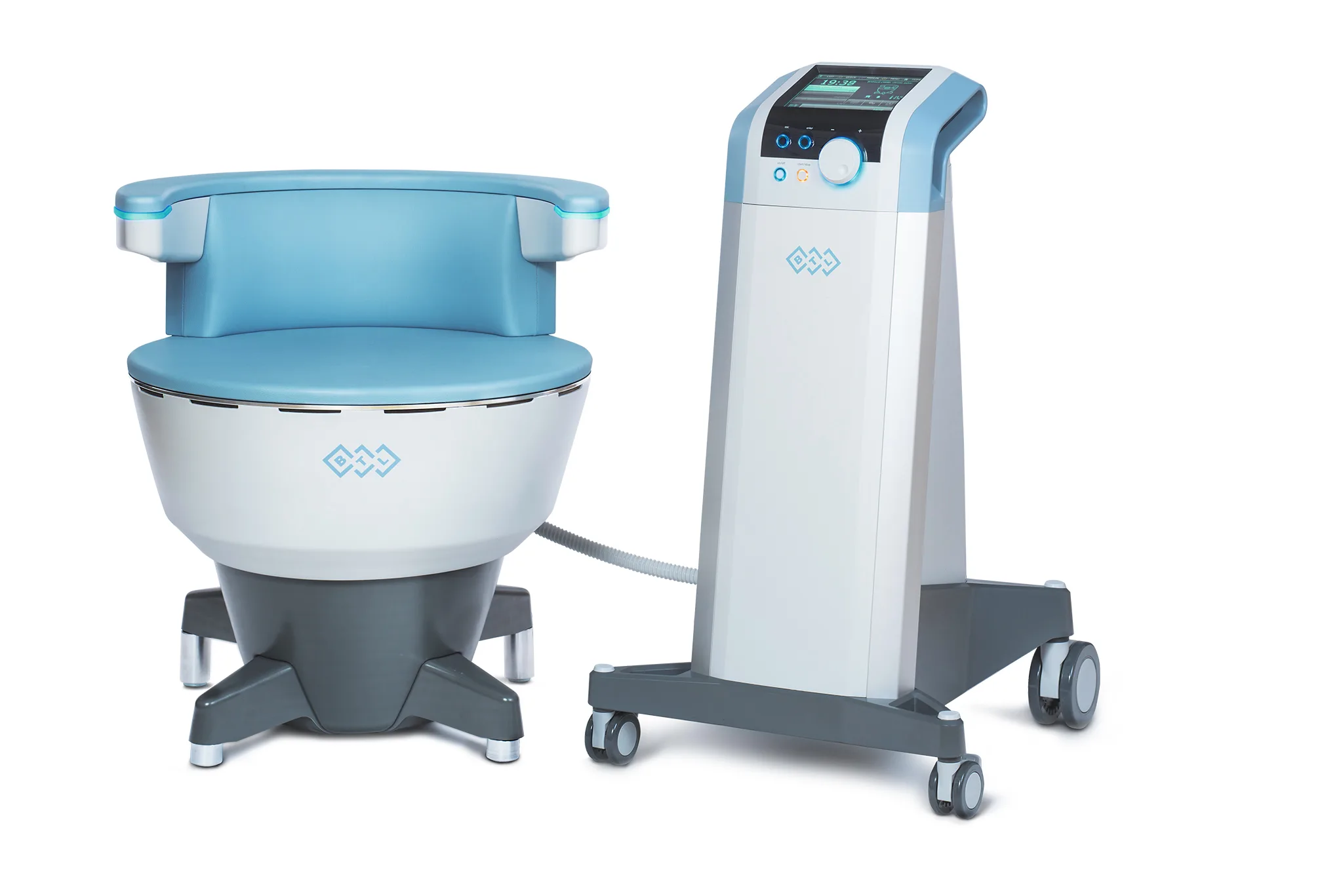 BTL Emsella chair, the FDA-cleared pelvic floor device
Most clinic owners buy the BTL Emsella chair the same way: they see the Samuels et al. (2019) data showing 95% of patients report improved quality of life after six sessions, they get quoted $175,000 by the regional BTL rep, and they sign because the clinical case is undeniable.
Then they spend the next 12 months wondering why payback feels further away than the day they wrote the check.
The technology works. The patients are real. The problem is the gap between what the spec sheet promises and what an actual schedule delivers. A chair that can run 14 sessions a day usually runs 4. A package priced at $2,400 closes at trial-session price 60% of the time. And the marketing strategy that was supposed to fill the schedule turns out to be "we'll send an email to our existing list."
This guide is the math, the assumptions, and the levers - written for clinic owners who want to know exactly when their Emsella chair becomes pure profit, before they sign anything or, more often, after they already did.
What Does an Emsella Chair Actually Cost a Clinic?
The number on the BTL quote is not the number you spend.
What's happening: A regional BTL representative quotes you $175,000 for a new Emsella chair. You assume that is the full CAPEX figure for your business plan.
Why it fails: The quote is the device only. Real CAPEX includes freight, white-glove installation, the BTL Aesthetic Academy provider training course, room buildout (you need a private treatment room with an outlet that can handle the load), and either upfront purchase or financed monthly payments for 36 to 60 months. New BTL Emsella units in the U.S. quote between $155,000 and $195,000 in 2025 to 2026, depending on region, dealer, and bundled service package. Some sources reference a $60,000 to $80,000 alternative figure for a base unit; in practice, that number is rarely available outside of specific market promotions.
The refurbished market lists units as low as $27,975 to $50,878 - but BTL typically requires a recertification fee of $20,000 to $35,000 before they will sell consumables or provide support to a non-original buyer. A "cheap" refurbished chair is almost never cheap.
The fix: Build your CAPEX line at $190,000 to $210,000 all-in for a new chair, or $70,000 to $100,000 for refurbished after recertification. Anything you save on the device, budget toward marketing - that is the line item that actually determines payback.
Action Step: Before you sign, request the full quote in writing including freight, installation, training, warranty, and any required licensing fees. Ask specifically: "What is the total cash out-of-pocket in year one if I take delivery in the next 60 days?" If the rep cannot answer in one number, you do not have a complete quote yet.
How Much Revenue Does Each Emsella Session Actually Generate?
Per-session pricing is the headline. Per-cycle revenue is the business.
What's happening: You see "$300 per session" advertised at competitor clinics and you assume your revenue model is $300 per appointment slot.
Why it fails: Single sessions are loss leaders. The Emsella protocol is built around six sessions delivered twice per week over three weeks, and that protocol is what drives the 95% quality-of-life improvement reported in the Samuels et al. (2019) multicenter study. Patients who buy a single session and never return are clinically and financially a worse outcome than patients who never started.
What clinics actually charge in 2026:
- Trial / introductory single session: $250 to $500
- Complete six-session package: $1,800 to $3,000 (most commonly $1,800 to $2,400)
- Maintenance sessions (every 3 to 12 months post-protocol): $300 to $400
That maintenance line is the part most business plans ignore, and it is the difference between a 12-month payback and a 6-month payback.
 Emsella session: fully clothed, 28 minutes, 11,200 contractions
A patient who completes the six-session protocol and returns twice a year for maintenance is worth roughly $3,000 to $3,400 in lifetime revenue. The same patient, treated as a six-session transaction, is worth $2,100.
Emsella session: fully clothed, 28 minutes, 11,200 contractions
A patient who completes the six-session protocol and returns twice a year for maintenance is worth roughly $3,000 to $3,400 in lifetime revenue. The same patient, treated as a six-session transaction, is worth $2,100.
The fix: Price and market the package, not the session. The trial session exists to convert into the package - its job is sensation testing and price-point reassurance, not revenue. Build a separate maintenance funnel for completed patients and run it every 90 days.
Action Step: Calculate your blended average revenue per patient cycle. Take your last 20 Emsella patients (or your projection if you are pre-launch), add up their total revenue including maintenance visits, and divide by 20. If that number is under $1,800, your conversion process from trial to package is broken.
What's the Real Break-Even Math?
This is the math nobody runs before buying the chair, and the math everyone wishes they had run.
What's happening: Your business plan models break-even at "8 patients per month" and assumes everything works.
Why it fails: The 28-minute session length means each chair-hour can serve roughly two patients. So 8 patients per month is 24 sessions, or roughly 3 hours of actual chair time per week. At a $300 average per-session price, that is $7,200 per month in revenue. Against a $190,000 CAPEX, payback at $7,200 per month takes 26 months - and that is before consumables, room rent, staff time, marketing spend, and financing interest.
The honest break-even math:
| Payback target | Monthly revenue needed | Sessions/week | Chair-hours/week |
|---|---|---|---|
| 24 months | $7,900 | ~26 | ~13 |
| 18 months | $10,500 | ~35 | ~18 |
| 12 months | $15,800 | ~52 | ~26 |
| 9 months | $21,100 | ~70 | ~35 |
| 6 months | $31,700 | ~105 | ~53 |
The chair physically supports 80 to 100+ sessions per week if scheduled at full capacity (10 hours per day, two patients per hour). The clinics hitting 6 to 9 month payback are not running a different machine. They are filling the schedule.
The fix: Pick your target payback window, work backward to the weekly session count, then ask the only question that matters: what is your patient acquisition plan to hit that weekly volume by month 3?
If the answer is "we'll put it on our website and email our list," your payback is 24 months. If the answer is a paid acquisition channel with a defined cost per acquired patient (CPA) and a converting consult process, you have a real plan.
Action Step: Open a spreadsheet today. List your current weekly patient flow, the percentage you can realistically convert to Emsella consults, and your conversion rate from consult to package. Multiply through. If the result is less than 20 booked sessions per week by month 3, you need a paid acquisition channel before you take delivery - not after.
Why Most Clinics Miss Their Payback Window
Three patterns. Same outcome.
What's happening: The chair sits in a treatment room, scheduled 4 to 6 sessions per week, while the rest of the practice carries the financing payment.
Why it fails: It is almost never the device. It is one of three failure modes, and most underperforming clinics have all three:
1. No patient acquisition system. Word-of-mouth and existing-patient referrals can sustain a busy hair removal laser. They cannot fill an Emsella chair, because the patient profile (women aged 40 to 70 with stress, urge, or mixed urinary incontinence; men post-prostate surgery) is not the same patient profile that fills your aesthetic schedule. Without a paid acquisition channel - Meta, Google Ads, or local outreach to OB-GYN and urology referral sources - you will plateau at 4 to 8 sessions per week and stay there.
2. Undertrained staff. BTL's own provider enablement materials emphasize that "incorrect technique = weaker results." Clinics that skip the BTL Aesthetic Academy training course or assign Emsella to a rotating roster of medical assistants see worse outcomes, more drop-offs mid-protocol, and lower NPS - which kills the referral and review engine. Train one person well and protect their schedule.
3. No package conversion process at consult. A patient walks in for a $300 trial session, feels the contractions, and asks "do you have a package?" If your answer is "yes, it's $2,400" with no framing, no payment plan, no risk reversal, and no package-day discount, you will close 30 to 40%. With a designed consult process, that number lifts to 65 to 80%. The math difference is enormous: a $2,400 package at 70% close rate is $1,680 expected revenue per trial. At 35% close rate it is $840.
The fix: Audit your last 30 trial sessions. Check three numbers: how many came from a paid channel, how many were performed by a certified provider, how many converted to a package within 14 days. If any one of those numbers is under 50%, that is your highest-leverage fix.
Action Step: Pick the weakest of the three failure modes and fix it this month. If patient acquisition is broken, allocate $2,500 to $5,000 to a 60-day paid Meta or Google test before you do anything else. If conversion is broken, write the consult script and rehearse it before next Monday.
How Do You Model Your Specific Clinic's Payback?
Generic ROI calculators lie. Yours has six inputs.
What's happening: You are using BTL's marketing ROI calculator or a generic spreadsheet that assumes industry-average everything.
Why it fails: The inputs that move payback by 6 to 12 months are local to your clinic: your average package price, your trial-to-package conversion rate, your maintenance return rate, your CPA on paid acquisition, your show rate on booked appointments, and your provider utilization. Industry averages mask the gap between a great clinic and a struggling one.
The fix: Build your own model with these six inputs, and update it monthly:
- Average package price (your blended sale price across single sessions, packages, and maintenance - pull from last 30 days of POS data)
- Trial-to-package conversion rate (what % of trial-session patients buy the six-session package within 14 days)
- Show rate (what % of booked Emsella consults actually arrive - typically 65 to 85%)
- Maintenance return rate (what % of completed-protocol patients return for at least one maintenance session within 12 months - typically 30 to 55%)
- Cost per acquired patient (CPA) on paid channels (Meta, Google, referrals)
- Provider utilization (what % of available chair-hours are booked vs. open)
Plug those into a spreadsheet that calculates monthly contribution margin, then divide your $190,000 CAPEX by that monthly margin. That is your real payback period. Update it every 30 days. The clinics that hit 6 to 9 month payback are the ones that look at this number weekly and treat it like the metric it is.
Action Step: Build the spreadsheet today, even if you have to estimate the inputs. The act of writing each number down forces a clarity that "the chair will pay for itself" never delivers.
When Is Leasing Better Than Buying?
Cash flow versus total cost. The math is unambiguous if you actually run it.
What's happening: Your accountant pushes you toward a 60-month lease because monthly cash flow looks better and "the lease is tax-deductible."
Why it fails: Leases preserve cash flow but add 15 to 30% to total cost over the term, depending on residual value and rate. For comparable BTL devices, used Emsculpt Neo lease pricing data shows monthly payments ranging from $1,054 (60-month term, low end) to $6,571 (24-month term, high end) - the long-term, low-monthly-payment option costs significantly more in total. The decision is not "lease vs. buy" in the abstract. It is "cash flow risk vs. total dollars."
The fix: Lease if any of the following are true:
- Projected first-12-months patient volume is under 60 completed cycles
- You do not have $50,000+ available to deploy on patient acquisition immediately
- You are testing the Emsella addition before committing fully to the service line
Buy if all of the following are true:
- You have a working patient acquisition channel with a known CPA
- You can model 100+ cycles in year one with confidence
- You have 6+ months of operating runway independent of the chair
The break-even between lease and buy lands at roughly 8 booked cycles per month, sustained over the lease term. Below that, leasing protects you from a worst-case scenario. Above that, buying outright lowers your cost per patient cycle for the lifetime of the chair.
Action Step: Get both quotes - lease and buy - from your BTL rep, and run both through your spreadsheet model. Do not let the rep frame the decision. Frame it yourself.
What Are the Hidden Costs Nobody Mentions?
The line items that erode payback if you do not budget them upfront.
What's happening: Your CAPEX line says $190,000 and your business plan stops there.
Why it fails: The recurring costs that nobody surfaces in the sales conversation:
- Provider training and certification: BTL Aesthetic Academy course, plus refreshers if you rotate staff. Budget $2,000 to $5,000 in year one.
- Room buildout: Private treatment room, appropriate electrical load, comfortable seating area for the 28-minute session. $3,000 to $15,000 if you need to convert existing space.
- Marketing budget: The line item that determines whether the chair pays back in 9 months or 24. Budget a minimum of $3,000 to $5,000 per month from launch through month 6, scaling with bookings.
- Reputation management: Review generation, before/after photo workflows, social proof. $200 to $500 per month for tooling and labor.
- Maintenance and consumables: Routine BTL service contract, replacement parts after warranty. $1,500 to $4,000 per year.
- Staff time for trial-to-package conversion: Dedicated consult time, follow-up calls, package paperwork. Real labor cost, often invisible in P&L until you measure it.
The fix: Add a "Year One Operating" line of $50,000 to $80,000 to your business plan beneath the CAPEX. That is the realistic floor for running the service properly. Clinics that skip this line because the chair "will pay for itself" are the same clinics that drift to 24-month payback.
Action Step: Total up your actual year-one operating budget for the Emsella service line, separate from the chair purchase. If it is under $40,000, you are underfunding the channel that determines whether the chair pays back at all.
BONUS: When the Chair Pays Itself Back Faster
Three levers that compress payback from 12 months to 6.
The men's market. Emsella is FDA-cleared for male urinary incontinence (specifically post-prostate surgery), and the device is also commonly used off-label for erectile dysfunction. Most aesthetic-focused clinics ignore this entire patient pool. A urology referral relationship and a dedicated men's-health page on your website can add 15 to 25% to monthly volume without additional ad spend.
Bundled "Core to Floor" or pelvic-health packages. If you also run an Emsculpt Neo, Exion, or Emtone chair, bundled packages price at $5,000 to $7,000 per cycle and lift average revenue per patient by 2 to 3x. Same chair time, more revenue per patient.
Maintenance as a subscription. Move completed-protocol patients into a quarterly maintenance schedule with auto-billing. Even at 35% adoption, this adds $400 to $800 per patient per year and converts a one-time transaction into a recurring revenue stream.
Action Step: Pick one of the three levers above and pilot it in the next 60 days. Do not pilot all three at once - measure cleanly, then expand.
BONUS: The Insurance Reality (And Why It's Actually Good for You)
Emsella is not covered by insurance in 2026, and this is a feature, not a bug.
The American Urological Association (AUA) and CMS classify electromagnetic pelvic floor stimulation as "investigational" - which prevents reimbursement but also means you operate on cash-pay terms exclusively. That means:
- No claim cycle, no denials, no rebilling. Revenue lands in your account within 1 to 3 days, not 60 to 90.
- No insurance fee schedule cap on what you can charge. Pricing is set by the market and your positioning, not by Medicare's RVU table.
- No prior authorization, no documentation requirements, no audit risk. The compliance overhead of insurance-billed services is not on your books.
The cash-pay model also self-selects for committed patients. Patients who write a check for $2,400 are more likely to complete the full six-session protocol, generate referrals, and return for maintenance - exactly the behaviors that drive lifetime revenue per patient.
Action Step: Stop apologizing for the cash-pay model in your consult. Frame it as a feature: no waiting on insurance, no surprise denials, the full course is paid up front and yours to complete.
What Should You Do This Week?
If you have not bought the chair yet:
- Get a complete written quote - device, freight, install, training, warranty, all-in.
- Build the six-input payback spreadsheet before you sign.
- Allocate a real year-one marketing budget separate from CAPEX.
If you already own the chair and payback is slipping:
- Audit your last 30 trial sessions across the three failure modes (acquisition, training, conversion).
- Fix the weakest one first. Allocate $2,500 to $5,000 to a 60-day paid acquisition test if that is the bottleneck.
- Add a maintenance funnel for completed patients. This is the highest-leverage fix that nobody runs.
The Emsella chair is one of the best-performing pelvic health devices on the market clinically, and one of the most-mismanaged business assets in clinic ownership. The clinical case is closed. The business case is up to you.
Book a free Emsella growth strategy call and we will run your numbers with you, audit your acquisition channel, and map the fastest path to break-even.
Read Next
- 7 BTL Emsella Marketing Mistakes That Keep Your Schedule Empty - The acquisition gap that determines payback
- Emsella Patient Acquisition Cost: The Real Numbers - CPA benchmarks for paid and organic channels
- Google Ads for Emsella Clinics: The Complete 2026 Guide - Keywords, budgets, and landing page strategy