TL;DR
- Sell the life, not the technology. Patients searching for incontinence relief do not care about HIFEM specs. They care about laughing, jumping, and sleeping through the night. Outcome-led copy lifts form submissions 30 to 50%.
- Treat Emsella as a six-session protocol, not a trial-session product. The 95% quality-of-life data sits at the protocol dose. Marketing the trial as the offer trains buyers to undervalue the package.
- Send paid traffic to a dedicated Emsella landing page. Per the Unbounce Conversion Benchmark Report, dedicated landing pages dramatically outperform homepages for paid traffic.
- Show the price. Modern healthcare buyers want transparency. Hidden pricing drives drop-off and selects for tire-kickers, not buyers. The MedSpa CRO case study at Conversion Wise documented a 700% lead lift when a medspa added pricing transparency and clarified its core offer.
- Build a 7-touch follow-up sequence. 33.3% of women cite embarrassment as the primary barrier to treatment. "Let me think about it" is fear, not rejection.
- Speed-to-lead matters more here than in any other vertical. The MIT/InsideSales.com data shows the first business to respond wins 78% of the time and 5-minute response is 21x more qualified than 30-minute response.
- Stop ignoring the men's post-prostatectomy market. It is FDA-cleared, under-marketed, and converts faster than the female aesthetic buyer.
- Reviews and Google Business Profile are non-negotiable. 94% of patients check reviews and 99.5% never click past page 1 of Google.
Most BTL Emsella clinics are running ads. Most BTL Emsella clinics still have a half-empty schedule. Both things are true at the same time, and the gap between them is not the device, the price, or the market. It is the marketing.
The clinical case for Emsella is settled. Samuels et al. 2019, published in Lasers in Surgery and Medicine, reported that 95% of patients experienced improved quality of life and 75% reported significant pad-usage reduction after the standard six-session protocol. The device is FDA-cleared (510(k) K181497, November 2018) under 21 CFR 876.5320 as a Class II nonimplanted electrical continence device. The math on a fully utilized chair is real, and we covered it end-to-end in our Emsella ROI and payback guide.
What's broken is execution. Most clinics are marketing a 2026 device with a 2019 playbook, and the patient profile they are trying to reach (women aged 40 to 70 with stress, urge, or mixed urinary incontinence, plus the entirely under-served men's post-prostatectomy market) is not the same patient profile that fills an aesthetic schedule. Different buyer, different psychology, different funnel.
After auditing BTL Emsella practices across medspa, urology, gynecology, and pelvic-floor PT verticals, here are the seven marketing mistakes that show up over and over, and exactly how to fix each one.
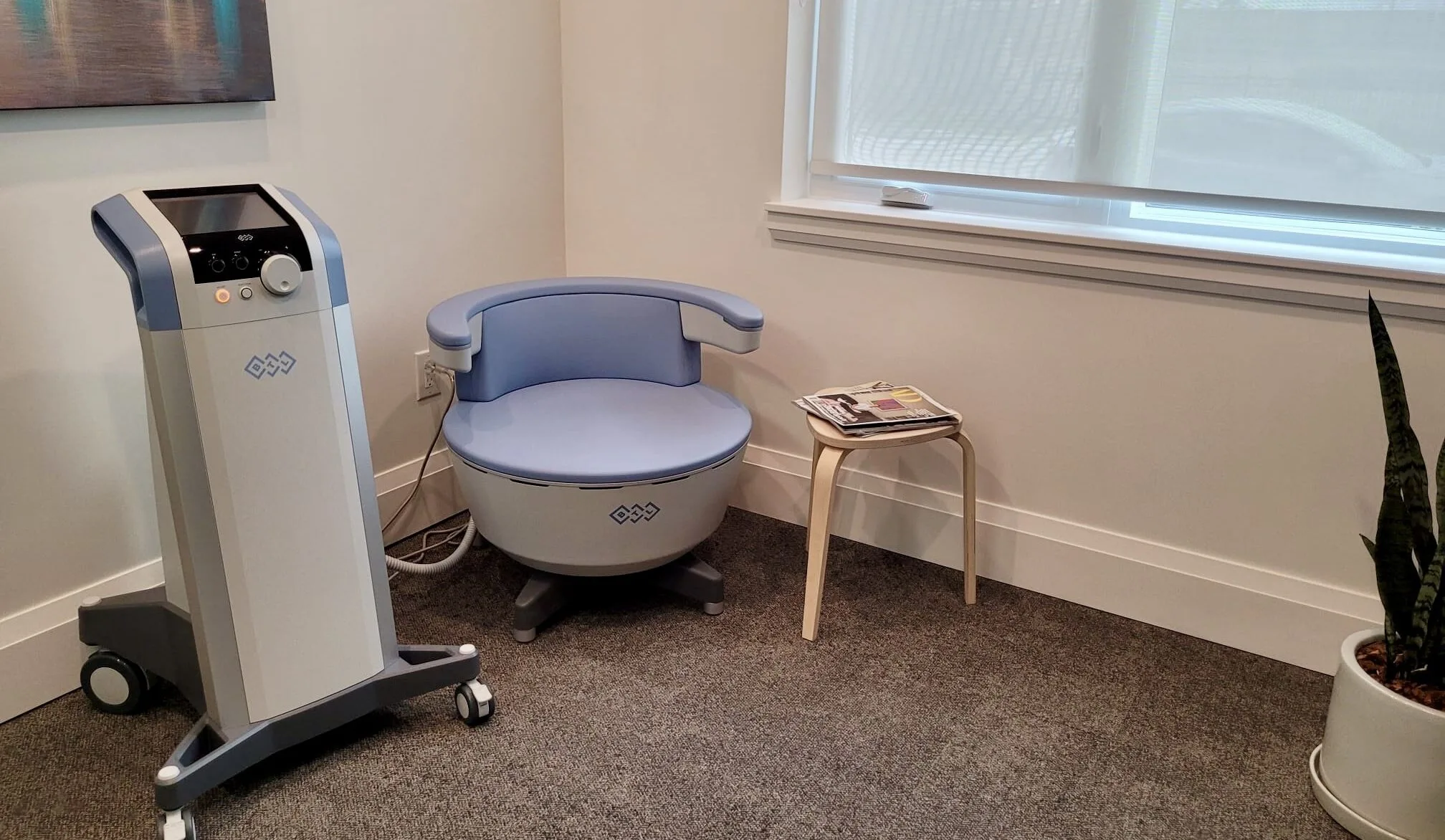 Empty Emsella treatment room, the schedule problem most clinics never fix
Are You Marketing the Technology Instead of the Life?
This is the single biggest leak in Emsella advertising. The chair is impressive, the technology is impressive, the contraction count (11,200 in 28 minutes) is impressive. None of that is what the buyer is searching for.
What's happening: Your headline reads "FDA-cleared HIFEM technology delivering 11,200 supramaximal pelvic floor contractions in a single 28-minute session." Your image is a photo of the chair. Your CTA says "Learn More."
Why it fails: A 54-year-old woman with stress urinary incontinence is not Googling "HIFEM technology." She is Googling "why do I leak when I sneeze," she is reading forum posts at 11 PM, and she has been doing this on and off for 6.5 years (the average symptom-to-treatment delay documented in pelvic health literature). She does not need a physics lecture. She needs to know that someone understands the life she has stopped living and has an answer.
The fix: Sell the vacation, not the flight. Lead with outcomes the buyer can feel.
- "Laugh again. Sneeze again. Pick up your grandkids without scanning the room for a bathroom."
- "The 28-minute appointment that lets you sleep through the night."
- "FDA-cleared pelvic floor restoration. No surgery. No exam. Stay fully clothed."
Mention the technology and the FDA clearance once, as a credibility anchor in the body. Do not lead with it.
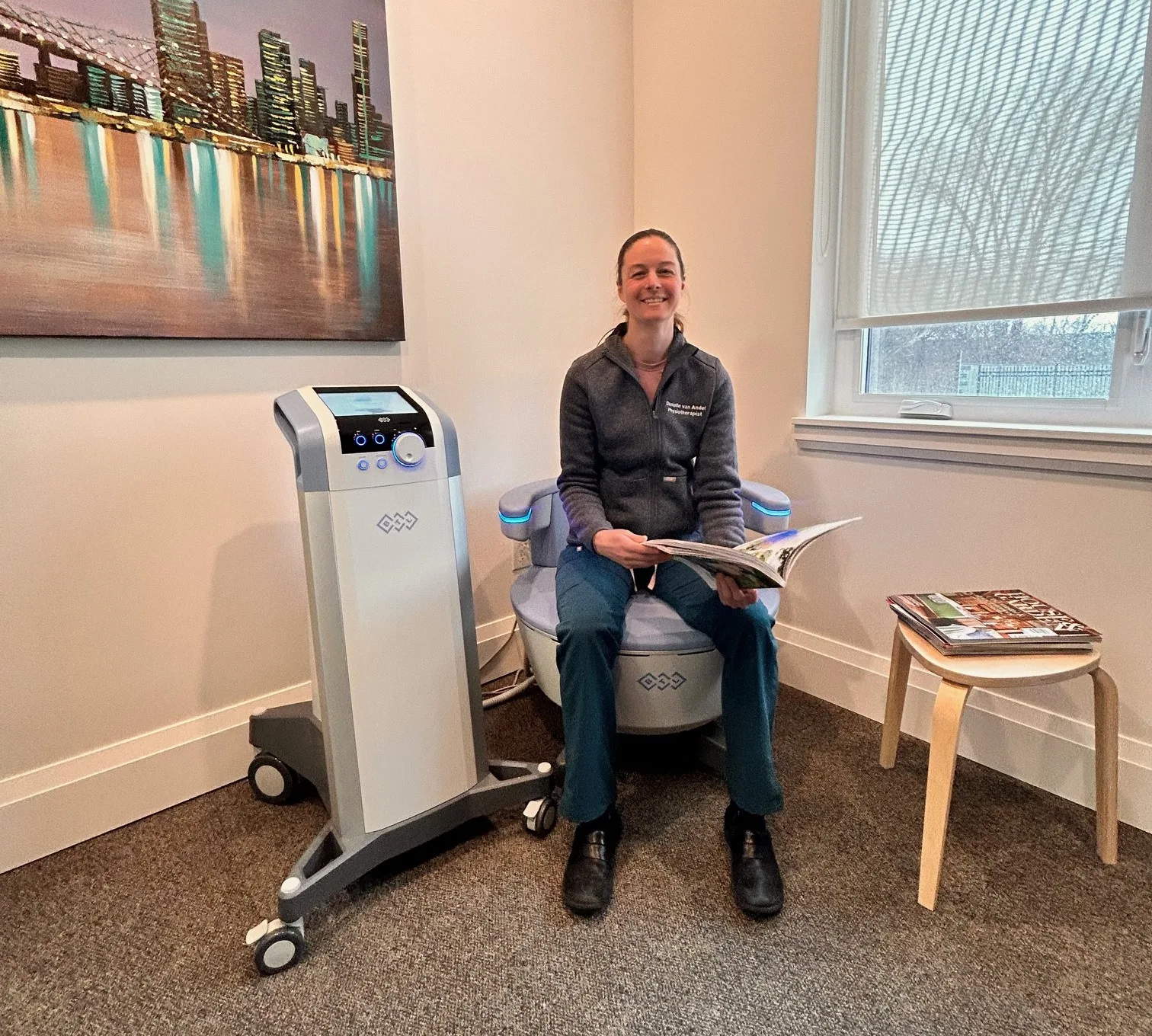 Emsella session in progress: fully clothed, comfortable, dignified
Outcome-led copy, in our advisory work and in published direct-response benchmarks, lifts form-submission rates 30 to 50% over technology-led copy on identical traffic.
Emsella session in progress: fully clothed, comfortable, dignified
Outcome-led copy, in our advisory work and in published direct-response benchmarks, lifts form-submission rates 30 to 50% over technology-led copy on identical traffic.
Action Step: Rewrite your hero headline today. Strip the words "HIFEM," "electromagnetic," and "supramaximal" from the first 200 pixels of your landing page. Replace with one sentence that names a moment in the buyer's actual life. Test for 14 days against the original.
Are You Selling Single Sessions Instead of the Six-Session Package?
The Emsella protocol is six sessions delivered twice per week over three weeks, plus maintenance. That protocol is what the clinical literature studied. That protocol is what produces the 95% quality-of-life outcome. Single sessions are demos, not products.
What's happening: Your website headline advertises "$300 Emsella Session" and your funnel is built around getting people to book a single appointment.
Why it fails: A patient who buys a single session, feels the contractions, and never returns has a worse outcome than a patient who never started. She got a sample, she got no clinical result, and she leaves with the impression that "Emsella did not work." Worse, you trained her brain to value the product at $300, which makes the $2,400 package feel like a 700% upcharge instead of the standard of care.
The fix: Lead with the package. Frame the trial as a fitting, not a treatment. We laid out the full numbers in our Emsella patient acquisition cost analysis, but the short version is this: a $2,400 package at 70% close converts a trial session into $1,680 expected revenue. The same trial at $300 walk-out value with no package conversion is a $300 transaction, and you spent $80 to $150 to acquire it.
Pricing structure that works:
| Offer | Price | Job in the funnel |
|---|---|---|
| Trial session | $250 to $500 | Sensation testing, price-point reassurance, package conversion |
| Six-session package | $1,800 to $2,400 | The product |
| Maintenance session | $300 to $400 | Recurring revenue, every 3 to 12 months |
| Core to Floor or pelvic bundle | $5,000 to $7,000 | Lifetime value lever for multi-device clinics |
Action Step: Audit your last 20 trial-session patients. What percent converted to the package within 14 days? If the number is under 50%, your funnel is built around the wrong product. Rewrite the offer page this week to lead with the package and frame the trial as a fitting.
Are Your Google Ads Landing on Your Homepage?
You are paying $3 to $12 CPM for traffic and sending it to a page that has eight navigation options, a header link to "Botox," and a footer link to your blog. That is how clinics waste $4,000 a month and call it "Google Ads."
What's happening: Your Google Ads campaign for "emsella near me" sends traffic to /index or /services, where the prospect lands, scans, gets distracted, and leaves.
Why it fails: The Unbounce Conversion Benchmark Report demonstrates that dedicated single-purpose landing pages dramatically outperform multi-navigation homepages for paid traffic. Geofenced healthcare campaigns can drive CPMs as low as $3.61 in tight local targeting, which means the cost of wasted impressions adds up fast when the landing experience is wrong. Healthcare paid search averages a 3.52% CTR, and click-to-lead rates of 3.7% are achievable on a clean Emsella landing page. Both numbers collapse on a homepage.
The fix: Build a dedicated Emsella landing page with these elements:
- One-sentence empathy headline (life outcome, not technology)
- Hero image that shows a real woman, real face, real lifestyle context (not the chair, not a stock photo of a doctor)
- Social proof block: Samuels 2019 data, FDA clearance, real review excerpts
- Package price stated openly with payment-plan option
- Single CTA repeated 3 times: "Book Your Pelvic Floor Assessment"
- No site navigation, no blog links, no footer
We covered the full architecture, including conversion-tracking and ad-copy compliance for an FDA-cleared device, in our complete 2026 Google Ads guide for Emsella clinics.
Action Step: Build the landing page this week and switch your highest-spend Emsella campaign to point at it. Measure conversion rate over 14 days against the homepage baseline. The lift is rarely subtle.
Are You Hiding the Price?
This is a holdover from old aesthetic-marketing instincts. It is wrong, and the data is no longer ambiguous.
What's happening: Your Emsella page says "Pricing available at consultation" or "Call for pricing." Your ads avoid the package number entirely.
Why it fails: Modern healthcare buyers research before they call. Hidden pricing reads as evasive, signals "expensive and they know it," and trains the prospect to expect a high-pressure sales conversation when she finally does book. The Conversion Wise medspa case study documented a 700% lift in qualified leads when a clinic added price transparency and a clarified core offer to its landing page. The buyers self-selected. The tire-kickers filtered themselves out before the consult, which lifted close rates inside the consult.
The Emsella buyer is not price-shopping for the cheapest option. She is price-validating against surgery ($6,000 to $12,000 with 18.7-day recovery and a 34.6% complication rate), against pelvic floor PT ($1,200 to $2,000 over 12 sessions), and against the cost of Tena pads forever. Show her your number and she does the math herself, in your favor.
The fix: State the package price openly. Use anchor framing.
- "Six-session Emsella protocol: $2,400. Surgery: $8,000 plus three weeks of recovery. Pelvic floor PT: $1,800 plus 12 weeks of weekly visits."
- Add a payment-plan option ($400 per month for six months, for example)
- Include an HSA/FSA-eligible note
Action Step: Today, add the package price to your Emsella landing page above the fold. If you operate in a market with three or more competitors hiding pricing, this single change typically lifts qualified consults 20 to 40% within 30 days.
Do You Have a 7-Touch Follow-Up Sequence?
This is the highest-leverage fix in Emsella marketing, and the one almost no clinic runs.
What's happening: A prospect calls, says "let me think about it," and never hears from your clinic again. No SMS, no email, no nurture sequence. You marked her "lost" in the CRM and moved on.
Why it fails: "Let me think about it" in pelvic health is almost never rejection. It is fear plus embarrassment. 75% of women with urinary incontinence suffer in silence, 33.3% cite embarrassment as the primary barrier to seeking treatment, and 41% have taken time off work due to pelvic-health issues they could not discuss. A prospect who said "let me think about it" is not a no. She is a soft maybe who needs permission and proof. We unpacked the full psychology in our Emsella consult vulnerability window guide.
Without a structured follow-up, you are confirming her belief that no one really cares about helping her. With one, 30 to 50% of soft maybes book a consult.
The fix: Build a 7-touch sequence and run it on every prospect that does not book on the first call.
- Same day, within 2 hours: SMS with a real review excerpt from a patient with the same concern. "Hi [Name], wanted to share what Linda said after her sixth session..."
- Day 2: Email with "What to Expect at Your First Emsella Session" PDF. Cover the privacy points: fully clothed, no exam, 28 minutes.
- Day 4: SMS check-in. "Still thinking about it? Happy to answer any questions, even just over text."
- Day 7: Email with a 60 to 90 second patient-story video. Real face, real voice, real outcome.
- Day 10: Phone call from the clinical lead, not the front desk. "I wanted to personally check in to see if there was anything I could clarify."
- Day 14: Email with a limited-time consult offer or fitting-session discount.
- Day 30: Re-engagement email. New patient story, new clinical update, low-pressure CTA.
Action Step: Pick the first three touches and write them today. SMS, email, SMS. Run them on the next 20 "let me think about it" prospects and measure how many book a consult inside 30 days. The number will surprise you.
Are You Marketing Only to Women Aged 50 Plus?
This is the most under-monetized blind spot in the Emsella market.
What's happening: Your ad targeting is set to women, 50 plus, with interests in menopause and pelvic health. Your imagery is exclusively female. Your landing page copy never mentions men.
Why it fails: Emsella received its FDA 510(k) clearance for "male and female urinary incontinence." The men's post-prostatectomy market (post-prostate-cancer surgery patients suffering from stress incontinence) is large, growing, and nearly entirely ignored by aesthetic-focused clinics. Off-label use for erectile dysfunction adds another adjacent demographic. Most clinics see this and assume men "won't sit in a chair," which is a 1990s assumption disproven by every urology practice currently running Emsella for prostatectomy aftercare.
The men's buyer also moves faster. Post-prostate-surgery incontinence is acute, recent, and tied to a major medical event he just survived. He is motivated, he expects to pay cash for non-covered services, and he often arrives via a urologist referral rather than a Google ad, which means lower CPA.
The fix: Build a dedicated men's-health landing page and a referral-outreach playbook for local urology, prostate-cancer-survivor groups, and men's-health practitioners. Target men aged 55 to 75 with interests in prostate cancer survivorship, men's health, and post-surgical recovery. Use male imagery, male language, and male testimonial structure.
We mapped out the full positioning differences across medspa, urology, gynecology, and pelvic-floor PT verticals in our clinic-type positioning guide. The short version: aesthetic-only positioning leaves 15 to 25% of monthly volume on the table for any clinic in a metro with at least one urology practice within 20 miles.
Action Step: This month, draft a single landing page targeting post-prostatectomy men. Allocate $500 to $1,000 to a 30-day Meta or Google test. Reach out to two urology practices in your metro and offer a referral relationship with a co-branded one-pager. The volume comes faster than you expect.
Are Your Reviews and Google Business Profile Costing You Patients?
For local pelvic-health searches, your Google Business Profile is your real homepage. A thin GBP and an absent reviews strategy make you invisible to the highest-intent prospects in your market.
What's happening: Your Google Business Profile lists "Medical Spa" as the category, has six photos from when you opened, three reviews from 2022, and never mentions Emsella by name in the description.
Why it fails: Invoca's healthcare consumer research found 94% of patients check reviews before booking. 99.5% of users never click past page 1 of Google. For a search like "emsella near me" or "incontinence treatment near me," the local 3-pack is the entire visible market. If your GBP does not list Emsella as a discrete service, does not have recent reviews mentioning Emsella by name, and does not have fresh photos and posts, you are invisible to the patients most ready to book. Google's AI Overviews now pull directly from GBP data, which compounds the problem.
We laid out the full local SEO and Google Maps playbook in our Emsella local SEO and Google Maps guide, but the basics matter most.
The fix:
- Add Emsella as a discrete service on your GBP. List it by name, with a description that includes "urinary incontinence," "pelvic floor," "FDA-cleared," and "non-surgical."
- Post weekly. A 60-second update, a patient-success quote, an educational note. Consistency matters more than length.
- Respond to every review inside 24 hours. Positive and negative. Thank, address, invite follow-up.
- Generate new reviews on a schedule. Send an SMS to every completed-package patient on the day after her final session. "Linda, congratulations on finishing your protocol. If you are open to sharing your experience, here is the link." Day-after-completion is the peak-emotion window.
- Upload fresh photos monthly. Treatment room, lobby, staff, before-and-after of the facility itself. Avoid stock imagery.
- Fill every field. Hours, services, attributes, Q&A. A complete profile outranks an incomplete one in identical local conditions.
Action Step: Log into your GBP today. Add Emsella as a service. Write a 750-character description that includes "urinary incontinence," "pelvic floor restoration," "FDA-cleared," "non-surgical," and your city. Then schedule a weekly post for the next 30 days. The compound effect on local visibility shows up inside 60 days.
BONUS: Is Your Provider Trained?
This is a marketing problem disguised as a clinical problem.
What's happening: You skipped the BTL Aesthetic Academy provider course because "the chair is operator-friendly," or you rotate Emsella across whichever medical assistant is on shift.
Why it fails: BTL's own provider enablement materials state that "incorrect technique equals weaker results." Patients who get suboptimal positioning, suboptimal intensity ramp, or suboptimal session pacing experience weaker outcomes, drop out mid-protocol, and leave neutral or negative reviews. NPS is the upstream input to reviews, referrals, and word-of-mouth, which together drive 30 to 50% of new bookings at mature Emsella practices. An untrained provider is not just a clinical leak. She is a marketing leak.
The fix: Designate one trained Emsella provider, send her through the BTL Aesthetic Academy course, and protect her schedule. Do not rotate. Train a second provider as backup, not as a regular operator. Outcomes lift, NPS lifts, reviews lift, and referrals lift. The marketing engine compounds.
Action Step: Book the BTL Aesthetic Academy training for your designated Emsella provider this month. Write the SOP for handoffs and protect the schedule.
BONUS: Where Are Your Before and After Photos?
Compliant before-and-after content is one of the highest-converting assets in pelvic-health marketing, and almost no Emsella clinic has a workflow for capturing it.
What's happening: You have no before-and-after photos because "incontinence is not a visual condition."
Why it fails: It is a quality-of-life condition, and quality-of-life is visible. The "before" is the bathroom map a patient draws of every grocery store in town. The "after" is her on her granddaughter's trampoline. The visual story is real, it just is not the kind of photo aesthetic clinics are used to capturing.
The fix: Build a story-capture workflow, not a photo workflow.
- Day-after-final-session SMS: "If you are open to it, would you record a 60-second voice memo describing what is different now versus before you started?"
- Quarterly in-clinic mini-shoots: real patient, real face, real lifestyle context (with a signed release). One day of shooting captures content for an entire quarter.
- Permission-based written quotes pulled from review responses, repurposed with attribution.
This content outperforms stock imagery on both organic social and paid ads, and it builds the local authority signal that compounds on Google Business Profile and AI Overviews.
Action Step: Send the day-after SMS to your next five completed-package patients. Capture three voice memos and one short video. That is one month of authentic ad creative.
What's the Actual Bottom Line?
The clinics filling their Emsella schedules are not running secret tactics. They are doing the visible work most clinics skip.
- They market the life, not the technology.
- They lead with the package, not the trial.
- They send paid traffic to dedicated landing pages.
- They show the price.
- They follow up seven times before they call it lost.
- They market to men.
- They run a real Google Business Profile with weekly posts and fresh reviews.
None of this requires a bigger budget. It requires a different playbook, executed consistently, for 90 days.
If you are running an Emsella practice and your schedule has more open slots than you would like, pick one of the seven mistakes above, fix it this week, and measure the result for 30 days. Then move to the next. By month three, the chair stops being a payment on a balance sheet and starts being the highest-margin asset in your clinic.
Whether you run a medspa, a urology practice, a gynecology clinic, or a pelvic-floor PT practice, these mistakes apply. See how we work with Emsella clinics, or read the companion guides below.
Read Next
- Emsella ROI: When Does the BTL Chair Pay Itself Back? The full payback math, six inputs, and the utilization gap killing most clinics.
- Emsella Patient Acquisition Cost: The Real CAC Numbers Channel-by-channel CAC, lifetime value, and CAC:LTV benchmarks for clinic owners.
- The Emsella Consult Vulnerability Window: Why Speed Wins Why the 6.5-year decision collapses into a 24-hour window and how to build the SMS system that catches it.