TL;DR
- Emsella does NOT require LegitScript certification. It is a Class II nonimplanted electrical continence device, not a controlled substance. The 7 to 14 day certification gate that blocks ketamine, Spravato, and addiction-treatment clinics does not apply.
- Healthcare paid search benchmarks for 2026: average CPM $5 to $12, geofenced local can hit $3.61, average CTR 3.52%, click-to-lead near 3.7%.
- Realistic monthly budget: $2,000 to $5,000 for most Emsella clinics, with $2,500 as the typical starting point. Plan for 2 to 4 booked packages per month at that spend.
- Dedicated landing pages convert 3 to 5x better than homepages. A 700% lead-lift case study confirms this is the single highest-leverage fix in the funnel.
- Commercial-intent keywords win: "emsella near me," "emsella [city]," "pelvic floor chair near me," "non-surgical incontinence treatment." Avoid broad informational queries as primary bid targets.
- Men post-prostatectomy are an unmonetized segment. CPC is 30 to 50% lower because almost no clinics bid there.
- 99.5% of users never click past page 1 of Google. If you are not in the top 3 paid results plus the local pack, you are invisible.
You bought the chair. The clinical case is undeniable. The Samuels et al. (2019) data shows 95% of patients report improved quality of life after six sessions. The FDA cleared the device under 510(k) K181497 in November 2018. Patients exist. Pain is real.
So why is the schedule empty?
Because the patients who need Emsella are not searching the way you think they are. They have suffered an average of 6.5 years before seeking professional help. Most of them never type "Emsella" into Google. They type "leaking when I cough," "non-surgical incontinence," or "pelvic floor chair near me." And the clinic that shows up first, with a landing page built for that exact moment, wins them.
This is the complete Google Ads playbook for BTL Emsella clinics in 2026. Compliance, keyword strategy, ad copy, landing pages, budgets, conversion tracking, and the speed-to-lead system that converts a click into a booked consult. Built specifically for a Class II FDA-cleared device, which means the rules are different and easier than ketamine, TMS, or Spravato.
Start with the compliance piece. Because the first thing every clinic owner asks, and the first thing most agencies get wrong, is whether you need LegitScript.
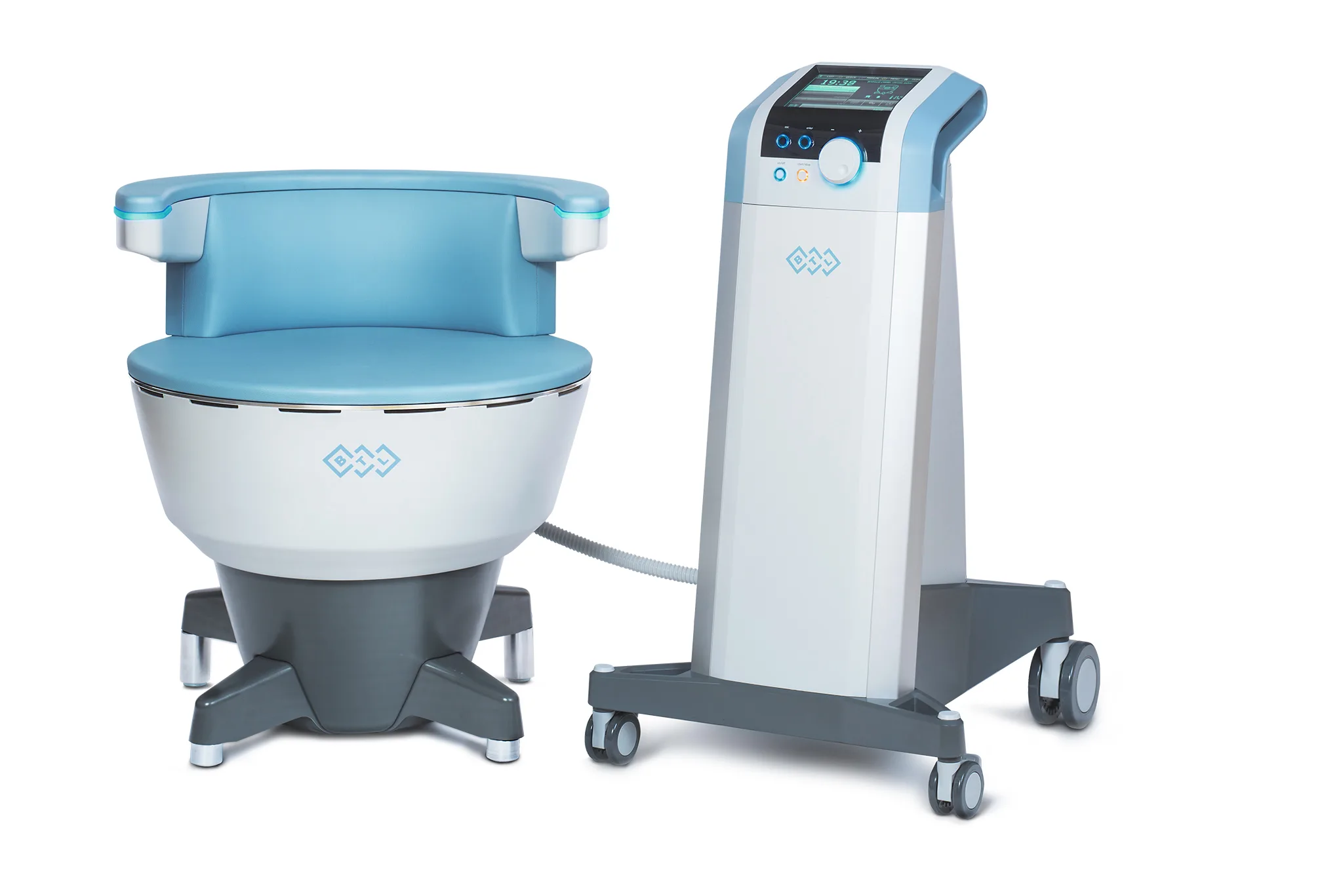 BTL Emsella chair, the Class II FDA-cleared device
You do not.
Do Emsella Clinics Need LegitScript Certification on Google Ads?
The answer that saves you two weeks and a few thousand dollars: no.
What's happening: Your agency or your in-house marketer tells you Google healthcare advertising requires LegitScript certification before any ads can run. They quote a 7 to 14 day approval window. They start preparing documentation.
Why it fails: Google's LegitScript requirement applies to a specific list of restricted healthcare categories: pharmacies, addiction treatment services, ketamine-assisted psychotherapy, Spravato, and a few other controlled-substance or HHS-regulated categories. Emsella is none of those. It is regulated by the FDA under 21 CFR 876.5320 as a Class II nonimplanted electrical continence device. The 510(k) clearance K181497, issued November 2018, covers "non-invasive electromagnetic stimulation of pelvic floor musculature for the treatment of male and female urinary incontinence."
That is a medical device clearance. It is not a controlled substance, not a pharmacy product, and not in any of Google's restricted advertiser categories that mandate LegitScript.
You still must comply with Google's general healthcare and medical claims policies. That means no guarantees, no superlatives, no unsubstantiated outcome claims. But you do not need a third-party certification gate to launch.
The fix: Skip LegitScript. Set up your Google Ads account, complete standard advertiser verification (identity and business verification, which takes 3 to 5 days), and launch. Use the time and the $1,500 to $2,000 you would have spent on certification toward a real landing page and a 60-day paid test instead.
Action Step: Confirm with your Google Ads representative in writing that Emsella does not fall under restricted healthcare categories. Get the confirmation in your account notes. Move on to the campaign build.
For broader clinic-marketing context, see 7 BTL Emsella Marketing Mistakes That Empty Your Schedule for the funnel-wide issues that kill payback even when ads are running.
What Keywords Actually Convert for Emsella?
Most clinics bid on the wrong keywords. They bid on what they would search for. Patients search differently.
What's happening: Your campaign launches with broad bids on "Emsella," "HIFEM technology," "pelvic floor stimulation," and "urinary incontinence treatment." The CPC is high, the CTR is mediocre, and the leads do not book.
Why it fails: Patients suffering urinary incontinence after 6.5 years of silence are not searching with clinical vocabulary. They are searching with three intent profiles, and only one of them converts:
- Symptom-driven informational ("leaking when I cough," "bladder leakage causes," "pelvic floor exercises"). Top of funnel. Convert at 0.5 to 1.5%. Use for SEO and remarketing audiences, not primary bid targets.
- Solution-aware comparative ("emsella vs kegels," "emsella reviews," "non-surgical incontinence options"). Mid-funnel. Convert at 2 to 4%. Useful in long-tail ad groups with educational ad copy.
- Commercial local intent ("emsella near me," "emsella [city]," "pelvic floor chair [city]," "non-surgical incontinence treatment near me"). Bottom of funnel. Convert at 5 to 10%. This is where 70% of your ad budget should live.
The single highest-converting keyword pattern in 2026 is the geographically modified branded search: "emsella [your city]" or "[your city] pelvic floor chair." These searches signal that the patient has done their research, knows the device by name, and is now selecting a provider. Win that auction and you win the patient.
The fix: Build three campaigns by intent layer.
| Campaign | Keyword pattern | Bid range | Conversion rate |
|---|---|---|---|
| Commercial local | "emsella near me," "emsella [city]," "pelvic floor chair [city]" | $4 to $8 CPC | 5 to 10% |
| Solution-aware | "emsella vs kegels," "non-surgical incontinence treatment," "emsella reviews" | $2 to $4 CPC | 2 to 4% |
| Symptom informational | "leaking when I cough," "bladder leakage treatment" | $1 to $3 CPC | 0.5 to 1.5% |
Allocate 70% of budget to commercial local, 25% to solution-aware, 5% to informational. Most clinics invert this allocation and wonder why their CAC is double what it should be. For a deep dive on the math, see Emsella Patient Acquisition Cost: The Real CAC Numbers.
Action Step: Pull your search term report from the last 30 days. Count what percentage of your spend went to commercial-local-intent keywords versus informational. If commercial-local is under 60%, reallocate this week.
How Do You Write Compliant Ad Copy for an FDA-Cleared Class II Device?
Google's healthcare policy allows more for cleared medical devices than it does for controlled substances. You still cannot lie. But you can sell.
What's happening: Your ad copy reads like a clinical pamphlet ("HIFEM technology," "11,200 supramaximal contractions," "non-invasive electromagnetic stimulation"). CTR sits at 1.5%. Click cost rises because Google's quality score is mediocre.
Why it fails: The patient searching "emsella near me" is not asking what the device is. She knows. She is asking which clinic to choose. Clinical specs are the flight. The vacation is the life she gets back: dancing at her daughter's wedding without scouting the bathroom, jumping on a trampoline with her grandkids, running a 5K without panty liners. Your ad has 90 characters of description. Use them on the vacation.
What Google explicitly disallows in healthcare ads:
- "Cures incontinence." Cure language is a guarantee.
- "Better than surgery." Comparative superiority claims without head-to-head clinical evidence.
- "100% effective." Outcome guarantees.
- "Painless miracle treatment." Subjective superlatives Google flags as unsubstantiated.
What you CAN say, with citations:
- "FDA-cleared treatment for urinary incontinence" (K181497, true, citable)
- "95% of patients reported improved quality of life in a peer-reviewed study" (Samuels et al. 2019, true, citable)
- "Non-invasive, fully clothed, 28-minute sessions"
- "Same-week consultations available"
The fix: Build three ad variations and rotate them.
Variation 1: Outcome plus speed
- Headline 1: "Emsella in [City]"
- Headline 2: "FDA-Cleared Incontinence Treatment"
- Headline 3: "Same-Week Consults"
- Description 1: "Stay clothed. Sit on a chair. 28 minutes. 95% of patients reported improved quality of life in a peer-reviewed study."
- Description 2: "Skip the surgery. Skip the medication. Book your private consult this week."
Variation 2: Vacation, not flight
- Headline 1: "Run, Laugh, Sneeze. No Worry."
- Headline 2: "Non-Surgical Pelvic Floor Repair"
- Headline 3: "Emsella in [City]"
- Description 1: "The chair that works while you sit. Fully clothed, 28 minutes, six sessions. No needles, no recovery, no panty liners."
- Description 2: "Most major HSA and FSA plans accepted. Book your free consult."
Variation 3: Comparative without superlatives
- Headline 1: "Tried Kegels. Still Leaking?"
- Headline 2: "Non-Surgical Solution"
- Headline 3: "Emsella in [City]"
- Description 1: "Studies show 30 to 50% of women cannot isolate the right muscles for Kegels. Emsella delivers 11,200 contractions per session for you."
- Description 2: "Six sessions. FDA-cleared. Most patients see results by week three. Book today."
Run all three for 14 days. Pause the worst CTR. Refresh the winner every 4 to 6 weeks to avoid ad fatigue. For the underlying voice principles, the direct-response copywriting approach applies here: sell the life on the other side, not the mechanism.
Action Step: Audit your live ads today. Count how many words describe the device versus the life the patient gets back. If device-words outnumber life-words, rewrite before next Monday.
What Landing Page Strategy Actually Converts Emsella Patients?
Your homepage is not a landing page. Sending paid traffic there is the most expensive mistake in the funnel.
What's happening: Your Google Ads point to your clinic homepage. Visitors land in a navigation menu listing 14 services, scroll past the rotating hero banner, and leave without booking. You see clicks. You do not see consults.
Why it fails: Homepages are designed for someone already sold on your clinic, browsing services. Paid traffic is the opposite: cold, comparison-shopping, evaluating you against three other clinics in the same search. The Unbounce Conversion Benchmark Report shows dedicated landing pages with a single CTA convert 3 to 5x higher than multi-navigation homepages on paid traffic. MedSpa CRO case studies cite up to 700% lead lift from the homepage-to-landing-page swap alone.
A dedicated Emsella landing page should hit 5 to 8% conversion. A homepage on the same traffic typically hits 1 to 2%. At a $2,500 monthly spend, that gap is the difference between 4 booked consults and 18.
The fix: Build a single-purpose Emsella landing page with seven sections, in this order:
- Hero. Headline that names the outcome ("Stop the Leak Without Surgery"), one supporting line, one phone CTA above the fold, one form CTA visible without scrolling.
- Trust strip. FDA-cleared badge, BTL certification badge, years in practice, number of patients treated. Keep it visual and scannable.
- The 28-minute promise. Photo of the chair, three-line description: "Sit fully clothed. Read your book. 28 minutes. Six sessions. That is the entire treatment."
- Outcome data. Cite peer-reviewed studies with linked sources: 95% improved quality of life, 75% pad-usage reduction, 81.33% UI symptom reduction (Samuels et al. 2019).
- Comparative table. Emsella vs surgery vs Kegels vs nothing. Cost, recovery time, complication rate, time investment. Pull from Emsella vs Kegels vs Surgery: The Honest Comparison for the full breakdown.
- Social proof. Three to five anonymized patient stories or testimonials with consent. Video preferred over text where compliance allows.
- Booking block. Phone number, form (3 fields max: name, phone, email), real human response promise within minutes.
Mobile speed matters. Emsella patients skew 40 to 70 years old, but mobile traffic still represents 60%+ of paid clicks in this category.
 Emsella session: fully clothed, no exam, 28 minutes
Page must load in under 2 seconds, form fields must be thumb-friendly, the phone number must tap-to-call.
Emsella session: fully clothed, no exam, 28 minutes
Page must load in under 2 seconds, form fields must be thumb-friendly, the phone number must tap-to-call.
Action Step: Build the dedicated landing page this week. Even a v1 with the seven sections above will outperform your homepage by 2 to 3x on the same paid traffic. Iterate from there.
How Should You Allocate Your Emsella Google Ads Budget?
Most clinics either underspend and conclude "Google Ads does not work" or overspend before the funnel is dialed in.
What's happening: You set a $5,000 monthly budget on day one because the rep said that is what gets results. Or you set $500 and conclude two weeks later that the channel is broken.
Why it fails: Both extremes ignore the optimization curve. The first 200 to 400 clicks are directional only. CPC, CTR, and conversion data stabilize between weeks 4 and 8. Scaling spend before stabilization burns money on unoptimized keywords. Underspending starves the algorithm of conversion data and prevents stabilization entirely.
The fix: Phase the budget by stage.
Phase 1, weeks 1 to 4: Baseline ($2,000 to $2,500 per month)
- Run all three campaign types (commercial-local, solution-aware, informational) at low daily caps
- Goal: gather 200+ clicks across the campaign, identify which keywords convert, kill the worst 30%
- Expected output: 8 to 15 leads, 2 to 4 booked consults
Phase 2, weeks 5 to 8: Optimize ($2,500 to $3,500 per month)
- Pause underperforming keywords and ad variations
- Increase bid on top-3 converting keywords by 20 to 30%
- Expand negative keyword list aggressively (cut "free," "DIY," "youtube," "review video")
- Expected output: 18 to 28 leads, 5 to 8 booked consults, CAC stabilizing
Phase 3, weeks 9+: Scale ($3,500 to $5,000+ per month)
- Increase daily budget by 20% per week as long as CAC holds
- Add second landing page variant for split testing
- Layer remarketing campaigns to recapture non-converting visitors
By the start of month 4, a well-run Emsella Google Ads campaign should produce 15 to 25 booked Emsella consults monthly at a CAC of $250 to $450 per booked consult. At a 60 to 70% consult-to-package conversion rate and a $1,800 to $2,400 package price, that is 9 to 17 closed packages and $16,200 to $40,800 in monthly revenue from a $5,000 spend.
For a full per-channel CAC breakdown including organic and referral comparisons, see Emsella Patient Acquisition Cost: The Real CAC Numbers.
Action Step: Map your current spend to the phase you are actually in, not the phase you wish you were in. If you have under 200 clicks of data, you are still in Phase 1. Do not scale yet.
How Do You Track Conversions That Actually Matter?
Form fills are leading indicators. Booked consults are revenue. Most clinics measure the wrong number.
What's happening: Your Google Ads dashboard shows 24 conversions this month at $42 cost-per-conversion, and the agency is celebrating. Your front desk confirms 6 booked consults and 3 closed packages. The numbers do not match the celebration.
Why it fails: A "conversion" in Google Ads, by default, fires on form submission. That is a lead, not a booked appointment. The patient who fills the form, ghosts your follow-up, or no-shows the consult is counted identically to the patient who paid for a $2,400 package. The optimization algorithm cannot tell the difference, so it keeps producing more form-fill leads instead of more package buyers.
The fix: Implement three conversion events, weighted by revenue impact.
- Lead form fill. Value: $0 (or a placeholder $25). Tracked as a soft conversion only.
- Booked consult (calendar appointment confirmed). Value: $200 (the average consult fee). Tracked as a hard conversion. This is your primary optimization target.
- Closed Emsella package. Value: $2,000 (the average package price). Tracked via offline conversion import from your CRM (GoHighLevel, HubSpot, or whatever you run) back into Google Ads.
The offline conversion import is the unlock. When Google Ads receives the data that "click ID 12345 became a $2,000 package buyer," the algorithm starts hunting for click profiles that match package-buyers, not form-fillers. Within 4 to 6 weeks of feeding offline conversion data, most clinics see CAC on closed packages drop 25 to 40%.
You also need to track speed-to-lead. According to the often-cited MIT/InsideSales study, leads contacted within 5 minutes are 21x more likely to qualify, and the first business to respond wins 78% of deals. If your Google Ads form fills sit unattended for 4 hours, you are paying for clicks that competitors close. Set up automated SMS within 60 seconds and a human callback within 5 minutes. For the full neuroscience and operational playbook on this, see The Emsella Consult Vulnerability Window: Why Speed Wins.
Action Step: Set up offline conversion import this month. If your CRM does not natively push package-close events to Google Ads, hire a Zapier or Make.com integration build. The 4 to 6 hour project is the highest-ROI optimization in your entire ad account.
Why Local SEO Compounds Your Google Ads Returns
Paid and organic are not separate channels. They compound each other.
What's happening: You run Google Ads in isolation. The clinic ranks somewhere on page 2 organically, the Google Business Profile is half-filled, and the local pack shows three competitor clinics every time someone searches "emsella [city]."
Why it fails: 99.5% of users never click past page 1 of Google, and on page 1 the local pack (the map with three businesses) absorbs 40 to 60% of clicks before users even see paid ads. If your competitors own the local pack and your ad sits below it, your CTR drops and your CPC rises. If you own both the local pack and the top paid slot, you double-tap the same searcher and conversion rates climb 30 to 50%.
The paid-and-organic compound is not theoretical. Google's own search-and-conversion studies show that brands appearing in both paid and organic results on the same query convert at meaningfully higher rates than brands appearing in only one. Local pack plus paid ad plus a strong organic listing is a three-layer presence that signals legitimacy and dominance to the searcher in 1 to 2 seconds.
The fix: Run Google Ads and local SEO as one integrated effort.
- Google Business Profile: Fully optimized, weekly photo posts, review velocity of 2 to 4 new reviews per month, accurate NAP (name, address, phone) consistent across all directories.
- Service-area pages: Build "Emsella in [City]" pages for every city in your service area, optimized for the same commercial-local keywords your ads bid on.
- Schema markup: MedicalProcedure and LocalBusiness schema on every Emsella page so Google's AI Overview features can cite you.
- Review generation: Post-treatment SMS asking happy patients for a Google review. Aim for 50+ reviews at 4.7+ stars within 12 months.
For the full local-SEO playbook including Google Maps rank factors, AI Overview optimization, and review velocity benchmarks, see Emsella Google Maps SEO: Rank #1 for Pelvic Health.
Action Step: Audit your Google Business Profile this week. Score it on completeness (0 to 100%), photo count (target 30+), review count, and Q&A activity. Anything under 80% complete is a money leak.
What Should You Do This Week?
If you have not launched Google Ads yet:
- Confirm with Google that Emsella does not require LegitScript. Get it in writing in your account notes.
- Build the dedicated Emsella landing page (seven sections, 5 to 8% target conversion).
- Set up offline conversion tracking from your CRM to Google Ads before you spend the first dollar.
- Launch Phase 1 budget at $2,000 to $2,500 with three campaign types.
If your Google Ads are already live and underperforming:
- Pull the search term report. Reallocate to 70% commercial-local-intent keywords.
- Audit your landing page conversion. If it is under 5%, the page is the bottleneck, not the ads.
- Implement 5-minute speed-to-lead with automated SMS plus human callback.
- Add offline conversion import this month to retrain the algorithm on package-buyers, not form-fillers.
The Emsella chair is one of the highest-margin medical devices in any clinic. The clinical case is closed. The marketing case is up to you.
Book a strategy call to map your Emsella Google Ads playbook.
Read Next
- Emsella Patient Acquisition Cost: The Real CAC Numbers - Channel-by-channel CAC math, lifetime value, and CAC:LTV benchmarks
- The Emsella Consult Vulnerability Window: Why Speed Wins - The 5-minute speed-to-lead system that converts paid clicks into booked consults
- Emsella Google Maps SEO: Rank #1 for Pelvic Health - Local pack dominance, GBP optimization, and AI Overview citations