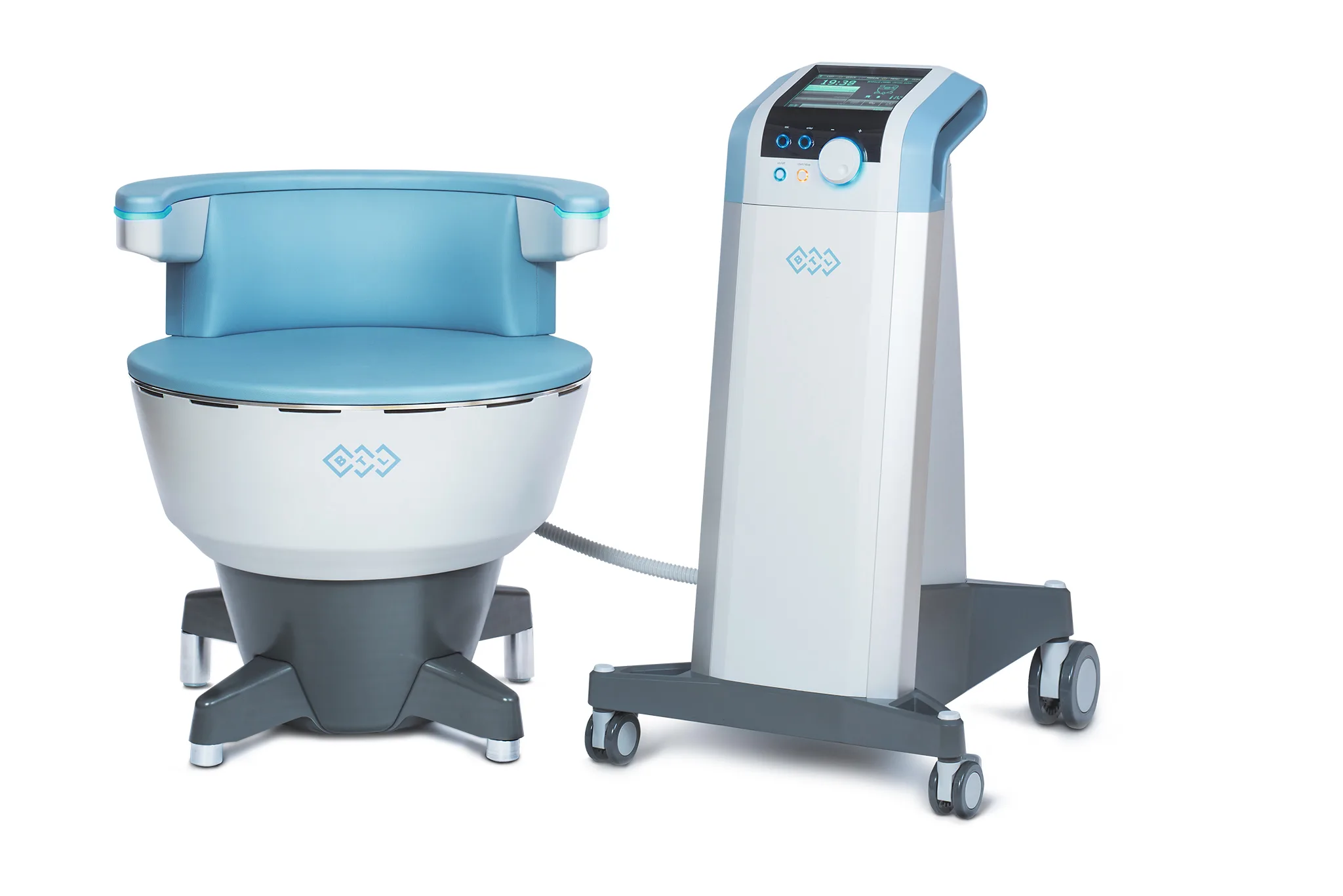
TL;DR
- All-in Emsella CAC ranges $180 to $650 per acquired patient in 2026, depending on funnel maturity, follow-up speed, and channel mix. Healthy target: $250 to $400.
- Healthcare paid search averages 3.52% CTR, with Emsella commercial-intent terms slightly above that. CPCs run $4 to $12 in mid-size US markets per WordStream healthcare benchmarks.
- Geofenced local placements can compress healthcare CPM to $3.61, versus the $5 to $12 industry average. Geography is the single biggest lever on CAC.
- Average Emsella patient LTV is $4,000 to $5,000 over 3 years (package + maintenance), and $7,000 to $12,000 with cross-sell into Emsculpt Neo, Emface, or Exion.
- Healthy CAC:LTV ratio is 1:5 minimum. Most well-run Emsella funnels hit 1:6 to 1:10 because of the package price and maintenance cadence.
- Payback period on ad spend is 7 to 14 days when patients pay the package upfront. Faster than almost any other healthcare service line.
- 75% of women with incontinence suffer in silence for 6.5 years on average before seeking help. Speed-to-lead determines whether they book with you or your competitor (per MIT/InsideSales data).
- Mature organic SEO produces $80 to $150 CAC, versus $250 to $450 paid. Both, not either.
You are spending money. Patients are showing up. But you cannot answer a simple question with a straight face: how much does it actually cost you to acquire one Emsella patient?
Most clinic owners we audit cannot. They know the topline ad spend. They know roughly how many new patients booked last month. The math in between is a fog. And inside that fog, money leaks.
Here is the uncomfortable truth: in 2026, Emsella is one of the highest-margin, fastest-payback service lines in aesthetic medicine. The clinics that scale are not the ones with the lowest ad spend. They are the ones who know their numbers down to the channel, the funnel stage, and the patient lifetime curve.
This post breaks down what Emsella patient acquisition actually costs in real numbers, channel by channel, plus the lifetime value math that determines whether your CAC is a bargain or a slow bleed.
What Does Emsella CAC Actually Look Like by Channel?
Aggregate CAC numbers are useless. The honest answer is channel-specific, because each channel has a different intent profile, a different cost structure, and a different conversion curve.
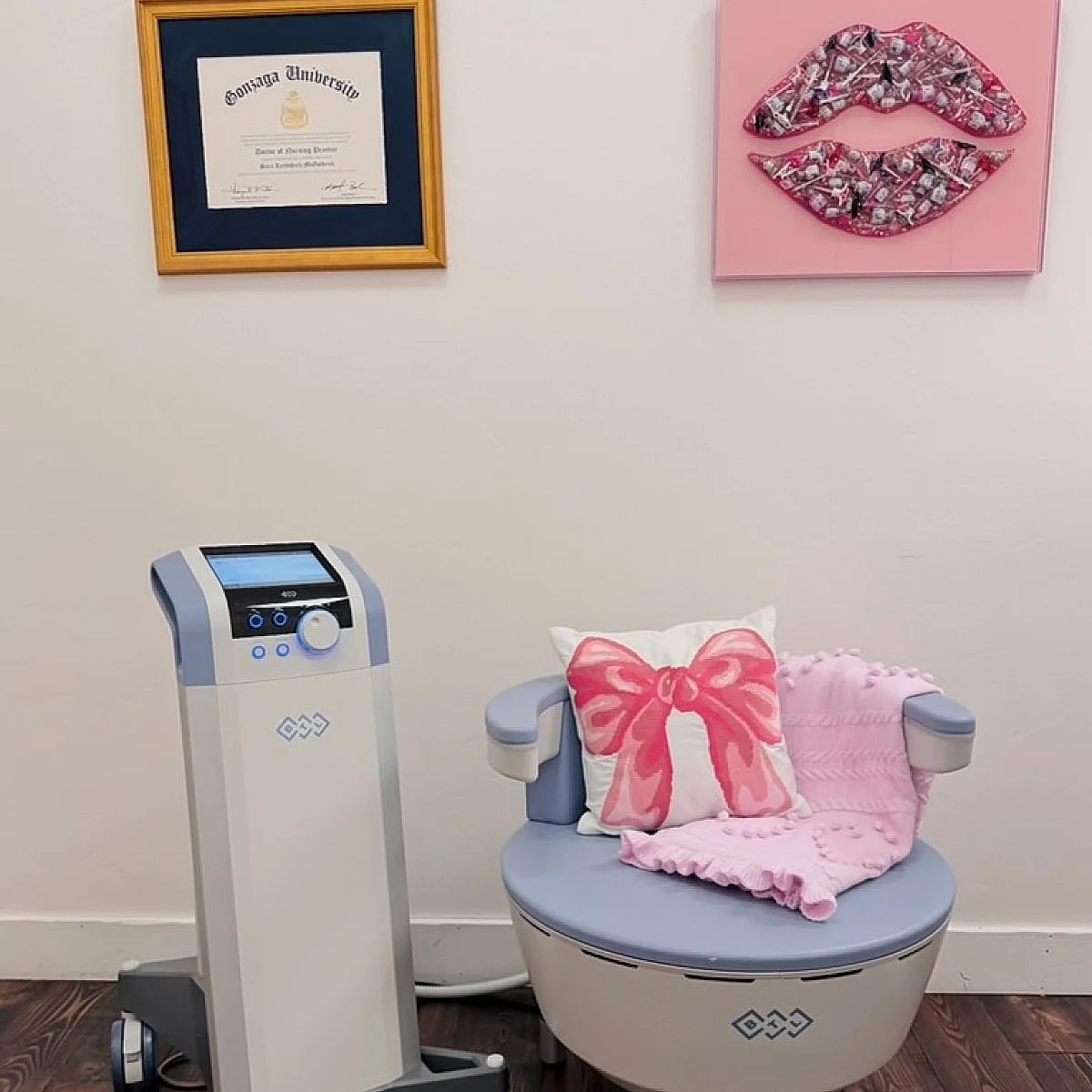 BTL Emsella chair, the patient acquisition target
Below is the 2026 benchmark we use across the Emsella clinics we audit.
BTL Emsella chair, the patient acquisition target
Below is the 2026 benchmark we use across the Emsella clinics we audit.
What is happening: Most clinics quote one number ("our CAC is around $300") that is actually a blended average hiding wildly different per-channel performance. Some channels are subsidizing the losers.
Why it fails: Without channel-level visibility, you cannot reallocate budget. You also cannot answer the only question that matters during a budget review: which dollar is producing the next patient.
The fix: Track CAC by channel monthly. Here is the 2026 benchmark range for Emsella across the major channels.
| Channel | Cost Per Lead | Lead-to-Patient Conversion | Effective CAC | Notes |
|---|---|---|---|---|
| Meta (Facebook + Instagram) | $35 to $90 | 12% to 22% | $200 to $550 | Best for cold awareness; punishes weak landing pages |
| Google Ads (search) | $40 to $110 | 18% to 30% | $180 to $450 | High commercial intent; LegitScript not required |
| Google Local Services Ads | $25 to $70 | 25% to 40% | $90 to $250 | Underused; pay-per-lead model |
| Organic SEO + Google Business Profile | $0 marginal | 20% to 35% | $80 to $150 fully loaded | 6 to 12 months to volume; compounds over time |
| Patient referrals | $50 to $150 (incentive) | 50% to 70% | $90 to $200 | Highest close rate, lowest volume |
| Physician/PT referrals | $0 to $50 | 40% to 60% | $50 to $120 | Trust transfer compresses sales cycle |
A healthy multi-channel mix typically produces a blended CAC between $220 and $380 in mid-size US markets. The clinics outside that band on the high side almost always have the same three problems: slow speed-to-lead, no dedicated landing page, and no follow-up sequence. We break the diagnostic pattern down in our Emsella marketing mistakes guide.
Action Step: Pull last month's spend by channel from your ad accounts and your CRM's "how did you hear about us" data. Calculate cost per acquired patient by channel. If you have no attribution layer, install a CallRail or Twilio tracking number per channel this week. You cannot fix a number you are not measuring.
How Much Does Meta Cost Per Emsella Patient in 2026?
Meta (Facebook plus Instagram) remains the dominant cold-traffic channel for Emsella because the audience reads, scrolls, and self-identifies on those platforms. The economics shift heavily based on creative quality and audience targeting precision.
What is happening: Most clinics run Meta ads featuring a Emsella stock photo of the chair, a headline like "Restore Your Pelvic Floor," and a generic "learn more" button. CTR is 0.6%. Cost per lead is $80. Lead-to-patient conversion is 8%. Effective CAC: $1,000+. They blame Meta. The problem is the creative.
Why it fails: Cold Meta audiences are not searching for a solution. They are scrolling through dinner photos. The ad has to interrupt with an emotional pattern interrupt, not describe a device.
The fix: The Meta ads that work for Emsella in 2026 follow a specific structure:
- Hook in the first 3 seconds. "I sneezed at my granddaughter's recital and ran to the bathroom for the third time that day." Real-life, specific, emotional. Not "HIFEM technology."
- Mirror the internal monologue. "You know the feeling. You stop drinking water before flights. You scout bathrooms before you commit to a workout class. You have stopped trusting your own body."
- Authority pivot. "FDA-cleared in 2018 (510(k) K181497) for non-invasive treatment of urinary incontinence. 95% of women report improved quality of life after 6 sessions, per Samuels et al. 2019 in Lasers in Surgery and Medicine."
- Clear CTA. "Book a free consultation. We respond in under 60 seconds."
Healthcare CPM averages $5 to $12, but well-targeted local Emsella campaigns with strong creative can hit $3.61 CPM with high relevance scores. That alone cuts CAC by 40%+ versus generic creative. We cover the full creative formula in our Google Ads complete guide, most of which translates directly to Meta.
Action Step: Audit your top 3 Meta ads this week. Score them on the 4-point structure above. Kill any ad that fails 2 or more criteria. Replace them with one ad built to the structure and run a 7-day test at $50/day before scaling.
Why Are Google Ads So Profitable for Emsella Clinics?
Google search captures intent. Someone typing "urinary incontinence treatment near me" or "Emsella clinic [city]" has already self-diagnosed and self-prescribed. They are not a cold audience. They are a hot lead arriving on your doorstep. The economics reflect that.
What is happening: Most clinics either ignore Google Ads entirely (assuming Meta is enough) or run a single campaign sending all traffic to their homepage. Both leave 60%+ of CAC efficiency on the table.
Why it fails: Search intent is the most expensive traffic to lose. Sending it to a homepage with 8 navigation links instead of a dedicated Emsella landing page kills conversion rate by half or more, per the Unbounce Conversion Benchmark Report. And without LegitScript-style attention to compliance (Emsella does not require LegitScript itself, since it is a Class II device, not a controlled substance), policy reviews can still suspend campaigns over copy mistakes.
The fix: A Google Ads structure that produces $180 to $450 CAC for Emsella clinics:
- Dedicated landing page per campaign. One page for "urinary incontinence treatment," one for "Emsella near me," one for "pelvic floor strengthening." Single CTA, no navigation, treatment-specific testimonials.
- Negative keyword list. Block "free," "DIY," "Kegel exercises," "amazon," "review reddit." These bring tire-kickers, not patients.
- Geofenced bidding. Concentrate budget within a 10-15 mile radius of the clinic. CPMs drop from $5-12 to $3.61 in tightly geofenced campaigns.
- Conversion tracking on form submits AND phone calls. CallRail or Twilio for call attribution. Without this, you are flying blind on 40-60% of conversions.
- Sub-60-second response system. Per MIT/InsideSales research, the first business to respond wins 78% of the time, and leads contacted within 5 minutes are 21x more likely to qualify. The Emsella vulnerability window is even tighter than for ketamine or TMS, because shame compresses the decision window. We unpack the full speed-to-lead system in our Emsella consultation vulnerability window post.
Action Step: If you are not running Google Ads, launch one campaign on "[your city] urinary incontinence treatment" with a $50/day budget pointed at a dedicated landing page. If you are running Google Ads to your homepage, build the landing page this week. Either change pays for itself inside 30 days.
What Is the True Lifetime Value of an Emsella Patient?
CAC is half the equation. Lifetime value is the other half.
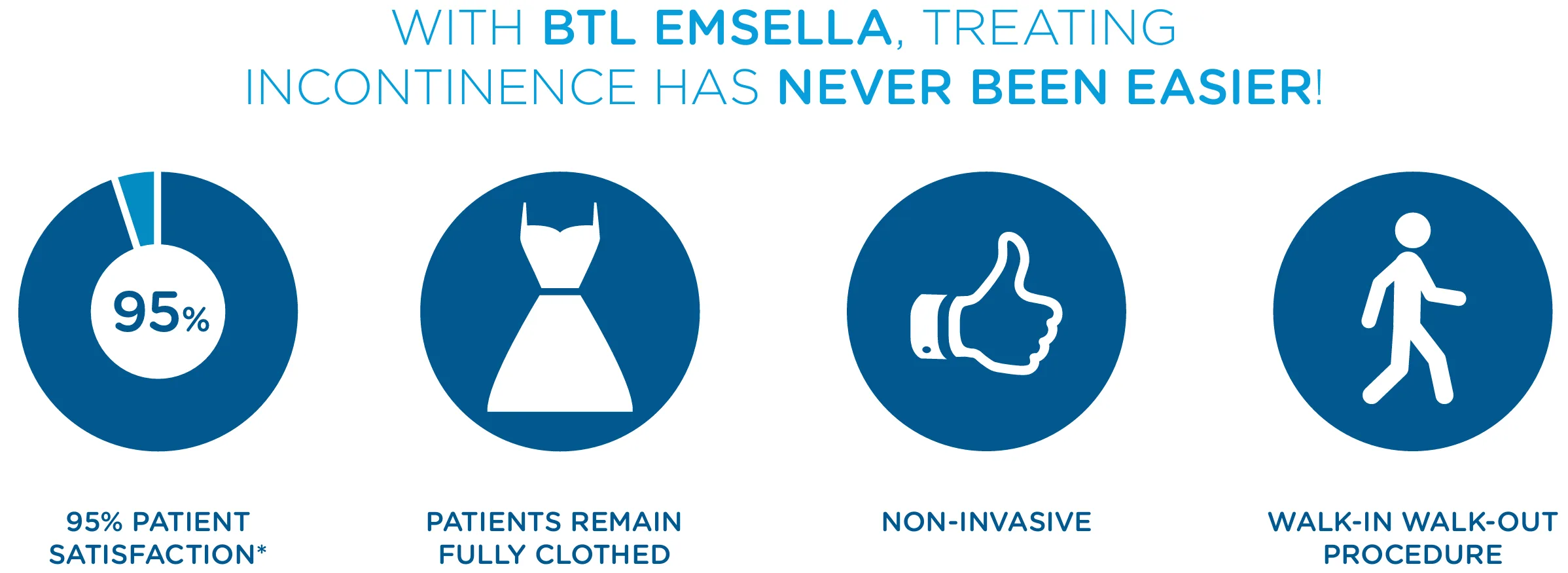 Emsella benefits and lifetime value drivers
And Emsella has one of the highest LTV profiles in aesthetic medicine because the package is high, the maintenance cadence is recurring, and the cross-sell into adjacent BTL devices is natural.
Emsella benefits and lifetime value drivers
And Emsella has one of the highest LTV profiles in aesthetic medicine because the package is high, the maintenance cadence is recurring, and the cross-sell into adjacent BTL devices is natural.
What is happening: Most clinics calculate LTV as "package price." That is wrong. The package is the entry. The real LTV includes maintenance, cross-sell, and referral value.
Why it fails: Underestimating LTV leads to underspending on acquisition. If you think a patient is worth $2,000 you will cap CAC at $200. If you understand they are worth $7,000+, you will happily pay $500-$700 to acquire them and dominate competitors who refuse to.
The fix: Calculate LTV in three layers.
| Revenue Layer | Per Patient | Notes |
|---|---|---|
| Initial 6-session package | $1,800 to $2,400 | Industry standard pricing range |
| Maintenance (2/year × 3 years) | $1,800 to $2,400 | $300-$400 per session, average 2 sessions/year |
| Cross-sell (Emsculpt Neo, Emface, Exion) | $1,500 to $7,000 | Roughly 30-45% of Emsella patients cross over |
| Referral value (1.2 patients per loyal patient) | $1,800 to $4,000 indirect | Word of mouth in this category is high |
| 3-year total LTV | $4,000 to $12,000+ | Wide range based on cross-sell mix |
Source studies for the package and maintenance economics: Samuels et al. 2019 in Lasers in Surgery and Medicine shows 95% of patients report improved quality of life after 6 sessions, with 75% reporting significant pad-usage reduction. That outcome quality drives the maintenance compliance rate, which drives LTV.
The strategic implication is hard: a clinic that is willing to pay $500 CAC to acquire a $5,000 LTV patient (1:10 ratio) outcompetes a clinic capping CAC at $200 against a $2,000 LTV (1:10 same ratio, but half the volume). Both are profitable. One scales. Combine this with the device payback math we cover in Emsella ROI and payback period to model your full economics.
Action Step: Pull your last 12 months of patient revenue data. Calculate average revenue per Emsella patient including maintenance and cross-sell. Most clinics discover their actual LTV is 60-100% higher than they assumed. That number unlocks your real CAC ceiling.
How Fast Does Emsella Ad Spend Pay Back?
Payback period is the metric that determines whether you can scale ad spend aggressively or have to throttle. Emsella has one of the fastest payback profiles in healthcare.
What is happening: Most clinics finance growth by adding ad spend slowly because they are not sure how long until they get the cash back. They are operating on instinct, not math.
Why it fails: Without a payback number, you under-invest in winning channels and over-invest in safer-feeling but slower-payback ones. You also cannot answer a banker or investor when they ask for unit economics.
The fix: Calculate payback in real numbers.
- Average package price: $2,000 (midpoint of $1,800-$2,400 industry range)
- Average gross margin per session: 70% (after consumables, provider time, allocated overhead)
- Gross profit per package: $1,400
- Average CAC: $350 (target benchmark)
- Payback period: $350 / $1,400 = 25% of one package, recovered the moment the patient pays
If patients pay upfront, payback is immediate (day of conversion). If patients are on a 3-pay structure, payback hits between day 30 and day 60. Maintenance and cross-sell revenue are pure profit on top.
Compare this to almost any other healthcare service line:
- Cosmetic surgery: 14-90 day payback (high LTV but slow consult-to-procedure cycle)
- TMS therapy: 60-120 day payback (insurance authorization delays)
- Aesthetic injectables: 7-21 day payback (similar to Emsella)
- Pelvic floor PT: 30-60 day payback (lower per-visit revenue)
Emsella sits with injectables at the top of the speed-to-payback rankings. That is the unlock: you can reinvest revenue from this month's patients into next month's ads, compounding growth without requiring outside capital. Exactly the dynamic that makes Emsella one of the better device investments for a clinic owner, as we lay out in the ROI and payback guide.
Action Step: Calculate your actual payback period this week. Take last quarter's CAC and divide by gross profit per package. If you are over 30 days, your gross margin is leaking somewhere (likely consumables, staff time per session, or allocated overhead). Fix that before you scale ad spend.
Where Do Most Emsella Clinics Leak CAC?
Knowing the benchmarks is not the same as hitting them. The clinics with the worst CAC are not the ones spending the most. They are the ones with leaks they cannot see.
What is happening: A clinic spends $4,500/month on Meta and Google. They book 8 new Emsella patients. CAC is $562. They blame the channel. The channel is not the problem.
Why it fails: CAC is the output of a system. If the system has a leak, every dollar of input loses efficiency on the way to a patient.
The fix: The 5 most common Emsella CAC leaks, in order of impact:
-
Slow speed-to-lead. A 4-hour response time vs sub-60-second response cuts your effective CAC by 40-60%. Per MIT/InsideSales research, the first responder wins 78% of the time. For Emsella specifically, where 33.3% of women cite embarrassment as the primary barrier and the average decision window is hours not days, this matters more than in any other vertical.
-
No dedicated landing page. Sending paid traffic to a homepage cuts conversion rate roughly in half versus a dedicated single-CTA landing page, per the Unbounce Conversion Benchmark Report.
-
No follow-up sequence. "Let me think about it" is not rejection in this category. It is shame-driven hesitation. Without a 7-touch follow-up sequence over 30 days, you lose 40-60% of warm leads. The full nurture system is in our vulnerability window post.
-
Generic ad creative. Stock photo of the chair plus "FDA-cleared" headline. Zero emotional resonance. The fix is the empathy-first hook structure laid out in the Meta section above.
-
No attribution layer. You cannot fix what you cannot measure. Without per-channel CAC tracking via tracking phone numbers, UTM parameters, and intake form attribution dropdowns, you will keep funding losers and starving winners for years.
Fix all five and CAC drops by 50-70% in 60 to 90 days. We see this pattern repeatedly in BTL Emsella practices we advise. It is not theory.
Action Step: Pick the leak you know is your worst. Fix only that one this week. Re-measure CAC in 30 days. Then move to the next leak. One at a time. Compounding wins.
Are You Building a Funnel or Renting Patients Forever?
The clinics that win the next 5 years of pelvic health are not the ones with the lowest CAC today. They are the ones building CAC compounding systems: organic content that ranks on Google, Google Business Profiles that dominate local pack, review velocity that makes the clinic the obvious choice, and email lists that convert old leads into next quarter's patients.
Paid is the lever you pull to fill the schedule today. Organic is the moat you build so you do not have to pay rising CPMs forever. The clinics that skip the second one stay dependent on Meta and Google's pricing power forever.
The numbers in this post are real, current, and achievable. None of them require a marketing genius. They require a clinic owner who decides, this quarter, to know their CAC by channel, fix the biggest leak, and reinvest the savings into the next leak. In 12 months, you will have a patient acquisition machine that runs at 1:8+ CAC:LTV, with a payback period under 30 days, and a moat your competitors cannot easily cross.
Book a free Emsella growth strategy call and we will run your CAC numbers with you, audit your acquisition channels, and map the fastest path to break-even.
Read Next
- Emsella ROI and Payback Period: A Clinic Owner's Guide - Device-level economics, utilization curves, and break-even math
- The Emsella Consult Vulnerability Window: Why Speed Wins - Speed-to-lead psychology and the 7-touch follow-up sequence that recovers 40-60% of warm leads
- Google Ads for Emsella Clinics: The 2026 Guide - Keywords, landing pages, compliance, and ad copy templates that hit the CAC benchmarks above