If you are running a brick-and-mortar ketamine or TMS clinic, the absolute most valuable piece of digital real estate you can own is not your website.
It is the top spot in the Google Maps "Local 3-Pack."
When a patient in your city searches for "ketamine therapy near me" or "TMS treatments [City]," they are at the bottom of the funnel. They have done the research. They know what the treatment is. They are actively looking for a provider to hand their money to.
Google Maps captures 42-50% of all clicks on local-intent searches, according to RedLocalSEO's 2025 Local Pack statistics, with the #1 position in the local 3-pack receiving 17.8% of click-throughs alone. And the best part? Ranking there is completely free. It requires zero ad spend. It simply requires a meticulous execution of Local SEO.
Here is the exact blueprint to dominate your local market.
Key Takeaways
- The Maps Pack wins. The top 3 Google Map results capture the vast majority of local intent clicks.
- Your GBP is your new homepage. Patients often decide whether to call you based solely on your Google Business Profile.
- Consistency is key. Your Name, Address, and Phone Number (NAP) must be identical across the entire internet.
- Reviews require a system. You need a formalized protocol for requesting reviews at the peak of the patient's positive experience.
How Do You Claim and Perfect Your Google Business Profile (GBP)?
According to Google's own business documentation, businesses with complete and accurate Google Business Profiles are 2.7 times more likely to be considered reputable by consumers. For ketamine clinics, where trust is the #1 barrier to booking, this is non-negotiable.
Your Google Business Profile (formerly Google My Business) is the engine of your Local SEO.
The Name Game: Do not try to "keyword stuff" your business name (e.g., "Aura Medical - Ketamine & TMS Clinic"). Google will suspend your profile. Use your exact, legally registered business name.
Category Selection: This is the most common mistake. Google relies heavily on primary categories. While you might identify as an "Infusion Clinic," your patients are searching for mental health relief. Make your primary category "Mental Health Clinic" or "Psychiatrist" (if a psych MD is on staff). Use secondary categories for "Pain Management" or "Wellness Center."
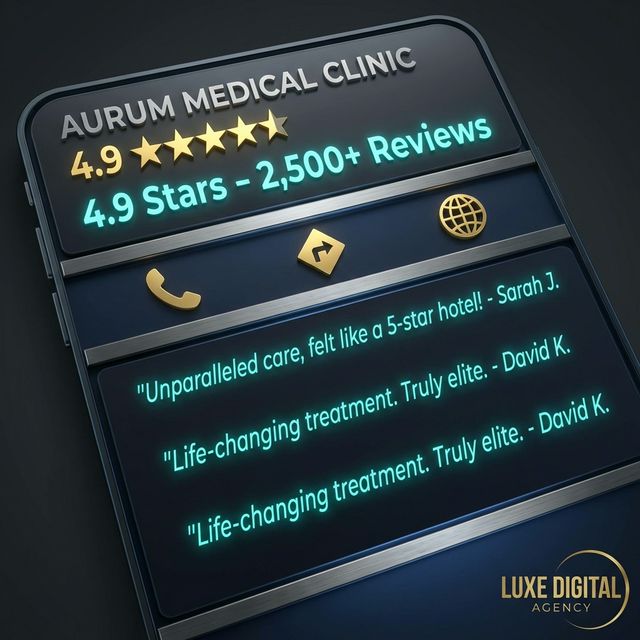 A modern, dark mode UI mockup of a Google Business Profile for a medical clinic
Action Step: Fill out every single field Google offers. Add your operating hours, write a 750-character SEO-optimized business description, and list every specific service (Ketamine infusions, Spravato, TMS, Integration Coaching) with detailed descriptions under the "Services" tab.
How Can You Master the Art of the "Safe" HIPAA-Compliant Review?
In the restaurant industry, you can just text a link to everyone who walks out the door. In the mental health space, privacy concerns make this incredibly difficult. Patients don't want the world to know they are battling severe depression.
However, reviews are the #1 ranking factor for local search. How do you bridge the gap?
The Strategy:
- Timing: Ask at the peak of their emotional journey. Usually, this is during the integration session following their final acute-phase infusion, when they are feeling the maximum lift in their mood.
- The Reframe: Do not ask them to "review their ketamine treatment." Ask them to review their experience with your team.
- The Script: "We are so happy to see your progress. Many patients are scared to come in here because they don't know what to expect. It helps them tremendously when they see reviews about how comfortable our rooms are, or how kind our front desk staff is. Would you be willing to leave a review strictly about the environment and the staff?"
This gives the patient permission to leave a 5-star review using their real name, without feeling like they are disclosing their medical history. Your Integration Guide should own this review-capture process as part of their post-session responsibilities.
Why Are NAP Consistency and Local Citations Crucial for Ranking?
Google is a machine. It relies on data certainty. If Google sees your address as "123 Main St. Suite B" on your Yelp profile, but "123 Main Street, #B" on your website, it loses confidence. When Google loses confidence, your rankings drop.
Your Name, Address, and Phone Number (NAP) must be absolutely identical across every single directory on the internet. This is especially critical when you are running Google Ads for your clinic—ad landing pages must match your GBP data exactly.
You need to build "Local Citations"—which are simply mentions of your NAP data on other websites. Ensure you are listed on:
- Psychology Today
- WebMD
- Yelp
- Apple Maps
- Bing Places
- Local Chamber of Commerce websites
Why Should You Format Your GBP Like an Active Social Feed?
Google rewards active profiles. If you update your profile once a year, Google assumes your business is stagnant.
- Add Photos Weekly: Upload high-quality photos (not stock images) of your treatment rooms, the waiting area, and your clinical staff. Patients are deeply intimidated by psychedelic therapy; your photos should demystify the space and prove it looks like a high-end spa, not a hospital basement.
- Use Google Posts: Whenever you publish a new blog post or host an educational webinar, create a "Post" directly on your GBP. This keeps the profile fresh and signals to Google that you are a highly engaged, authoritative business.
Ranking #1 on Maps is not magic. It is the result of thousands of micro-trust signals organized perfectly. If you want to bypass the learning curve and have our agency manage your Local SEO ecosystem, explore our growth programs.
Read Next
- Google Ads for Ketamine, TMS & Spravato Clinics: The Complete Guide — Pair local SEO with paid search for full funnel coverage
- The Vulnerability Window: Speed-to-Lead for Ketamine Clinics — Convert the leads your Maps listing generates
- 7 Ketamine Clinic Marketing Mistakes Killing Your Growth — The marketing mistakes that undo your local SEO gains
- Emsella Google Maps SEO: Rank #1 for Pelvic Health - Same Local SEO playbook for BTL Emsella clinics